Spenser looks into the case of a missing teen who looks like a runaway until an amateurish ransom demand arrives.
What I Liked
Dipping back into classic Spenser seems indulgent, and perhaps even a bit of a cheat. In this book, you see him meet Susan for the first time and you know where it will all lead. She’s the kid’s guidance counsellor and makes suggestions to Spenser about what the kid is like and where he might be hiding, if he is hiding at all. Later, when Spenser roots out a scamming component of a bodybuilder who confuses having muscles with being tough, there are surprisingly open-minded and advanced treatments of gender identity issues and being gay. Not completely reflective of more modern interpretations, but pretty advanced for the era. I also love the introduction of the ongoing Spenser theme for being able to handle yourself in a fight and keep going.
What I Didn’t Like
Some of the secondary characters are a bit basic, including the parents.
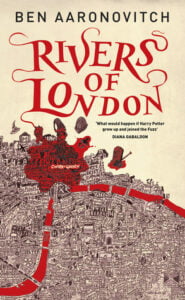
A new police officer in London is about to get a dull desk job when his career gets a boost — he meets a ghost who witnessed a murder.
What I Liked
Originally called Midnight Riot, the book focuses on Peter Grant who is about to get his first assignment as a police constable in London. When he meets a ghost who witnessed a bizarre murder that involved a beheading, he’s not sure if he’s going crazy or has just been handed a career opportunity. Much of the book is about him learning about magic being real, and there are lots of fun cultural cross-references to other magical books or shows. In Harry Potter land, he’s a Muggle who just got his letter for Hogwarts, except the training ground is a division in the police force made up of one Inspector who investigates the “funny” cases. Called The Folly, apparently they have been policing for years, but there isn’t much happening, so they have an arrangement with magical folks to have one wizard on the payroll. Now two, as Peter joins him.
I love the efficient leaps in explanations that magic is real and how it works. Rather than going into really long boring backstory, they might say, “Hey, some of the magical folk would like a Ministry of Magic”. Short, pointed cross-reference, and the story moves along. I was fascinated in book 1 of the series with the focus on how all the rivers are goddesses and minor goddesses, and how the stronger ones can use glamour to compel the weak-minded to do their bidding. Jedi mind tricks without the midi-chlorians. And it is the world-building that drives the beauty of the first book more so than the mystery.
What I Didn’t Like
There are two scenes in the book that are a little out of character with the rest of the book. One is a huge elongated action scene involving an opera company, a pretty broad swath of people being controlled, etc. All of it way beyond what the “magical antagonist” should be capable of doing. It reads almost like satire or spoof at that point, something more akin to Douglas Adams than JK Rowling. The second scene is the near finale that suddenly has Peter pursuing a suspect through magical happenings that also have not really been party to the story up to that point. Almost as if Hans Gruber in Die Hard was falling to his death and suddenly had the ability to sprout wings. I don’t want to spoil things any more than that, but it’s almost like, “Oh, I forgot to mention I can do this.” It detracts a bit from the amazing world that has been built.
Back in 2006, the International Astronomical Union decided to create a definition of a planet, one which demoted Pluto from “planet” to merely a “dwarf planet”. Dr. Mike Brown had found objects beyond Pluto in the Kuiper Belt that were as big as Pluto, and astronomers were revisiting the definition of a planet — if Pluto was “in” scope, then the new object (or objects) would be planets too; if Pluto was “out”, then so were the new planets. Dr. Brown’s findings helped drive the need for a new definition.
What I Liked
I like the book for two reasons. First and foremost, it is highly engaging. It is written in plain-language with details about his personal life and other events going on at the time he was spending enormous amounts of time going back and forth between images and clicking a mouse “no”. Second, Dr. Brown makes it pretty clear early on that he did not create or change the definition, but rather that his work helped inform and nudge the decision-makers of the IAU when it was time to make a decision. It was an interesting element to see him, the potential discoverer of what would have been the 10th planet, saying “no”, what he found and by extension then Pluto, should not be planets. I also enjoyed seeing some limited excerpts of the interplay with the Communications departments and a somewhat cynical yet likely accurate view of journalism and scientific discovery.
What I Didn’t Like
I was not particularly persuaded by the arguments put forth why all the other objects that were smaller than Pluto should be elevated to be on the same status, nor that Planet X (or its successors) shouldn’t be planets too. At one point, he uses a metaphor of an alien visiting our galaxy and seeing the big 4 planets first — and thus that is the definition of a planet, aka size. It undercuts the entire argument in my view. And it’s why I took a point off. Of the 200 other possible items in the list that “could” be planets, few have sufficient mass to be rounded nor have their own satellites.
The Bottom Line
My solar system still includes Pluto but it was a fun read.
I took a small break again with C&P, reading a series of books in both fiction and non-fiction. And then jumped back in last night. According to my new Kindle, it will take me another 6h to finish it, although there is extra info in the ebook file, so the estimate may be off.
The big element of the last 10% has been the actual “crime” from the title. What began as a thought experiment for him becomes reality when an irresistible opportunity to limit his risk presents itself. He keeps telling himself that he can’t do it, he’d never go through with it, but when the hour is upon him, he rushes through all the steps with no time to think or second guess himself. Although he does have time to wonder about why so many criminals leave clues behind.
…[he] had been extremely occupied by a single question; why are almost all crimes so badly concealed and so easily detected, and why do almost all criminals leave such obvious traces? He had come gradually to many different and curious conclusions, and in his opinion the chief reason lay not so much in the material impossibility of concealing the crime, as in the criminal himself. Almost every criminal is subject to a failure of will and reasoning power by a childish and phenomenal headlessness, at the very instant when reason and caution are most essential. It was his conviction that this eclipse of reason and failure of will power attacked a man like a disease, developed gradually and reached its highest point just before the perpetration of the crime, continued with equal violence at the moment of the crime and for longer or shorter time after, according to the individual case, and then passed off like any other disease.
Interestingly, his reason holds but he fails to plan for a contingency of someone else arriving home or of other visitors coming too. The first is corrected by ruthlessness, while the second is more by luck than careful reason. “When reason fails, the devil helps”, or so the narrator believes.
Yet despite his belief in his superiority of mind, he fails to plan for a bunch of rather basic elements afterwards. Blood stains. Hiding loot. The intrusion of others.
By the time I reached the 25% mark, his fever seems to have resolved itself and the original need for his crime (economic) has been relatively eliminated. He has work, he has friends, his prospects are improving. Yet he has committed the crime that will plague his mind in the weeks and months to come.