
↓
 

The PolyBlog

My view from the lilypads

  • Home
  • Goals
    • Goals (all posts)
    • #50by50 – Status of completion
    • PolyWogg’s Bucket List, updated for 2016
  • Life
    • Family (all posts)
    • Health and Spiritualism (all posts)
    • Learning and Ideas (all posts)
    • Computers (all posts)
    • Experiences (all posts)
    • Humour (all posts)
    • Quotes (all posts)
  • Photo Galleries
    • PandA Gallery
    • PolyWogg AstroPhotography
    • Flickr Account
  • Reviews
    • Books
      • Book Reviews (all posts)
      • Book reviews by…
        • Book Reviews List by Date of Review
        • Book Reviews List by Number
        • Book Reviews List by Title
        • Book Reviews List by Author
        • Book Reviews List by Rating
        • Book Reviews List by Year of Publication
        • Book Reviews List by Series
      • Special collections
        • The Sherlockian Universe
        • The Three Investigators
        • The World of Nancy Drew
      • PolyWogg’s Reading Challenge
        • 2026
        • 2023
        • 2022
        • 2021
        • 2020
        • 2019
        • 2015, 2016, 2017
    • Movies
      • Master Movie Reviews List (by Title)
      • Movie Reviews List (by Date of Review)
      • Movie Reviews (all posts)
    • Music and Podcasts
      • Master Music and Podcast Reviews (by Title)
      • Music Reviews (by Date of Review)
      • Music Reviews (all posts)
      • Podcast Reviews (by Date of Review)
      • Podcast Reviews (all posts)
    • Recipes
      • Master Recipe Reviews List (by Title)
      • Recipe Reviews List (by Date of Review)
      • Recipe Reviews (all posts)
    • Television
      • Master TV Season Reviews List (by Title)
      • TV Season Reviews List (by Date of Review)
      • Television Premieres (by Date of Post)
      • Television (all posts)
  • About Me
    • Subscribe
    • Contact Me
    • Privacy Policy
    • PolySites
      • ThePolyBlog.ca (Home)
      • PolyWogg.ca
      • AstroPontiac.ca
      • About ThePolyBlog.ca
    • WP colour choices
  • Andrea’s Corner

Monthly Archives: May 2026

Leveling up: Memes, postcards and flashcards

The PolyBlog
May 13 2026

So, I have two giant premises working against me here:

  1. My blogs are very heavily geared towards words.
  2. I am not, by nature, a visually creative person.

Yet, every guru on anything web-related has said the same thing for the last fifteen years — that blogs and posts are only successful with eye candy. I’ve played with the formats of posts over the years in certain categories, trying to get them to a set format that I could perhaps turn into infographics or memes or postcards, oh my!

As I near retirement, and will be spending even more time writing and blogging, I decided to do a formal review of different categories to see how I could up my game.

Reviews

On my website, I have reviews of books, movies, TV episodes and seasons, and music, plus I have dabbled with the idea of reviewing podcasts. Highly text-based, maybe a visual in terms of something to identify the product — a book cover, a movie poster, a still from the TV episode, cover art from the album. But most visuals that are “out there in the world” are about the size of a 4×6″ photograph or postcard. Once you get past a few lines or a couple of headings, the text starts to get so small as to be unwieldy. All of my reviews are longer than that.

Book reviews are the most well-defined review type for me in my blog, with over 300 on file. I include a title with a rating, the year it was published, and the year of the review. Then, for the detailed review, I include a basic plot/premise, what I liked and didn’t like, any disclosure, and a one-line finishing line. I have also included images of the covers of the books. I could fit about 20% of my reviews on a postcard-sized layout, and that’s assuming my review is REALLY short. Most of them are not.

Looking at what else is out there, most alternatives take ONE of those elements and make it large. The cover, the text (200 words), half/half (text is about 40 words), carousels (strong hook on first card, maximum 3 cards for maintaining interest), or a thumbs up / thumbs down vibe. Or just the rating, sitting centre-stage (like for music reviews). Essentially, the real “outcome” of the comparison process is to realize that I can do three things:

  • Make a consistent format and stick to it;
  • If text doesn’t fit, make it fit OR treat it like a teaser to the website; and/or,
  • Decide how to handle the “branding elements” (ratings format, graphics for the book cover) which is often either consistent with the original cover or uniquely and consistently rebranded (cropping, recoloured, whatever).

I want to design “something”, likely with the cover embedded somehow. Maybe a frog-themed “presentation”.

I came up with a simple background, added the main parts of my book reviews, designed a consistent format, and some taglines, added a new frog image…and meh. They’re just blah. Someone might read them, they might not, but there’s nothing on them that will wow anyone. It’s really just my website review in a different format. There are lots of examples out there for Instagram or Pinterest, but my reviews aren’t really like any of them. As I said, they’re heavy-text, sure, but they’re also content-rich, not visual-rich. So “the simple option” of a consistent format and “making it fit” really doesn’t work.

Instead, I’m going to go with a teaser…I’ll include the cover at larger size, some froggy “chrome” (the parts around the content that signal PolyWogg/ThePolyBlog), and a call to arms … or to clicking mice to visit my website.

Movie reviews, TV reviews, music reviews, any other reviews…they all suffer the same limitations. I need a “teaser” card, not a full card.

For Music, most “reviews” are long-form publications, video reviews, podcasts, or tweets about charts. Very few include any sort of “rating” system, and many specialize in a specific genre to build credibility and followers.

For Movies, a lot of the sites are more aggregator sites like Rotten Tomatoes, showcasing accumulated ratings and taglines. If there is much else shared, it is often more long-form web posts or video clips.

For Video Games and Board Games, areas that I’m not yet reviewing, there are a lot of YouTube items, or the Playtography site from Singapore, with multiple high-quality images and instructions per game. I like the idea of something larger, but I think if I do these, I’ll have to settle for teasers to longer-form info on the website. Interestingly, game “badges” seem to replace traditional visual ratings systems in many of the good sites.

Teachable moments

I have a separate desire for “cards” of some sort related to teachable moments and materials. Take, for example, astrophotography. I would like to do simple AP cards, taken with my smartphone and telescope to show “this is what you see”. Maybe I’ll include a better photo inset to show what a longer exposure can get you; or maybe it’s the opposite, a high-quality photo with a smartphone picture inset. Or maybe it’s just the smartphone image along with the basic EXIF style data of settings, duration, etc. that produced the photo. I want to use a similar approach in my “intro to astronomy” books, but they would work well as a set of flashcards too. So people know what to expect when they’re expecting to see Star Trek-style and instead get black and white images more reminiscent of a dot matrix printer than a high-res copier. In part, what I want to compete against is the high-end video- or image-first feeds out there that show what you can get as an expert with too much time on your hands. On the smaller side, I’d like “baseball cards” for astronomy. Collect all your favourite galaxy clusters! Very few sites out there outside of commercial companies are doing picture-with-metadata. Starwalk probably comes the closest, although they’re also marketing their app, of course. Well, not including NASA or Astronomy Magazine / Sky & Telescope articles. What I don’t know is if I want to do star charts too, or guides to types of scopes, or even make the cards reversible. If they’re just photos, they can be postcard-sized; if I want teachable info, they likely go flashcard size.

I feel a similar desire around Photography in general. Part of me wants to share what I learn as I go, aka how to get off manual mode and take better pictures. And turn that into stuff that budding photographers might also find helpful / useful. Some of that might even be more software-oriented — how to process your photos or astrophotos in GIMP. I think all of those are more likely to be flashcard-size than postcards. And the vast majority of the rest of the field have moved to short-video, not text or cards.

If I go more general, teaching for software tools tends to be more video-based than anything else. Showing people — literally — how to do things in software. AI cards are becoming increasingly common, but so are long-form explanations. I’m intrigued by the various sites that generate strong content only in the form of infographics (e.g., HR on LinkedIn). Some use an “I’m an expert” voice; others are more like me, learning as they go (peer voice). Still others are more unique, with an entertainment voice or a humour voice, for example. Very few have a mascot, like my frog. More professional, less personal voice.

I have to confess. I would also love to have a series on writing. Maybe excerpts of adapted beat sheets from Save the Cat. Heroes’ Journey arcs. Summaries of tips from various writing books. There are some great bloggers out there on the writing life:

  • Jane Friedman (tips);
  • John Scalzi (writing life);
  • Austin Kleon (the writing life);
  • School of Plot (mostly fantasy craft);
  • K.M. Weiland (structuring);
  • Ann Handley (business and marketing);
  • Abbie Emmons (story craft for fiction);
  • Quill and Ink Society (a bit aggregator-ish, but consistent style to tips and resources);
  • Writing Prompts (on Instagram);
  • Tips for Writers (kind of similar to what I was thinking, albeit their version is a bit more aggregator-ish than personal);
  • Save the Cat (beats, of course);
  • Shawn Coyne (Story grid, more of an editorial methodology);
  • Chuck Wendig (working writer);
  • Writers Helping Writers;
  • Writer Unboxed;
  • Anne R. Allen (guidebook author);
  • The Brevity Blog (non-fiction writing);
  • Joanna Penn (indie publishing);
  • Welcome to the Writer’s Life;
  • The Marginalian (writing about reading); and,
  • Cal Newport (study hacks).

There are lots of tips and writing prompts; a few are broken down into reusable flashcards. I don’t quite know if I’m thinking of postcards or flashcards yet. Too soon to tell. But I do have some sub-categories to think about:

  1. Fiction craft (tips, lessons, plot, character, dialogue, voice, drafting, editing, etc.);
  2. The writing life (including creativity, inspiration, etc.);
  3. Business of writing and publishing (including marketing, self-publishing, etc.);
  4. Reading (including reviews, books in general, etc.);
  5. AI (as the devil or saint);
  6. Online resources;
  7. Non-fiction craft (tips, lessons, argument, evidence, framing, reframes, voice, etc.);

It will be a while before I can level up in some of those categories. But at least I have a LIST of the categories.

Recipes

In contrast to the above categories, recipe cards are overwhelmingly represented on the web. There is nothing new under the sun, so to speak, and EVERYTHING is relatively homogenous — ingredients on the left, instructions on the right. Different sites offer pictures of the meal if/when you print it out; some include it in a web app or full app; some include different styles of time estimates; some allow you to alter serving size, which then attempts to alter the ingredient totals; and some have designated “genre” or “difficulty” ratings. Or the type of meal — breakfast, lunch, dinner, appetizer, dessert, etc.

But the format is not that variable. What is variable is whether you produce full recipe cards that can be shared (the relative standard within a site) or teaser cards that lead to the site. Most use teaser cards to drive traffic to the site. And then have 10,000 ads when all you need is a recipe. Pages and pages of scrolling past pablum about their late Aunt Martha’s preference for paprika from one specific store that has nothing to do with the recipe, other than that the recipe happens to include paprika. The content is just there to give space to ads around it and drive revenue for the expensive sites. I hate them with a passion, honestly. Interestingly, almost all include a link labelled “Jump to the recipe.” Is there anyone who DOESN’T jump? Doesn’t matter, the ads still load, they get paid. Whatever. I don’t have ads, I will never have ads, I never want ads. I might have links to websites that I really like, but that’s just sidebar design.

I want to print all my recipes, but I’ve been stuck on a format for quite some time. So I stalled out. However, Andrea and Jacob gave me a special recipe book setup for Christmas this past year, and I’m going to start formatting and putting the good ones in the binder. 🙂

And establishing some cards to go with it. However, I suck at doing “method as photos” while making them, and most of the time, I can’t even remember to take a picture of the final product. Plus, I need to work on the presentation. Anyway, I could install some nice little plugins to format everything for me, AND generate recipe cards for me, and all it costs me is $100 a year. Hmm…not likely. Let’s put a pin in that for now.

Humour and Quotes

Okay, so after all that, I’m back to the beginning. My real problem is not quotes. I know what the quotes can look like, put them on a postcard, make them shareable, just have to spruce it up more. Make it a bit more visually appealing than what I have (text on a bordered background with an alt text add-on for searchability). Boring.

For Humour, I was trying to figure out what to do with some of the long jokes…I was seeing it too much as an all or nothing style. If it’s short enough to go on a shareable meme, it can. If not, some of them may go on teaser cards, all postcard-sized. That took way more time to figure out that it should have.

I was curious, though, in the humour category, to see if there was anyone else there focused on retirement humour that went past sex-crazed snowbirds or old-age homes, or men wearing black socks, or false teeth issues. Aunty Acid is one, Maxine is another. Although they do trend at times towards “grumpy old woman” / wine / yoga pants / naps motif. I found The New 60…click through to see the blog and the latest entries, they’re quite good.
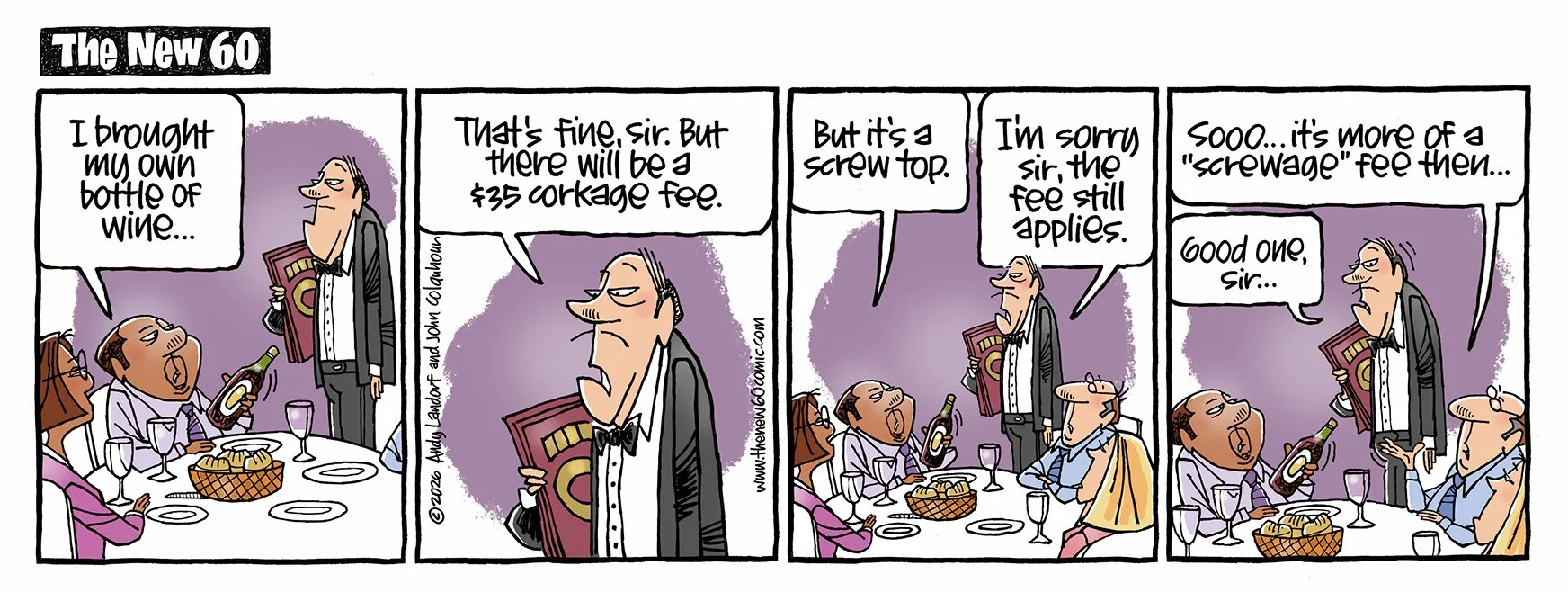
Pickles and Flo & Friends are decent, although a bit too snarky for my tastes. I also tripped over Oldster Magazine (already mentioned in a previous post, I think).

And that’s the ballgame for now.

Some good ideas, and some stuff resolved. Not a bad situation.

Posted in Computers | Leave a reply

Leveling up: Retirement content

The PolyBlog
May 6 2026

As I mentioned yesterday, I’m doing a “content” review of my websites to see if there are areas I should be expanding or contracting, comparing them to other blogs and posts that are out there. I would like to do more on retirement as I transition out of the public service, but I am always conscious of my voice. What do I bring to the discussion that others might not?

One area that I’m interested in is the psychology of retirement. Topics such as how people mentally prepare for retirement, how they frame the decision…do they see it as parole from a long jail sentence or graduation from a long tenured role or simply a celebration of their past accomplishments? Is it a transition — both sweet and sad — as they say goodbye to one domain and hello to another?

Oddly enough, despite my normal types of blogs, I have no interest in blogging about “the how” of retirement. I don’t want to talk about finances or pensions or forms or anything like that. I am interested in the experience, not the process. There are far better people out there on process. If it was something people did regularly, a transition that occurred such as you would experience changing departments, it might interest me. One-offs? Not so much.

As I started looking at some of the blogs that were out there, I found a lot about social security, Medicare in the US. OAS and CPP, etc., none of which are particularly of interest to me as a blogger. Instead, most of what I found that might be anywhere near my style is more that of long-form essayists building frames than bloggers dashing off quick hits.

The wish that was

It doesn’t take long in this space to come across the late Ronni Bennett (Time Goes By). Alas, she passed away in 2020, apparently, and her archived website is now triggering phishing warnings in two different security software programs that I’m running. No worries, there are LOTS of other essays she wrote in other sites, and they’re all good. I almost wish I was looking for stuff ten years ago and could have found her stuff as it was being published. Alas, ten years ago, I wouldn’t have appreciated it as much. And yet, reading back to a post (through the Internet Archive’s Wayback Machine) she wrote on June 15, 2020 (coincidentally my birthday of the year in which the world shut down):

I have always used writing to figure out what I think or believe and at this stage, there is a diminishing number of productive hours in a day. So here we are – an exercise in working out my thoughts and a blog post, all in one.

This was part of her Crabby Old Lady persona posts, and included the news that she was within the last six months to go. Short. Poignant. Resonance. A glimpse inside a heart as it actively beats, reverberating loudly in the quiet and increasing darkness. One can aspire to such beauty.

Wisdom of (an individual in) the crowd

Sara Botton runs the Oldster Magazine site, which is more of a digital collection than a traditional magazine, focusing on people aging, at whatever age. How we live, how we die, and everything in between. She has taken a structured approach to interviewing lots of famous people with a subversive “questionnaire”. Some questions resonate with one interviewee, some with another.

  1. How old are you?
  2. Is there another age you associate with yourself in your mind? If so, what is it? And why, do you think?
  3. Do you feel old for your age? Young for your age? Just right? Are you in step with your peers?
  4. What do you like about being your age?
  5. What is difficult about being your age?
  6. What is surprising about being your age, or different from what you expected, based on what you were told?
  7. What has aging given you? Taken away from you?
  8. How has getting older affected your sense of yourself, or your identity?
  9. What are some age-related milestones you are looking forward to? Or ones you “missed,” and might try to reach later, off-schedule, according to our culture and its expectations?
  10. What has been your favorite age so far, and why? Would you go back to this age if you could?
  11. Is there someone who is older than you, who makes growing older inspiring to you? Who is your aging idol and why?
  12. What aging-related adjustments have you recently made, style-wise, beauty-wise, health-wise?
  13. What’s an aging-related adjustment you refuse to make, and why?
  14. What’s your philosophy on celebrating birthdays as an adult? How do you celebrate yours?

Do you see what’s NOT in that list? Anything about retirement, work, money, marriage, children, regrets, death, etc. It’s not about benchmarks or hallmarks, it’s about how you feel right now. That’s kind of powerful.

For me, I’d be more interested in how people approached retirement (expectations), what it was like (voluntary or not, reality of process), negative “outcomes” you sought to avoid, stuff you miss and stuff you are glad to have gone, what does busy look like in your life now, current source of purpose, how have your friends group shifted if at all, any milestones you look forward to or dread, etc.

I could create my own questionnaire of sorts, I suppose. And I’d love to have such conversations with people. Something to think about.

Long-form essayists

Anne Lamott is more familiar to me for writing advice than for the long essays in Hallelujah, Anyway (on Substack) or the numerous books on faith, hope, etc. I have not seen her life-stage focus, or at least, I’ve never noticed it. Not quite a voice I would emulate, however beautiful and lyrical the prose. I admire the voice, but I don’t want to sing like her.

Sara Lawrence-Lightfoot’s work on the “third chapter” of life (ages 50-75) has been nothing short of groundbreaking, shifting the paradigm toward more productive conversations beyond retirement, slowing down, and/or declining health. I’ve added her books to my reading list (The Third Chapter, 2009; Exit, 2012; and Growing Each Other Up, 2016), although I confess I’m most interested in her thoughts on lifelong learning and embracing new things after 50.

Marc Freedman has a similar target audience — the age 50+ — but more on doing meaningful work. His work with Encore.org has all the marks of humanitarian creation, volunteering in retirement, etc. But I am not usually enamoured of the throughline. The argument, frequently, is “do meaningful work, improve your life”. Few question the logic, except that the logic is dependent that your “meaning” in life is from what you do, not what you experience. The service to others argument is indeed powerful, but it is the same argument that suggests every woman should be a mother, easily debunked. If you assume a good life is one that serves others, then serving others is a good way to have a meaningful life. The frame doesn’t hold for me, even if I admire the ethic. It’s part of the answer, but I have never felt it was the whole answer. Too simplistic, in my mind. Not simplistic for everyone, not in a normative sense, I just mean it doesn’t resonate enough with me.

I think what bothers me most, in a simplified way, is the idea of defining your worth in terms of meeting other people’s needs. It is a particularly utilitarian way of looking at life — and a slippery slope to saying other people are only of value if they serve me in some way too. That’s not the message, I know. But it is partly why it doesn’t resonate with me. I think a well-lived life is more about choosing a path, and adhering to it against adversity. Looking for truth in any form you can discover it. Service is one way, but not the only way. Which, of course, won’t stop me from reading his work and learning any applicable lesson I can. 🙂

Tyler Cowen co-created the Marginal Revolution (Small Steps Toward A Much Better World) and the content is glorious. Everything anyone ever wanted to learn about economics is in plain language and free. Unless you buy the textbook. The scope is ambitious, the result is stupendous. And envy-inviting. I could only dream of creating something so significant. And he’s blogged every day since 2003, although he is a bit more succinct than I, and he seems to curate more these days than write. But what does he have to do with retirement? Nothing, really, so much as he does talk about productivity over the life-course. I’m not sure if that will hold as an ancillary lens for me, but it’s worth checking out in more detail. And if not, well, who doesn’t like learning about economics?

Mary Catherine Bateson’s point-of-view of “adulthood II” is compelling as a metaphor, as is the idea of life being a composition. But when she embraces the spirit of cultural anthropology, I find it merely interesting, not resonant.

That can’t be everybody

Of course not. There are literally hundreds of thousands of people out there blogging about various stages of life, but finding ones that are closer to my voice is a bit harder than a pure Google search. And what I avoided were ones with singular niches or specialties. Sports in retirement. Dancing in retirement. Travel in retirement. Sex in retirement. Finances in retirement. That’s not what I’m looking for, nor what I’m likely to focus on. As I said above, lifelong learning is more likely to be my slant than anything else.

And yet searching for that will basically just turn up enormous numbers of sites with ads to “learn with them as a mature adult”. I’ve already blogged about all my learning considerations and options when I retire. And whether I might take a Transitional Support Measure to do some formal learning.

Tom Vanderbilt’s approach in “Beginners: The Joy and Transformative Power of Lifelong Learning” (2021) focuses on a year of doing new things, which is intriguing as an initial premise, but not near long enough to judge a framework.

Although, maybe I’m too quick to discount the ads. There is the Osher Lifelong Learning Institutes (OLLIs) in the US that used to be “Institutes for Learning in Retirement”; the UK and France created the University of the Third Age which is more international now; and there are some examples in Canada. Perhaps worth a look.

I also should perhaps pull my head out of the retirement space to reframe the lifelong learning component and see what others are writing about for lifelong learning BEFORE retirement. People like Cal Newport; Andy Matuschak; Maggie Appleton; or Michael Nielsen. Not quite sure they’re worth the time investment to dive deep or not, as they are often focused on the nature of adult learning itself, which is only part of the issue for me. Although I **DO** have other non-fiction writing that would benefit from that lens, and some of Cal Newport’s work is already in my TBR pile.

I thought I would find more of a definitive resonant source to read. Instead, I found fragmented stuff, all of which are potential rabbit holes for me. The economic stuff alone could consume a year of fun reading. No, I’m serious. 🙂

Useful starting points though.

Posted in Computers, Learning and Ideas | Leave a reply

Leveling up: Government content

The PolyBlog
May 4 2026

Let me start by saying I like my websites. Sure, there are always things I could tweak here or there, or it could be on a faster server, or it could be more SEO friendly. I’d love to host videos inline without jacking the server costs. But overall, I like my two froggy homes. ThePolyBlog for my personal stuff and PolyWogg for my more professional stuff. Or, to steal from someone else’s framing that I like, the first is for me and the second is for others.

That doesn’t mean, though, that I don’t take it seriously. There are almost 2M words on the two sites, and more than a few regular followers. Which is rare for a long-form personal blog. As I near retirement, I wanted to do an honest review of my content against what other people in similar or adjacent spheres were doing. Both to help me understand my positioning as well as potentially give me ideas for opportunities I’m not exploiting. Most of that review is done. Let’s see where I’m at.

Insight into government

I naively thought there might be more sites like mine out there blogging about government life, how government works, etc. Insider looks from a public administration mindset. Government 101 perhaps. Maybe not a lot in Canada, but around the world? Average people like, well, me? Surely there would be some in Australia, US, UK, maybe New Zealand.

In Canada, I quickly tripped over Michael Wernick’s “Governing Canada”, which I had already read. It’s a good find as I do admire some of his style and his ability to remain apolitical in his descriptions (which reviewers decry). Except it was a little too white bread treatment, even for my tastes.

Donald Savoie is a huge Canadian voice, with books, Policy Options essays, etc. They’re practically a whole genre unto themselves. And yet, they don’t land with me as strongly as they should. A little too theoretical, upbeat? Not enough grit perhaps? Not sure.

Sam Freedman’s stuff on Substack (Comment is Freed) and his book (Failed State). A little too British-specific to catch my attention, but quite popular. And long form (many posts > 3000 words!). Except it is far more political than I would want. Predictions on elections, analysis of races, analysis of political positions in various cases. Not my cup of tea, normally. Yawn.

Ian Dunt has Striking 13 on Substack, books and podcasts (oh my!). Finding him was like finding buried treasure. I’ve marked his book, How Westminster Works… and Why It Doesn’t, for later, although I’ve already skimmed a few chapters. I was super excited about the first bits, until I realized the general thread of “how it works” seems similar to some books written in the Maritimes in Canada — government is stupid because politicians are stupid and do stupid things. Not really my jam. I know why people believe that, I know why people like that line…I’m just not one of them. A little too angry a line for me. Maybe 10% will be useful for me to think about for future topics.

Martin Stanley is a little too Mandarin-ish by contrast. Amazing stuff, from the https://civilservant.org.uk/ website to the Substack. I’ve bookmarked his book, “How to be a Civil Servant” for later. Mostly as I want to see what he has to say about running policy teams. And he has the right tone — this is “how it works” with some analysis of limits and perks, but not angry. Definitely a tone I aspire to match.

I had not seen Jen Pahlka’s work before, or maybe I dismissed it as too US-centric, not sure. The name was familiar, but I had not specifically seen her “Recoding America” stuff before. Digital service delivery is mostly outside of my purview, but I’ll take a look.

David Eaves stuff for Canada is a bit more data-ish, even more than Pahlka, probably more than I’ll enjoy, but I’ll also take a gander.

And then I run out of options that I’m likely to emulate.

Future options

I know I want to write about skills, performance, Government 101, audits, HR and life as a manager. I already know my voice for most of those, and maybe about 10% of the above will help flesh out the 101 stuff and life as a manager. The rest? That’s mostly on me. And some books, of course. Lots of books. I was just hoping to find other writers fighting government monsters and gazing long enough into the abyss that the abyss has begun to start gazing back into them. A few abyss dwellers. And me. Alone in my pond. Typing away. 🙂 I assumed my voice was rare; I didn’t think my croaking was unique. Ribbit.

Posted in Computers | 2 Replies

Countdown to Retirement

Days

Hours

Minutes

Seconds

Retirement!

One of my favourite sites

And it's new sister site

My Latest Posts

  • Leveling up: Memes, postcards and flashcardsMay 13, 2026
    So, I have two giant premises working against me here: Yet, every guru on anything web-related has said the same thing for the last fifteen years — that blogs and posts are only successful with eye candy. I’ve played with the formats of posts over the years in certain categories, trying to get them to … Continue reading →
  • Leveling up: Retirement contentMay 6, 2026
    As I mentioned yesterday, I’m doing a “content” review of my websites to see if there are areas I should be expanding or contracting, comparing them to other blogs and posts that are out there. I would like to do more on retirement as I transition out of the public service, but I am always … Continue reading →
  • Leveling up: Government contentMay 4, 2026
    Let me start by saying I like my websites. Sure, there are always things I could tweak here or there, or it could be on a faster server, or it could be more SEO friendly. I’d love to host videos inline without jacking the server costs. But overall, I like my two froggy homes. ThePolyBlog … Continue reading →
  • Book clubs 2026-04: Options for AprilApril 22, 2026
    March was extremely productive in my personal life, but not so much for reading. I was still finishing My Friends by Fredrick Bachman, and the first 20-25% was a struggle. I loved it, in the end. And I’ve been doing huge personal projects, so no reviews lately. Let’s take a look at the options for … Continue reading →
  • AI testing: The Bad…Time loops, tech support quirks, and driftApril 18, 2026
    By now, most people have seen some form of AI crop up in their tools. The most obvious one is Google’s search engine, which provides results from its AI mode first in the list. You can go pretty far with that prompt, even asking for image creation, although that’s a terrible place to create images … Continue reading →

Archives

Categories

© 1996-2025 - PolyWogg Privacy Policy
↑