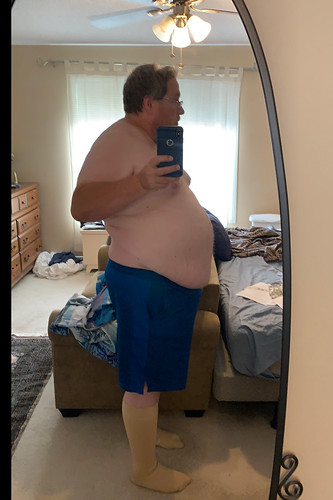
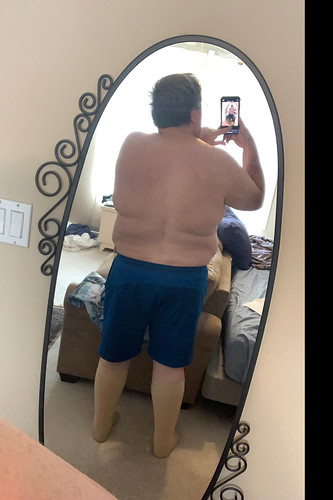
September 11 is the start of my new attempt at body transformation. My intent is to do all my measurements and photos on the first of each month, and so I’m a bit behind in a sense, but I need to set my baseline now. I have to start somewhere and there’s no real reason to delay until October 1st. So here it goes…
Physical baseline
Weight: 343.4 lbs … My highest top out was 350 even and that will be my overall mark from which I’ll do my formal deductions in the macro sense, so in a sense, I start already down 6.6 lbs, 158.4 lbs to go (4% of my goal). Yay me, hehehe
BMI: 47.9 (Obese Class III) [+4.8 since 2018]
Body fat: 53.5% [new baseline]
Neck: 20.25″ [+1.25 since 2018]
Bust / chest: 53.5″ [+.5 since 2018]
Lower-chest: 52.5″ [+1.5 since 2018]
Waist: 56.5″ [+1.5 since 2018]
Lower-waist / belly-button: 56.5″ [+2.5 since 2018]
Hips: 50.0″ [+2 since 2018]
Buttocks: 52.5″ [new baseline]
Right bicep (soft): 17.5″ [+.5 since 2018]
Right bicep (flexed): 18.5″ [new baseline]
Right forearm: 11.5″ [-1.5″ since 2018]
Left bicep (soft): 18″ [+1.5 since 2018]
Left bicep (flexed): 18.5″ [new baseline]
Left forearm: 11.5″ [-1.5 since 2018]
Right thigh: 28″ [+2 since 2018]
Right knee: 18.5″ [-1.5 since 2018]
Right calf: 20″ [+.5 since 2018]
Left thigh: 28″ [no change since 2018]
Left knee: 19″ [-2 since 2018]
Left calf: 20″ [no change since 2018]
Well-being baseline
Medical / sense of physical health: 3 / 10 [new baseline]
Social flexibility (willingness to do sports/exercise): 3 / 10 [new baseline]
Lifestyle (confidence for social outings despite obesity): 1 / 10 [new baseline]
Finances (related to obesity): 2 / 10 [new baseline]
Mental health (regarding health): 1 / 10 [new baseline]
Milestone tracking
COMMITMENT (Psychological)
Commit to the journey
Announce goal
Set up Seinfeld progress for plan
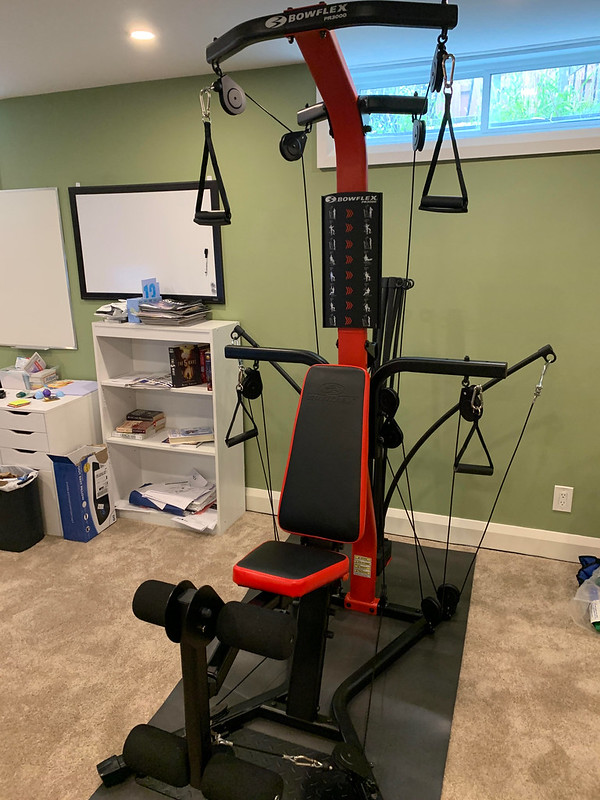
First workout for BowFlex
Setup bicycle machine
First week of 3 workouts
Average of 3 workouts per week in a month
Average of 4 workouts per week in a month
Average of 5 workouts per week in a month
Average of 6 workouts per week in a month
MEASUREMENT (Physical)
Set up tracking of weight and BMI
Set up photos
First weigh-in
First new pound
10% of goal
25% of goal
33% of goal
40% of goal
50% of goal
66% of goal
75% of goal
80% of goal
90% of goal
100% of goal
First set of measurements
First photos
PLATEAUS
Change of 1″ in waist
Change of 5″ in waist
Change of 10″ in waist
Change of 15″ in waist
Change of 20″ in waist
DIFFERENCES
See my toes past my belly
Tying shoes without effort
Kneeling without pain
See my abs / muscle definition
See difference in photos
See difference in clothing (275 / 240 / 205 / 185)
Fit into ~30″ pants
Hugs from Andrea and Jacob
Elimination of sleep machine
Elimination of compression socks
Elimination of medicines (4)
MONTHLY FITNESS TEST
Fatigue limit for all 26 exercises
Pushups
Expand fitness test
Photos
There’s no accountability without photos, however much I hate doing it.
And that’s a wrap. My new baselines are set. See you on October 1.
So this morning I decided to work through all the exercises for the first time and decide which ones I can do and at what power for now. A “starting” point, if you will.
Initial stretching. I don’t have a good stretching routine set up yet, so I’ll have to add that to my list. I did the basics:
Achilles Tendon and Calf –> Hands on wall, one foot back and lean in;
Qaudriceps –> Pull one ankle up behind your butt while standing;
Hamstrings –> Leg up on third step (almost horizontal) and lean towards feet;
Rotation –> Grasp alternate wrist, and rotate trunk to side;
Shoulders / lats –> Put hand up by opposite ear, and pull in on the elbow with the free hand;
Neck –> Seated, with one hand under seat and lean head opposite direction;
I have a workout mat for later in my efforts to be able to do some basic yoga, and I’ll eventually incorporate Tai Chi stuff too but I’m a long way from there. Heck, I’m going to have to add a milestone that even my stretching routine isn’t taxing for me. Sigh.
On to the chest exercises!
Chest #1 — Bench Press…The first one in the book is the ever-popular Bench Press. It is designed to work the Pectoralis Major, Deltoids and Triceps. It is a seated exercise, as you can see from the diagram below that comes from the owner’s manual for the BowFlex PR3000.
It’s a good exercise, and I’ll keep it in my repertoire probably for just about every routine. There are two more in the book that change the angle of attack for the “decline” (downward) and “incline” (upward).
When I started planning, I thought the main question was going to be simply spreading the “load” so that I knew which areas I was targeting (chest, arms, etc.). However, while the gym is designed in a way that prevents having to do multiple “pulley adjustments” throughout the routine, it quickly became clear that those aren’t the only variables.
For example, it is easier to start with only “seated” exercises. It reduces the risk of injury in the early stages, in particular as it makes for very controlled movements. There are 10 of those to choose from in the list.
However, I had more or less expected that the exercises would generally all use similar grips and pulleys in a run. Obviously, they don’t. For the first three above, they all use what is called the “centre bar” i.e., the pulleys attached to the centre bar that runs horizontally across the gym. Which means switching from one exercise to another that uses the same bar is pretty simple — you’re already holding the grips! If you switch to the top bar for the next exercise, then you have to reach around to find it.
Not a big deal for the top bar option or the centre bar option, they’re not too far away. But switching to the squat/lower bar is a bit more work to adjust. For simplicity, it would probably be easiest if I do all top bar exercises first, then centre bar, and then squat bar ones. If I was doing the full 26 in a run, there would be 5 top bar, 10 centre bar and 11 squat.
If I tried to combine them in some semblance of order, it would mean 10 seated exercises to start, 2 with the top bar (narrow pulldown and reverse grip pulldown), 7 with the centre bar (bench press, decline bench press, incline bench press, seated shoulder press, triceps extension, and abdominal crunch), and 2 with the squat bar (biceps curl and leg extensions). The last one requires installing a separate attachment, but as the last exercise in a routine, that shouldn’t be too much of an imposition.
How did I do?
I ran through 16 exercises, 1 set of 10 reps, mostly with everything set at 60 lbs (30 per side). Plus some additional stuff at the end along with some other testing. Call it 9600 lbs for the main workout and another 3000 lbs, or 12600 lbs in total.
But I made four errors in the workout.
Form…I will still need a lot of work on that over time. Some of the exercises seemed easy from the diagrams, but even if I start with the easiest of all (bench press), the tips are not as easy to do all at the same time:
90 degree angle between upper arms and torso;
Tighten chest muscles;
Limit and control range of motion;
Head back;
Keep elbows in front of shoulders;
Pinch shoulder blades;
Maintain spinal alignment.
Oh, and just for fun, you’re supposed to do them all slow — three seconds out, three seconds in. I know from earlier training, as well as numerous articles, that all of this comes together over time. Some recommend picking one and “nailing” it for muscle memory in the first few weeks, and as you get more comfortable, work on the other parts of your form. But as long as you are not going for much larger weights, i.e., keeping the entry-level down, you avoid risk of serious injury while letting you work on flow and motion at controllable weights.
Hydration…I’m an idiot. I honestly didn’t even think about it while I was working out. Obviously, I need to, but it’s been so long, and I was so focused on the machinations of the new tool, I didn’t really think of it as a normal “workout”. Easily rectified, just silly.
Constant weight setting…This is more of a choice than an error. In theory, of course, each of the exercises will be at a different weight / resistance setting so that you can tailor every exercise to your specific muscle group. It’s not rocket science, you are going to be able to do less weight on trunk rotations than on leg extensions. I set it low (30 lbs a side) and that was fine for the whole exercise except trunk rotations. I fatigued a lot faster on that one, and in fairness to the book, it did tell me to reduce for that one, and I chose to ignore it in favour of a smaller number of reps and ease of process. Long-term, I’ll be able to adjust all of them, and be more willing to as well.
One challenge that I mentioned earlier for me is the need to adjust settings, including pulleys and grips, and this gym was chosen in part because that is addressed through the design to limit the number of changes required. Four areas of change are still built-in though … switching from top bar to centre bar to the squat bar (and I’ve ordered extra grips so I don’t actually have to MOVE the grips too), seated vs. standing exercises where it recommends you remove the seat but I feel I can do most of them without doing that, attaching the leg extension (no option to avoid that), and the big one, changing weight settings. Whichever one is the most annoying is the one you “sort” your routine around to limit the changes required as you go.
Cooldown…I was taking notes, writing things up, trying to almost pre-blog as I went, and in all of that, I didn’t think about what the cooldown would look like. If you don’t do it, your muscles cramp up and you’re even sorer the next day. I didn’t really think about it in advance, kind of like the hydration thing, so I was about 20m post-workout and was like, “Oh, wait, I missed something, why am I feeling THAT there? Oh right, cool-down.” I did some basic stretching, and went for a walk around the block with Jacob, but I need a better cooldown routine.
But I did my first workout. Now I have a day off to recover. 🙂
I mentioned yesterday that I have my new BowFlex set up now, and I want to start using it this weekend. While it is a “good problem” to have, my challenge is to figure out which exercises to do and why. For example, the manual that comes with it suggests 26 possible exercises for Chest (3), Shoulder (6), Back (4), Arm (4), Abdominal (2), and Legs (7). But there are some other variables at play, of course.
Of the 26 exercises, 10 are seated, which is likely not a bad place to start for me. There’s only one seated one for legs and one for shoulders, but all the others have multiple options. In the short term, seated exercises will take some of the pressure off the rest of the body, reducing the likelihood of injury too.
But for the muscles? I thought there would be more overlap for some of them:
Deltoids — 9, but some are all Deltoids, some are only specific ones;
My goal for the workouts is primarily overall toning and conditioning, but I would like to build up some strength and power too. Not necessarily right away, but I wouldn’t be against it. I know my short-term goals are going to be more reps at lower weights, which is fine with me.
Measuring progress and results
Obviously, the measures for progress are pretty simple for these types of machines…frequency of work-out, number of exercises, number of reps per set, number of sets, and weight. Ideally, all of those increase, just not simultaneously.
Results are a bit harder to come by for useful, practical indicators. My goals is overall well-being, but I think I’ll have to settle for some more traditional measurements (many of which I’m stealing from #50by50ish #50 – Lose weight – Part 8, off-scale success):
Weight;
BMI;
Neck size;
Arms (upper, bicep, forearm);
Bust;
Chest (below nipples);
Waist (1/2″ above belly button);
Stomach (belly button);
Hips (widest part);
Legs (thigh, knee, calf)
When it comes to more well-being indicators, I’ll go for a simple 10 point scale:
Social Flexibility — willingness to do other sports (1-10);
Lifestyle — confidence/openness to social outings despite size (1-10);
Mental Health — feeling mentally healthy in the last period (1-10);
Financial — Expenses related to size (1-10);
Medical — Overall feeling of physical health (1-10);
I do have some milestones that I’ll steal from that other list I had in the post linked above:
Initial commitment (Psychological)
Commit to the journey
Announce goal
Set up Seinfeld progress for plan
First workout for BowFlex
Setup bicycle machine
First week of 3 workouts
Weight measurement (Physical)
Ongoing tracking of weight and BMI
Ongoing photos
First weigh-in
First pound
First set of measurements
Overcome a plateau
Change of 1″ in waist
Change of 5″ in waist
Change of 10″ in waist
See differences
See my toes past my belly
Tying shoes without effort
Kneeling without pain
See my abs / muscle definition
See difference in photos
See difference in clothing (275 / 240 / 205 / 185)
Fit into ~30″ pants
Hugs from Andrea and Jacob
Monthly fitness test
Fatigue limit for all 26 exercises
Pushups
Expand fitness test
It’s good enough for my start, and Jacob and Andrea are going to help with my measurements and stuff this weekend. Onward! Oh, wait, I didn’t share the list of exercises that I’m choosing from:
Okay, so let’s talk about my experience with various exercise machines. Let’s start with the basic reality that I’m fat and I’m not particularly enthused about working out around a bunch of fit people who know what they’re doing. It waxes and wanes in intensity, but it doesn’t completely go away. I also have trouble being motivated if I have to actually GO somewhere to work out.
Back in high school, I bought a small home gym, and I really liked it. It had a stack of weights that went up to about 150lbs as I recall, and I started using it. The downside is I had a small bedroom, with a desk already and a bookshelf, plus the bed of course and a wardrobe, and this weight machine. I had to move a bunch of stuff around to even use it. Plus, it was the old style that every time you wanted to switch from exercise x to exercise y, you generally had to reconfigure the pulleys. And, not for nothing, it was also a bit loud in the house when the weight stack came back down sometimes, particularly if I was doing leg lifts that had the most weight, and my father, in particular, found it noisy. They also found my exercise bike pretty noisy when I was riding it, but I didn’t have anywhere else in the house to do it. I tried reconfiguring my back porch (which was an enclosed area), to see if I could get it going out there, but it wasn’t much of a solution. In the end, I sold it off to a friend who could put it in his basement.
Fast-forward from 1988 or so to 1998. I was living in Sandy Hill, joined a Good Life centre, took some coaching to develop a good workout routine, and tried to get in the habit of going in the morning before work. I’m not enough of a morning person to really do that, unfortunately. Particularly with having workout clothes, and work clothes to change into, plus the time to actually work out and get to work on time. I was doing okay, and I liked the routines, but the location wasn’t really working for me.
I tried again with a Good Life over on Queensview, and had some hopes to get going there, got my playlist going, but again, having to GO to the location was bothering me, and I was also feeling really self-conscious about myself at the time. I stuck with it for a short while, then nada.
Somewhere in there, we bought a home exercise bike, one of the good recumbent designs to take the pressure off the jewels, a little less harsh for your back. And when we moved from Roundhay to Mattamy, I had to take it apart. Since we moved in, I’ve either had no place ready to re-assemble it and use it (until we redid the basement), or I’ve been missing the parts that have to go INTO the bike to make it work again. Or I’ve been missing the manual to tell me HOW to do it. Plus, I’m not very motivated as I’ve never really loved the cycle — I like bikes, but the tension on this one always seemed extra-vibrate-y and loud. Mostly excuses, but not very motivating to do it, particularly as I’m not very handy and I don’t know what I need to do. I’m hoping it’s a five-minute job, expecting it to take me at least an hour though. Andrea would like me to get it going again though too, i.e., set up so she can watch TV while she’s doing it, and Jacob might even be able to use it on lower settings.
Enter the home solution again
In the fall of 2018, I was feeling a bit more motivated to work on my body, and I even managed to drop 25 pounds with diet and some basic exercise. But as I tried to figure out WHAT I wanted to do, the idea of the home gym came back to me repeatedly. I’d love one of the big expensive ($5K) but compact home systems with multiple stations (usually three on angles) and easy switching between exercises. One of the challenges is those are often abnormally tall for upper clearance, and lots of basement rooms won’t fit them. And with the weight, I really feel like I want one on a hard basement floor rather than an upper house floor.
I looked around at some options, and was pleasantly surprised to see that Walmart had some massive deal on the Bowflex PR3000. For example, right now, you can still see it listed various places at $1300, although the price has gone up a bit since 2018 with availability, parts, shipping, etc. But back when I was looking, it ranged between $1000-$1200.
Walmart had it on sale one week for $599. Basically half-price.
I couldn’t say no, and apparently neither could Andrea. So I ordered it. It was NOVEMBER 2018. An important date to look back to because I expected to assemble it in January 2019. I had some other issues going on then, I decided to reconfigure part of the basement first to pack up some of Jacob’s things he had laid out like trains, train tables, etc. So it was around March when I thought I would finally get around to doing this. I was still naive and optimistic.
Then COVID hit. And while that SHOULD have given me lots of time and energy to set it up and get it going, well, it didn’t. Most of my basement has been in turmoil for a good portion of that time, with stuff piled everywhere to allow me to do some stuff at one end while ignoring the other. I feel zero motivation for some really big clean-ups that I need to do.
Fast-forward through 18 more months of laziness and motivational ennui, and the thing was still sitting in a box in my basement. Unassembled, and of course, unused. Taunting me. Stressing me.
Heck, Andrea bought a trampoline in June and the assembly just about killed us. It was brutal. Did I really want to try assembling the Bowflex? Don’t get me wrong, there is a VERY serious question in there for mental health. There are literally videos on the internet about all the things the instructions for Bowflex systems, including this one, have wrong and how to overcome the errors. You don’t just take this on willy nilly and expect no challenges, particularly if your experience with home tasks generally leads to frustration more so than celebration.
Hippety hop, hippety hop
About two weeks ago, I was looking for some shelving for the basement to get my office completely set up and working the way it should be (again, hello, ennui?) and ended up ordering some basic stuff from IKEA. I need functional, not chic. Anyway, I get all the way to the end, and it asks me if I want someone to come to assemble it. I’ve never noticed this before when ordering, and I was curious how much they charge. It’s not like a Billy bookcase is hard, we’ve done lots over the years, but what could it hurt to look?
IKEA has farmed out their assembly for years, but now route it all through TaskRabbit. If you don’t know the TaskRabbit site, it is basically a freelancer’s gig-economy site where people can post their job and choose a contractor who works on those type of tasks, including in this case, furniture assembly. For reference, the average cost is about $45 an hour for the labourer, plus the overhead for TaskRabbit. It wasn’t worth it for the bookcases, we can do those ourselves as I said, but it got me thinking.
Could they assemble a Bowflex that’s known to be a royal pain-in-the-ass and that I haven’t gotten to in 2.5 years? It couldn’t hurt to pose it, could it?
I went on TaskRabbit, described the project, did a quick search through the contractors, chose one that had the most previous experience with decent ratings, and selected him. There’s a 2-hr minimum charge for a booking, and you can cancel anytime. I sent him a follow-up message through the website, he said he could do it (not exactly ringing endorsement and enthusiasm, just “yes”, but I’m trying not to stress about things I don’t need to stress about). I confirmed he was double-vaccinated in the sense that I asked him, he was good to go, I booked him for today (Thursday), and he showed up at 11 with his tools.
I started to explain to him the two main errors I had found online and warned him the instructions were supposedly terrible, to which he replied, “Oh, I know, I put one together for a lawyer in town a few months ago.”
Well, why didn’t you say so, buddy? Two and a quarter hours later, he was done. I helped him put in a bolt that was a bit tall for him to reach AND hard to do while holding the other piece in place, and I helped move it into place, but otherwise? It was all him.
I have a full Bowflex up and ready to go, and I wish I had this option back when I first bought it. Best $100+ that I have spent in a LONG time. Admittedly, TaskRabbit threw in some sneaky hidden fees I hadn’t been expecting, but hey, still came out fine. He got $90, I got a Bowflex assembled with no stress. He also hangs pictures, assembles other furniture, does basic home repair, whatever we need. I wish he could clean and sort my garage, but that’s more on me, unfortunately. Still, it is a major project DONE and DONE.
Now I have to figure out all the exercises to do, adjust the seat and benches to the right heights, figure out reps and sets, set a schedule, show Andrea and Jacob how to use it, and re-assemble the exercise bike too. Plus, you know, actually work out.
But we’re a major step closer, thanks to a rabbit. I’ll definitely call that a win.
I’ve been thinking a lot recently about “who I am” and how I describe myself. I even wrote a psych profile of myself. Me, trying to step outside myself, to see myself more objectively. And I started thinking of who I am as I approach retirement, what I want to have accomplished in my life by the time I pass on, etc. Somewhere in there, I started to think of it a bit as a simple question. What is my legacy from having lived? What difference did I make, what will people remember about me?
I realized early on that it depends very much on my various roles. If I go chronologically, the simplest legacy is my first role in life, as the son of Jack and Theresa. I had no legacy as a grandson as I never really knew my grandparents, I only had a grandmother left when I was born and she died when I was very young.
It’s also odd to realize too that my legacy as a son, who I was as a son, is a finite area. My parents have passed on, my ongoing duties to them are (mostly) finished. Sure, there are other things in life that I could “credit” to them having been my parents, but it is not necessarily in my role as their son. That period is officially over.
In the first 20 years of life, I don’t know that I generated much of a legacy. My father was proud of my academics, my mother probably felt like she didn’t understand me. I didn’t really understand either of them very well. I also feel like I probably seemed ungrateful, that my desire to move out, to graduate from university, to get a white collar job, etc., all seemed like somehow I was better than them. It wasn’t true, but it’s hard as a teen to realize that when you say you don’t want “x”, and “x” is what your parents want for themselves (or have at least achieved for themselves), there is inherent in that striving to better myself a judgement of what came before. Not intentional, not malicious, just there.
I was the Golden Child for my mother, that was clear, as her youngest always was, I suspect. As the last of the children, I got to keep the title and prize belt longer than the other kids. A mix of pride and expectations, not necessarily the “favourite”, more that I could rarely do wrong.
My legacy with my father
My legacy, such as it is, is probably three-fold.
First and foremost, from age 20-28, I got to know my Dad better than ever before, oddly enough from a distance. I had a better understanding of his life choices, perhaps simply reflecting the cliché that teens leave home thinking their parents know very little, yet see a few years later how much the same parents have learned in the meantime. However it came about in phone calls or from verbalizing our feelings more, I feel like he passed on with neither of us having anything left undone or unsaid. I would have liked another year or two to really solidify what we had, but nothing that would rise to the level of actual regret. I was his son, he was my father; we loved each other and we both knew how the other felt. I honour that bond when I tell my own son that I love him every day.
Second, I did my father’s eulogy. I am not quite sure that is a legacy, since he had already passed on, and we only decided after he died that I would be the one to give it. It’s a double-edged honour though. I did it, yes, but I cried my whole way through it. I doubt anyone understood a word I said. I am proud I did it, or perhaps more honoured that I had the privilege, but I wish I had “performed” better as his son.
Third, I also helped my mom after his passing. He knew I would do it, it was part of the deal we made when he appointed me co-executor. He expected and I accepted that Mom would need help, and while we didn’t discuss it in detail, it was assumed that I would be the one most likely to be able to do it without Mom feeling like I was telling her what to do as well as the duty not interfering too much with my non-existent family since I was still single. I like to think he approached his death knowing whatever needed to be one in the early stages, I would step up.
My legacy with my mother
When I started writing this, I thought the two legacies would be very different. I had a very different relationship with each of my parents, yet as I tried to describe the key variables, I find myself using the same structure.
First, again, I had a good relationship with my mother before she passed. There was nothing left unsaid or undone. As desired by my Dad, I helped her immediately after his death with a bunch of financial stuff, paperwork, etc. I still remember her telling me the day he died that she needed me to keep it together, for her and myself. At least for a little while to get through everything. And I mostly did, up until she felt comfortable doing it all on her own. I don’t know that she really needed the help, but she did appreciate it.
More importantly, to me at least, I had (mostly) reached the point where I saw her for who she was, not some childish thought of who I wished her to be. Acceptance, as they say. There were two or three things near the end that I would prefer she hadn’t done, but it was who she was. It didn’t change how I felt about her and I didn’t judge her for them, even when they annoyed me. She was 84 years old at the time of her death, having lived through the Great Depression and the Second World War; lost parents and siblings through war and aging; married and outlived her husband by another 17 years; raised six kids and lost two babies to miscarriages; worked in stores and as a cleaning lady; smoked and drank; loved trivia; and laughed whenever she could. She could be a force to be reckoned with, when she wanted to be.
Second, as with my father, I did her eulogy too. I worked my ass off to make sure I could get through it, that I could read it without crying the whole time. It was one of the hardest things I’ve ever done, and I got it done the way I wanted. I have a photo on my PolyWogg website taken the day of her funeral, a remembrance of life out at the lake, with the water as calm as I had never seen it before. Eerie almost. Yet I use it to remind myself both of my mother and that I was able to honour her the way that I intended.
Third, the last part again is dealing with her estate. When my mother was in palliative care, she asked me to do three things. I was somewhat sad to tell her that two were beyond my abilities to control, and that with a family of my own, I would not accept the requests. I essentially chose to say no to two deathbed requests. That rankles me, in the abstract. She understood why I said no, and while disappointed, she wasn’t angry with me for my choice. She asked because it was something she hoped for but accepted my refusal. And I would give the same answer today.
The third request was tied to her estate, and as I had already agreed long before to be co-executor, it was more of an “add-on” to the previous request. I knew it would be unpleasant, I would much rather that I had said “No way, Jose”, but since I was already saying no to two other requests, I agreed to that one. It seemed to give her some peace of mind that I was willing to take it on. It got done, it was unpleasant, but I did what was requested. I mentioned above that I felt I was “mostly” done with my legacy, but there is something outstanding. I agreed with my siblings that I would eventually scan all my mother’s photos and share them with them, and while I’ve started a couple of times, I have no real desire to do such a large and potentially depressing project. Sigh.
And yet…
I find myself wondering if there are more things to include here, like the legacies FROM my parents to me…loving books, movies, trivia, jokes. Preferring informal over formal, small get-togethers over big events. The importance of telling my wife and son that I love them, as well as my siblings. I would tell my close friends too, but well, that can get a bit creepy hehehe Yet I feel like those other legacy gifts to me will all show up in the other legacy posts.
Overall, I guess that I feel comfortable with my “legacy” as a son. Which is good because it’s not like I can change it at this point without time travel. 🙂