
↓
 

The PolyBlog

My view from the lilypads

  • Home
  • Goals
    • Goals (all posts)
    • #50by50 – Status of completion
    • PolyWogg’s Bucket List, updated for 2016
  • Life
    • Family (all posts)
    • Health and Spiritualism (all posts)
    • Learning and Ideas (all posts)
    • Computers (all posts)
    • Experiences (all posts)
    • Humour (all posts)
    • Quotes (all posts)
  • Photo Galleries
    • PandA Gallery
    • PolyWogg AstroPhotography
    • Flickr Account
  • Reviews
    • Books
      • Book Reviews (all posts)
      • Book reviews by…
        • Book Reviews List by Date of Review
        • Book Reviews List by Number
        • Book Reviews List by Title
        • Book Reviews List by Author
        • Book Reviews List by Rating
        • Book Reviews List by Year of Publication
        • Book Reviews List by Series
      • Special collections
        • The Sherlockian Universe
        • The Three Investigators
        • The World of Nancy Drew
      • PolyWogg’s Reading Challenge
        • 2026
        • 2023
        • 2022
        • 2021
        • 2020
        • 2019
        • 2015, 2016, 2017
    • Movies
      • Master Movie Reviews List (by Title)
      • Movie Reviews List (by Date of Review)
      • Movie Reviews (all posts)
    • Music and Podcasts
      • Master Music and Podcast Reviews (by Title)
      • Music Reviews (by Date of Review)
      • Music Reviews (all posts)
      • Podcast Reviews (by Date of Review)
      • Podcast Reviews (all posts)
    • Recipes
      • Master Recipe Reviews List (by Title)
      • Recipe Reviews List (by Date of Review)
      • Recipe Reviews (all posts)
    • Television
      • Master TV Season Reviews List (by Title)
      • TV Season Reviews List (by Date of Review)
      • Television Premieres (by Date of Post)
      • Television (all posts)
  • About Me
    • Subscribe
    • Contact Me
    • Privacy Policy
    • PolySites
      • ThePolyBlog.ca (Home)
      • PolyWogg.ca
      • AstroPontiac.ca
      • About ThePolyBlog.ca
    • WP colour choices
  • Andrea’s Corner

Category Archives: Health and Spiritualism

Post navigation

← Previous Post
Next Post→

The end of wound care (with warning)

The PolyBlog
April 24 2021

For those who are friends with me on FaceBook, you’ll know that since mid-January, I’ve had an ongoing issue with one of my legs. An open wound that wasn’t healing. It’s a long, torturous saga, and I’ve been torn (literally, hah!) about how to talk about it in a way that makes sense to other people, because it wasn’t a “small thing”. In many ways, it likely seems like it. And it started that way. But I didn’t want to share ugly photos on FB that people would see and immediately say, “Ewwww, why would share THAT? That’s gross!”. Because it IS gross in some places.

So this is the big warning — some of the photos are raw portrayals of the actual wound. Not exactly “bloody” or gory, but not something you want to view before dinner or share with Grandma. If you don’t want to risk seeing that, DON’T SCROLL FURTHER.

Let’s start with a bit of simple context

I’m overweight. And pre-diabetic (depending on my latest A1C numbers, sometimes I am closer or not at all). Regardless, big, diabetic-ish, and as per both, I have problems with liquid pooling in my legs. They swell, and then I sleep, they drain, it starts again. Gravity is not my friend in these things, or many others for that matter.

I have scars on both legs on my shins. A well-spent youth, shall we say. Nothing scary, nothing worrisome, just old childhood scars. On my right leg, it’s a bit more of an issue than the left, but that’s through usage.

If I go to block a soccer ball, or catch a closing door, or some wood slides and is going to bang against my leg, it is ALWAYS my right leg that goes forward. Almost NEVER my left. Right at the exact same height on my right leg is where I catch the dishwasher if it’s open and I move too close too it as I go around, or the corner of the car door if I have my hands full and trying to use my body to close it. Over the last few years, some of the scars have swelled up at times. Or at least I thought that was what was happening. They’d swell, like a blister, and go away or pop and leak water, heal, all good. It happens, it’s annoying, but generally no biggie.

Over the last year though, I’ve done way less walking around than I used to when I was commuting to work, so the swelling is a bit worse, and at the time of the “incident”, my right leg had a couple of blisters. I thought it was just the scars, but in retrospect, it was PROBABLY blisters / leg ulcers due to veinous insufficiency (the fluid doesn’t drain as well as it used to, and if you don’t move around as much / walk as much, then the calf muscle doesn’t get around to pumping it back up).

So what was the “incident” and why do I keep referring to it that way? Because it was really innocuous. Benign. Simple. It wasn’t a trauma, no war injury. I am not exactly sure of the date because it WAS so minor. Late October / early November, I guess.

I was going to bed late one night, it was dark in the bedroom, and as I went by a laundry basket on the floor, I caught my shin on the edge of the rim. It hurt, sure, but it wasn’t OMG, I’M GOING TO DIE or anything. It was “nothing”. I did an intake of breath, cursed under it, and went to bed.

When I woke up in the morning, I realized I’d actually broken the skin. It tore the “blister” and a bunch of water leaked out. So I had a bit of blood, and a spoonful of water or so probably, but well, not much more than a 100 other scratches you would get in the garden.

It was no big deal.

Until it was “something”

Fast forward to January, it had more or less healed, didn’t really think much about it. A couple more times it leaked in November and December, but well, there was no blood. I’d clean it up, have a shower, get on with my day. I wasn’t really worried about it, it was just annoying.

But in the third week of January, it started to hurt. The blister also seemed bigger. But it didn’t seem like a major cause for concern. I took a photo just so I could see it better.

Pre infection - Jan 18

It didn’t scream “giant problem about to take over your life”, but it was sore, maybe infected, so I called my GP. Of course, it’s a pandemic, so going to a GP isn’t my idea of a good time if I can avoid it, but saying the words “potential infection” moved me to the top of the list. By the time I saw them that week, it had, umm, progressed and was clearly now infected.
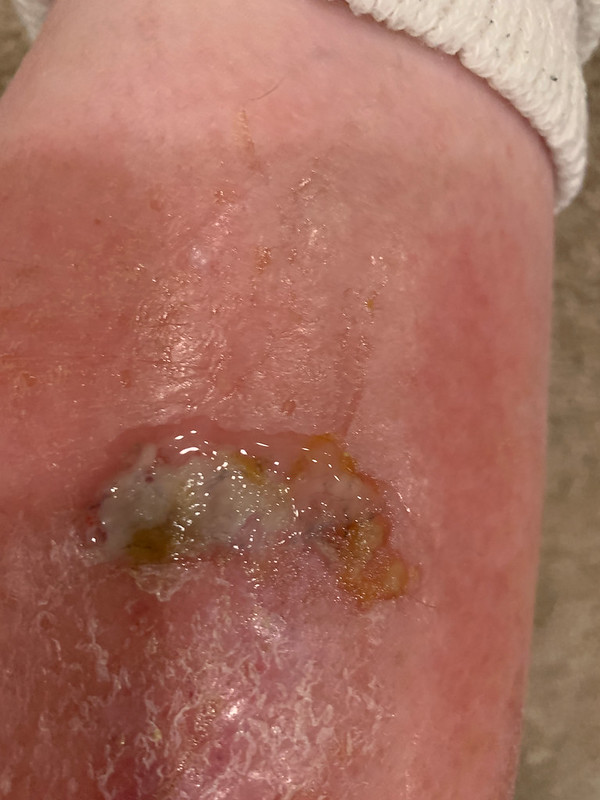
Infection - Jan 21 Last appt - Jan 22

(the first photo is taken upside down from above, and the lighting is off, it wasn’t that red, but the infection part is relatively clear). I did 10d of antibiotics, plus they cleaned and dressed it, and then the GP referred me to the Local Health Integration Network for ongoing wound care. They deal with a lot of post-surgical follow-up so people don’t have to go to hospitals to do it, they have multiple companies and offices all over the city, and wonders of wonders, one just two blocks from my house. Awesome.

Round 1 of wound care

So I started wound care. Basically what this means is that they would see me every two days. I would go in, and we’d start with some general COVID screening questions (a light screening since many of the patients coming in ARE running fevers, so they have to see more “is this normal fever or something else?” and really mostly seeing if anything changed in the last two days). I wouldn’t say it felt as “formally safe” as going to places like massage therapists or chiro or even a hospital where you have to fill out a full form everytime, but they run fairly efficiently, so I never waited more than a minute or so in the waiting room to go in, where it was just me and the nurse in a repeatedly sterilized room.

For wound care, they remove all the old bandages and stuff, check to see how much drainage there was and what colour, they clean the wound with saline, and then start “debriding it” which scrapes off any of the dead skin that is preventing / blocking healing. Yep, that sounds about as much fun as it is. Anyway, after it’s clean and debrided, they put a layer of “something” to fight infection / draw stuff out of the wound, a layer of bandage to capture any drainage, and then a layer of compression to force any liquid out of the leg and improve healing.

Given my weight and diabetes, and the original ulcer-like blistering, all tied to the swelling of fluids, I was in compression for the right leg. Note that you can use custom wraps, put a compression “tube” on, use generic over-the-counter compression socks, or get custom-fitted compression socks. I call them geezer gaiters/garters, but all four options are rated by pressure in “mm of mercury” similar to blood pressure.

The rating for commercial over-the-counter stuff is often 10-20 mmHg, and I had tried those once before back in about 2016 or so. I didn’t find them terribly useful, didn’t seem to do anything, and since they were also hot, scratchy and uncomfortable, I only lasted a few weeks before ditching them. This time around, it wasn’t optional.

It also has to be “uniform” to promote healing, and the best way to do that is a custom wrap. Like a mummy up to the knee. So every two days, they’d give me a new anti-infection layer, a bandage layer and a compression layer. The tension of the wrap establishes the level of compression, and therapeutic use is generally 20-40, with a good starting point of 20-30 mmHg. So that’s what we did.

Every two days, regardless of the day of the week, I would go over and get everything changed. The first two weeks went well enough, a bit of pain here and there, but the antibiotics seemed to work, compression was going okay, I was working on longer-term custom socks (I’ll come back to that in a minute). Things were progressing.

After two weeks, it looked like this:
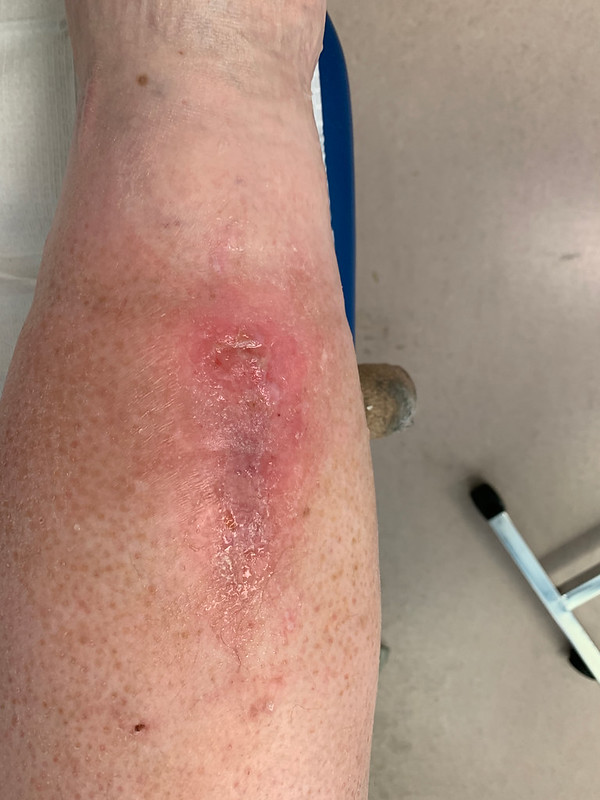
20d later - Feb 8

Really, I was only having three issues. The first was easy — going every two days and doing the debriding was a little irksome. But no real choice, and oddly enough, I think the regular human contact was probably a good thing in retrospect. Second — showering was REALLY annoying. You can’t take the wrap and bandages off, so I had to get a little shower bag thingie to cover my lower leg while I showered. Not very satisfying, but no biggie.

But the third issue was my mental health. I can manage my health well enough for my physical stuff, being obese and diabetic-ish. It’s taken its toll over the years, but I make progress when I do what I’m supposed to do, and I don’t when I don’t. Not the happiest of subjects for me, not a great success story, but I know all aspects of it. Yet here was something I couldn’t avoid/control/manage.

I suck at chronic physical pain. I can handle stress, emotional stuff, intellectual blowouts, I know how to adapt, manage, evade, control, etc. But physical? It’s my weakest area. And I’ve always known that. It’s my greatest fear about getting old, or even falling now and injuring a knee. This wasn’t my knee, so I could still walk around, but I have to wear compression socks generally for the rest of my life. Which I’m going to be embarrassed to do, for example, at a resort or at the cottage. So will I be able to be out in public in shorts? I already tend to wear a t-shirt in swimming (a rash guard for avoiding sunburn, hah!) but how am I going to be with compression socks on? Will I do what I expect I’m likely to do and just wear pants until I’m about to go in the water and come out, put on the socks, and then cover everything up? Adjusting to the new reality messed with my head for a few weeks. Yeah, I knew I’d get there mentally, but it messed me up for awhile.

But the rest of it? Relatively manageable.

Okay, I had ONE setback

Most of what was going on was simple adjustments. We tried wrapping to “this” height or “that height”, one felt better than another. Standard adjustments. But I did have one BIG setback.

I mentioned there were 3 layers — anti-infection layer, bandage layer, and a compression layer. We started off with using a silver nitrate type layer for the anti-infection layer. It’s essentially a mesh layer with silver in it that helps fight and draw out infection. Here’s an example from later in my treatment plan of what it looks like going on:

Silver nitrate worked well - April 3

It worked well for me, generally, but after about a week, the one nurse thought the drainage pattern was a bit sub-optimal, so we tried a new tool. It’s an iodine base layer. It goes on like a layer of cloth, all dry, but as the leg warms it up, it turns to a bit of a paste. She felt it might work well on my leg and draw out more infection. There’s no “single” way to fight this stuff, they adapt their choice of tools to how the wound looks, and in her view, it was asking for the iodine layer.

Setback -- the iodine layer - Jan 29

Now I’ll tell you, we also adjusted the compression that night from 20-30 to 30-40. To help the leg heal faster by draining fluid that attracts trouble, like infection. Great, right?

I had everything done mid-afternoon and shortly after supper, my leg was SCREAMING at me. Really really painful. Up until that point, on a scale of 1-10, the first week it was maybe a 3-4. Occasionally, if I sat too long without raising my leg, I’d get a twinge that would go to 3-4 too. But overall, maybe a 1-2. Nothing to write home about.

By 6:30? My leg was a really irritating 5-6. I had no idea what was going on, and the only thing I could figure out was that the new compression increase was too much. I couldn’t take it. So, despite the fact I’m not SUPPOSED to do this, I had to take it off. Instant relief. It dropped to about a 2-3 again. Still a bit sore, but manageable. And I wasn’t jumping every few minutes. Whew.

Until about 9:00 p.m. When it started again. I was going crazy, it was like someone was constantly stabbing me with a pin. Fine for about 30s and then another stab. Two minutes, settling down, okay, then stab, stab, stab. WTF?

I had to see what was going on. So I took the bandage off with Andrea’s help and the wound looked like the photo above with the goop on it. It was stinging so much, I had no choice, I had to wash it off. It stopped screaming again, and stayed that way. Sore, sure, but easily manageable with Tylenol or just putting up with it.

So we switched back to the silver nitrate the next day AND figured out that I needed backup bandages at home in case I ran into another problem. I had simple stuff, but nothing that would work well for wound care.

The next couple of weeks were, umm, iterative. 🙂 We would adjust something here or there, make it more comfortable, address my latest pain point so to speak, but it was, overall, progressing.

Time for discharge?

About 6 weeks after we had done everything, I was nearing the end of my time. Basically they don’t do anything if you’re no longer “leaking” i.e. “no discharge from the wound = discharge from wound care”. I was feeling good, able to move around a bit better perhaps too, etc. We took a drive out to the Carp Library to pick up some telescopes for a project I’m working on, I was carrying one out to the car, and I fell.

I was going through the door, my boots kind of rubbed against each other, the little buckles caught on each other, almost like I had tied my shoe laces together, and I went down. Hard. Right on my right shin.

I was freaking out mentally. No, no, no, no, no, this CANNOT be happening. I’m DONE. No, no, no. On top of it, I fell on cement that was covered in that ice melting stuff, the crystals, and it was eating into my knee. Yep, I had ripped part of the pant leg, gashed my leg, drawn blood, and I had potential ice crystal crap on it. Fudgicles was NOT the word that came to mind.

I did realize something though. The compression wrap on my leg? It acted like a shinguard. I had felt NOTHING below the knee. It was intact, no issues at all. It had even protected the knee a bit by absorbing the fall. We finished up, and then I drove home, limped into the house, and had Andrea check the leg. It was not great looking, but very superficial wounds, we thought. I called the wound care people, I went in the next day, no damage. Simple abrasion, very shallow, we’d monitor it, but no setback.

I wanted to cry in relief.

A week later, I was good to go.
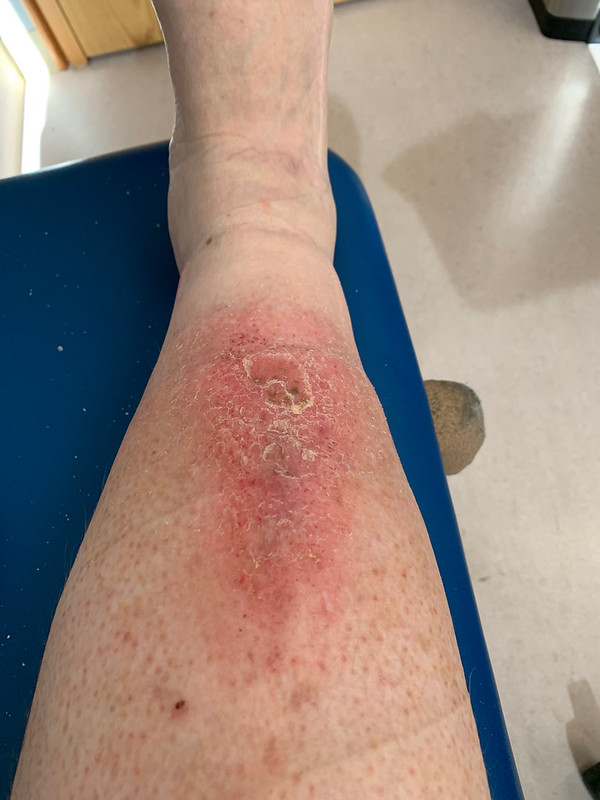
Ready for discharge - March 7

It would take a while to heal, and I was having “dry skin issues”, but I was good to go. No more drainage, no more wound care. I was officially discharged.

Woohoo!

Not so fast there, chief

That night, I’m at home, and I notice that my sock is a bit wet. WTF? Why is my SOCK wet? Oh, there’s a small area at the bottom inside of the wound area that is still leaking. Okay, call them the next day, I’m back in wound care until that spot closes. No biggie, this happens all the time. I skipped over mentioning that not too long before we got to week 6, I was changed over to every 3 days instead of every 2, normal for pre-discharge. Anyway, I was back in.

But it was minor, so they don’t even want to see me. I can do it myself at home and come back in a week. They give me a small nitrate for the infection layer, just in case, AND, just for fun, this exciting new bandage.

Dun, dun, dun, I call it the spider bandage.

It’s basically a large bun-like bandage, about 3 inches in diameter, you put it over the area, and then it has about 8 little strips of adhesive going off it like spider legs to adhere it to the leg. All good, easy to work with, I’m fine.

Andrea helps me with wound care after 2d and we switch out the old spider bandage with the new one. She even has to do the saline cleaning, no debriding thank goodness, but we’re good. Takes a bit longer the first time, but it’s easier for her to do it than for me to try. It stings a bit when we take off the old bandage, but well, it’s a bandage. It doesn’t kill me or anything, maybe a little more painful than a bandaid, but it’s 8 strips.

Day 3-4 go okay, it’s a bit sorer than I was expecting, but okay, fine. Another change of bandage, a bit more pain, but I appreciate the help, and I don’t have to go out. All good.

Day 7 is the next change, and well, it doesn’t go as well. It’s sore removing the bandage and my leg is inflamed. It is red, it hurts, and as my GP calls it later, visually striking.

Houston, we have a terrible, terrible problem

I go into wound care, and it is clear I’m in pain AND the wound has gone drastically in the wrong direction. It isn’t clear to me at first how or why, but something is seriously off. The main nurse looks at it, asks what we were doing, asks what was on it, realizes it was the spider bandage and says, “Oh.”

We give the other nurse the benefit of the doubt that my leg has reacted to the adhesive. In fact, fast-forwarding to the end of my diagnostics, what actually happened was that the choice of bandage meant that the adhesive strips were on relatively “new” skin next to the wound. It hadn’t fully healed. So when we took off the bandage, it basically tore the new skin off with it. We work with the “one or the other” possibility for a few weeks, and I’m not chasing blame, just diagnosis as we did with the iodine (“Okay, that doesn’t work for you!”) but eventually one of the doctors tells me it is / was not a reaction to the adhesive, it is very clearly skin tears.

Okay, I’ve held off long enough. This is the scary photo.
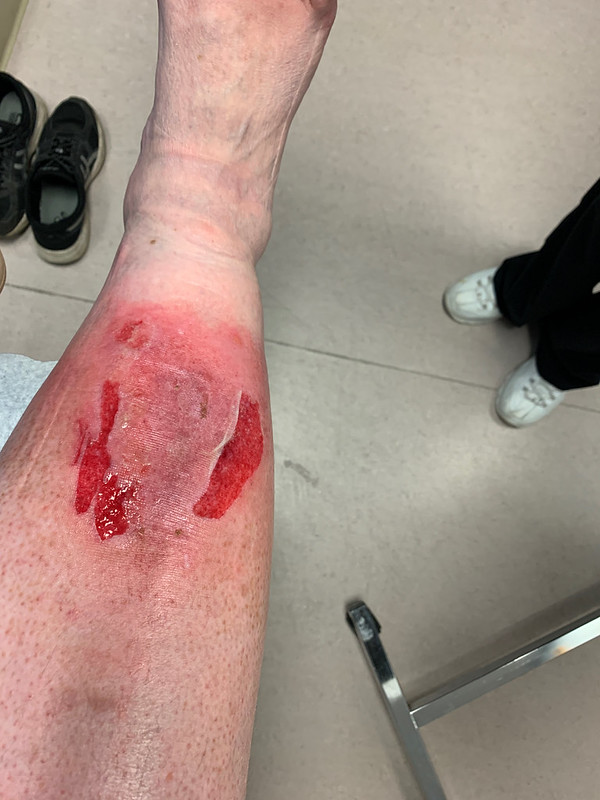
Angry and painful - March 18

The good news is that my primary area in the middle is unaffected, but now I have two NEW wounds either side of it. FFS.

And yes, it is painful AF. I am DEFINITELY not discharged, in fact, I’m back not only to square one, but in fact we’ve also past that point and regressed further. I’m now worse off than when I started. There is only one small saving grace.

The new “wounds” are NOT like the previous ones which were deep. These are, relatively speaking, superficial. Sure, I now know what it means for someone to tear a strip off me (hence my original joke at the top about tearing), but well, it might not be as long. I hope.

Nevertheless, the wound care people heavily advise me to go see my GP. Obviously. Which I do. The on-call doctor covering is a long-time GP that I love, not my doctor but he fills in when she’s on vacation, and he did indeed sum it up well. “Well, that certainly is visually striking.”

(Our cousin and friends are doctors who concurred that it was better to be visually striking than medically interesting at least.)

He looks at it, assesses it, confirms continued wound care, and turns me over to the nurse who is new and also covering for the regular nurse. She is a bit older, and practiced nursing in her home country before immigrating to Canada, very nice. But she doesn’t listen to me very well. I don’t know if it’s her bedside manner or a language barrier.

For example, when we were removing the bandages, we got to the bandage layer, which regrettably has had some drainage and thus is stuck to my leg. I’m at week 8 of wound care, and I know that the best way to get it off is with saline to soak it to let it “release”. Which I tell her, she confirms, and then proceeds to rip the bandage off in three strips. Like removing a bandaid, as they say. EXCEPT I’M THERE BECAUSE I HAVE NO F***ING SKIN because the bandages already took it off. I visibly react in pain. “Oh did that hurt?”. Okay, deep breaths.

We get through everything, we go to do the close out, so she cleans and dresses the wound. She doesn’t have silver nitrate (or more accurately, doesn’t know where this office keeps it), so she does a basic bandage which will be fine until the next day with real wound care. But she uses this liquid to clean the wound. I forget the name now, but when it goes on, it practically burns. It is really stinging. She then takes a cloth and proceeds to quickly WIPE DOWN MY LEG AREA OVER THE WOUND. I just about jack-knifed off the table. OMFG. If I wasn’t almost passing out, I would have been screaming at her. I did, in fact, scream a little when she did it. And she suddenly realized that I am in fact in pain and she’s about to get murdered, as she switched to being very careful after that. I got the name of the liquid so that we won’t ever use it again in my wound care, and when I told the wound care people, they were like, “Are you crazy? You can’t use that on a wound. It’s a debriding agent. It probably took off more skin!”. Yeah, so there’s that.

They wanted me to report her, not for punishment but as a learning opportunity, and I thought about it but I’d moved on. Then one of the nurses there called to follow up and I said, “soooo, while we’re on the phone, who do I report this too?” Not for blame, just to let her know, never do that again. They reported it to the nursing manager who did, apparently, use it as a teaching moment.

Whatever. I’m focused on wound care.

Starting to heal - March 28

Wait, I haven’t been to the ER yet, have I?

I’m set up, wound care fixes me the next day, I’m all good. I’m moving forward.

Until the Saturday morning. I wake up, and my leg is SCREAMING at me. A 5-6 level, WTF? Why? What’s going on? It’s been hurting a bit all week, actually, but that’s just normal stuff I think. I do have a MAJOR LEG WOUND after all. It isn’t a paper cut.

But Saturday morning? It’s screaming. If I am vertical longer than about 30s, it starts hurting. If I elevate it, it’s more normal.

Now, of course, all the way through this journey, I’ve been asking, “So what if…” this or that happens, what do I do?

One of the things to watch for is sudden intense pain or spreading pain that might indicate blood clotting. Well, here I am, with very intense pain. I don’t know that I need the ER, but, well, it’s Saturday. And the wound care people said, “If you’re in pain, go to the ER.”. Okay, off I go.

I go in mid-afternoon, finally see someone around 6:30, and then doctor around 7:30. Dr. Carter is his name. Very good, imo, although mostly I spend time evaluating pediatric people, not docs for adults! Anyway, he agrees that it is very visually striking, no signs of infection, but he wants to run a blood test to see if there’s any chance of blood clotting. He warns me that the test often gives a false positive in the sense that a negative result rules out 2-3 things, but a lack of a negative result only means they can’t rule it out, not that it’s positive. If it comes back “non-negative”, then I’ll need an ultrasound.

Great, I love phlebotomy as a practice. (Not). But it goes well, all done. And 20m later he’s back — I’m negative, none of the problems we tested for are what’s going on. No signs of clotting or anything else.

But here’s the thing. I’ve been in the ER for about 4.5h at this point, with a lot of pacing since I couldn’t put my leg up. Which means I used my calf muscles to get the fluid moving out of my leg, and the pain is almost gone too. I can go home, since there’s not much else to do, but I don’t have any real “resolution”.

However, he is concerned about who’s driving my wound-care bus. When I tell him me, he says, “No, I mean someone with a medical degree.”. I had to admit, well, almost nobody. Sure I saw Doctor #1 back in January, Doctor #2 by phone in late February for another round of antibiotics), nurses for ten weeks, and doctor #3 the day before, but well, I guess my main GP was following all of it (which she was, I shouldn’t imply she wasn’t, I just mean I didn’t meet with her because of timing).

None of which was sufficient, and in his view too, it was dragging on. He referred me to the soft tissue clinic at the hospital, and they gave me an appointment for 2w out. In the meantime, I would continue with wound care.

I went home, we adjusted my wound care to go only with the silver nitrates that worked, the 20-30 compression that worked, and a new wrapping technique for the bandage layer that covered more area with less slippage and no tape anywhere on my skin. Okay, 2w and we’d see what happens.

The ER was so much fun the first time

Fast-forward 6 days to Good Friday and I went to bed really late on Thursday night, planning to sleep in. I was digging deep to move my website recover along, and it was about 3:30/4:00 a.m. when I crashed. Normally that would mean sleeping until about 10:30 or so, but at 8:30, I was wide awake with my leg SCREAMING at me again. I was hitting about a 6-7 this time on the 10 point scale, it wasn’t going away, AND on top of it, I couldn’t get it to stop even my elevating my leg. I’d raise it, turn it on the pillow and 30s later, back screaming. No good positions at all anywhere. The only thing that helped was walking.

So off to the ER again. I confess, I debated not going the first time. I mean, let’s be real. What were they going to do? It’s a leg wound; I’m not dying. Better pain meds? It didn’t seem like it was worth it. But I got the blood test done and was referred to the soft tissue clinic. I hadn’t seen them yet, that would be another week, but I had felt that the first visit was worth the 4.5 hours.

And yet here I was again, with no explanation. I took the compression off, no change; I took the bandage off, no change. We had used the best infection layer, the best bandage technique, the best compression. WTF????

So off I went again. The pain went down with all the walking, and after 5h, I saw the doctor. This one was not as, umm, useful. I described it more as what I originally expected. Nothing they COULD do. So she recommended cognitive pain management, although I don’t mean that in a technical sense. I just mean it was more “suck it up buttercup”.

She didn’t think it looked infected, but honestly she was already half-way out the door to talk to some other patient, I guess, with a real problem. She gave me a prescription for antibiotics in case it was infected (up to me to decide in a few days) and a prescription for a topical steroid to reduce inflammation (also up to me to decide if I wanted to use it).

Now I could play Health Gambling. Here are the rules of the game:

  • If you have an infection, then you should take the antibiotics;
  • If you have inflammation, you should use the cream;
  • If you only have inflammation, but guess wrong, the antibiotics will do NOTHING to help the inflammation;
  • If you have infection, but guess wrong, the cream will cause the infection to go CRAZY and get way worse.

Up to me to decide. Great. Where’s that wound care bus driver the first ER doctor wanted?

I talk it over with the wound care nurses after the weekend, and we all agree that it is probably safest to take the antibiotics to eliminate the chance, and then when it’s done, use the cream. Fine. I’m good to go. I have a plan.

Probably the wrong plan

So when I picked up my antibiotics, the pharmacist asked me about the prescription. Because the Rx was for 2x a day. Except that antibiotic is normally ordered for 4x a day. I confirmed she had indeed very clearly said 2x a day, so I went with it. He said it was possible, just unusual, but okay.

Took it for 4.5 days and then went to the soft tissue clinic. I had photos of the whole journey, and this is what my leg looked like at the time.

Just after soft tissue clinic - April 11

The clinic doctor was very clear and immediate with his diagnosis. THIS WAS THE BUS DRIVER WE WERE LOOKING FOR!

So, here’s the run-down:

  • Yes to everything about compression for the long-term except the level. The wound care nurse was pushing me to go for 30-40, he said 20-30 was working, and sufficient based on my left leg, all good;
  • The original problem probably could have been prevented with better initial cleaning, ongoing moisturizing, and compression throughout;
  • The secondary trauma was very clearly skin tears from a bad choice of bandage, not a reaction to the adhesive;
  • No signs of infection and I should stop the prescription immediately AND it should have been four times per day, the 2x was doing nothing but suppressing stuff;
  • I could stop wound care because there was no longer any sign of discharge (the bandage was clear after two days and he poked the wound a LOT, the only one who has oddly enough); and,
  • I had a skin inflammation that did need cream but the original prescription was not a great choice for this (and I hadn’t started it anyway), so he gave me a brand new one (the same one the wound care nurse recommended).

All of which we did in about 10 minutes (albeit it took longer with the resident initially).

Wow, now THAT’s a bus driver who knows the route!

Newly discharged

I went back to the soft tissue clinic today for my two week follow-up. Over the last two weeks, I’ve basically done three things.

First, I’ve used the cream. I was supposed to do it twice a day, 12h apart, but because my sleep schedule has been messed up, it was more like 3x every 2 days. Anyway, it was working.

Second, I’ve been wearing my new custom-fit compression socks, and I’m okay with them. My brain has already adjusted to them for the most part, and since wearing them is no more embarrassing then walking around fat, F*** the universe if they don’t like them if I’m wearing shorts. At least they are reasonably close to my own flesh colour. I’ve also been wearing an extra liner on my right leg just to stop any fabric from rubbing against the wound, and it doesn’t hurt that it adds another 10mmHg to the compression regimen. I’m also a little bit optimistic about the fabric. It is fairly durable, and I’m hoping it will prevent some of those past scratches in the first place when I inevitably bang my leg again.

But you know what else I’ve been doing? Showering.

That is so huge, you have no idea. Since I’m wearing just socks, and have no wraps to protect, I can just have a normal every day shower, no baggie / cast cover on my leg required. It feels like heaven. Sure, I can’t “rub” it with the towel for fear of scraping skin off, but a regular shower? That’s worth it’s weight in gold.

Discharged - April 22/23

The final photo above shows fewer wound issues, reduced swelling, and reduced inflammation. It will still take time for all of it to heal, but I don’t have to use the cream anymore unless I notice something later.

Which leaves me with a healed leg, some good ongoing treatment solutions, some renewed impetus for other health stuff for the future, and regrettably, a small lingering mystery.

What caused the pain to spike which sent me to the ER twice? I have a theory, and it holds up enough to be viable, but no way to know for sure. Both times, I was off work that day. Why is that relevant? Because it means I was up late the night before.

I just averaged an extra 40h a week for six weeks rebuilding my website, and on the Friday night before the first ER visit, I was up to almost three or so. For the second visit for Good Friday? I was up to almost 4 the night before.

Which means I put in two really long days while sitting at my computer for REALLY long periods of time without a lot of movement around to do other things, they weren’t generally days I had wound care so wasn’t out for that, and then at night, I spent almost 7 hours straight at my desk. Without raising my leg or moving around. Because I was “in the zone”.

If I’m right, that being too sedentary the day before led to the pain the next morning, I need to remember that gravity isn’t my friend and to set alarms to move around more.

In the meantime, start the jukebox…”Freedom’s just another word for…” being discharged.

I just need to keep my squirrels under control too. Because every bump on my leg makes me think it’s another potential ulcer and the bus stops at my front door every trip. What I do need to focus on is moisturizing. My feet and legs are REALLY dry right now. I couldn’t handle would care on my own, but this? I think I can manage this one.

Posted in Health and Spiritualism | Tagged health, leg, wound | Leave a reply

Question: Who do you owe? (Part 2 – Supervisors and bosses)

The PolyBlog
November 15 2020

Just over a week ago, I wrote a post based on a question in a book that I have, and the question was:

Who do you owe in life that you can never pay back?

Since I’m an analytical type, I immediately started thinking of “who” in terms of categories, and teachers was an obvious first choice that wasn’t too emotionally-charged and relatively easy to do. I had two elementary school teachers, both of whom have passed on; three high-school teachers and I think two might be still alive, but can’t find much of a digital footprint for them; two undergraduate professors who I reached out to in order to say “hi” and “thank you”, and I just heard back from one who is now retired but still going strong; a law professor who taught me almost 30 years ago at the start of her career who is now semi-retired and who confessed, not surprisingly, that she didn’t remember me but still said hello; a graduate coop advisor; and two professors at Carleton, one who passed away earlier this year and another who is still actively teaching, remembers me (it was only 15 years ago) and invited me to join one of her online forum discussions! One more is through a MOOC course, and she is young, attractive and teaches academic stuff related to programming and video games. Like many in that field, I suspect she hides her digital footprint post-GamerGate and it might seem stalker-ish for me to track her too hard just to say, “Hey, liked your course, thanks!”.

For part two of my little mini-series, I thought I would reach back to think about my supervisors and bosses. I wrote a huge series about the jobs I had previously, and I don’t want to repeat that of course (What I learned from my previous jobs part 1/) . But it also gives me a starting point to think about my bosses or supervisors in that time.

A. Paperboy — No one, really. There were people at the paper but they seemed really distant. I could argue my bosses were my customers, but that’s a stretch.

B. Dishwasher — It was just one night, and I didn’t really know the boss. In a way, my brother was my supervisor and he gave me no useful perspective for the night…I had no idea that I hadn’t done a terrible job, but instead had done more work than most do. I felt like a failure, and in a way, that has inspired me to always be overly concerned about what feedback my teams get from me, or that they THINK they’re getting from me.

C. Telemarketing — No training, here’s your sheet, go. Pass.

D. Serials Assistant at the Bata Library — Well, this is a hard one, I had LOTS of bosses. My direct supervisor Barbara was warm and caring, but with a bit of a hard side (she was a union official) and I liked her a lot. She gave me room to do my thing and to get to know people around the Library. Helen was happy to have help, Marie was a bit difficult to work with at times, Anna I didn’t really get to know as the big boss. But Helena was not that much older than me, and a bit of a mentor to show me what I could do with my degree. A real job in a sea where I didn’t really know what university-educated people “did” with non-professional degrees. I think almost all of them have passed away now, but they were my first “work family”. I seriously considered trying to get a job in the Library when I graduated rather than going for an MPA or LLB or even work in government. I liked them a lot. My debt is three-fold. First, after growing up in a household where my father railed against the idiot bosses he had at the factory that never knew anything, I realized my bosses were real people, not faceless, nameless drones. Second, it was the first time I knew that bosses could be friends. And third, I learned that I was a bit different in how I worked and they both let me and helped me figure that out.

E. Assistant to the Treasurer — I helped the Treasurer of a nursing association, and she let me do as much as I wanted to do. Whatever I wanted to take on, she was willing to let me do that, to trust me. That’s a pretty good legacy.

F. Computer lab assistant — I never really knew who my boss was. Sure, I had people who did scheduling and gave me the ten-cent tour, but then I never heard from them again. Weird. One of the instructors who used the lab on a night when I was working taught me about gratitude with coworkers…I went above what she expected and above what others in the lab did, and she was grateful for it. Another notch that maybe I worked a bit differently than others. The legacy is that I try to show that appreciation to others I work with who go above and beyond.

G. IT Support (internal) — I can picture the faces of my three supervisors, and I don’t remember their names at all. They sent me out on calls around the university helping faculty and staff with IT issues. Another “job” that I wondered about doing long-term. It wasn’t that challenging but I loved being the one to go in and help people solve a problem, leaving them better off than when I met them. I don’t know that I feel a deep legacy, but I learned about what I liked.

H. IT Support (internal and external) — This is, in part, one of the same bosses. And the legacy is that they gave me room to figure out how best to run the office. As long as it was “running”, they didn’t care if it was chaos behind the scenes but it made it hard for all of us. So I took it on, changed some things, and rather than being upset with us, they were like, “Great ideas”. Another decent legacy in trusting the people who are doing the job to know how to do it better.

I. Law Co-op Student — I was a law student for a summer and fall at the Ministry of Education in B.C. It was my first “real office job”, in my career. My first GOVERNMENT job. And the legacy was immediate. I was relieved to see jobs in government that I wanted to do and COULD do. I worked for an Director, Peter, who was the big lawyer for our legislation and policy unit. Lots of briefs of Ministers, ADMs, etc. Then there was the Assistant Director, and he was the old hand. He knew how all the different parts worked. He was human, he was fun, he was a thoughtful boss. I’m distressed I can’t think of his name at the moment. I remember his last name had a double letter and that’s it. And then Diane, my direct supervisor and the lead policy person. I not only wanted her job some day, I wanted to BE her. I saw real world jobs that I wanted. I hadn’t been wasting my time thinking I wanted government but really not knowing what their day-to-day jobs looked like. Their legacy was both that I was good at government stuff (they hired me on and wanted to keep me, something they hadn’t done with previous students) and I had a path forward, a vision of my potential future.

J. MPA Co-op Student — My first 8 months at Foreign Affairs was as a co-op student, and I had basically four bosses. Ken, the Director was a very big, tall, lumbering man who laughed loud when he was happy and shouted loud when he wasn’t. Mostly he was happy. There was Ian, the senior policy guy, and other than having him approve stuff or going out in large groups for beers, I didn’t have much direct contact with him. My policy boss was Jim, and he was a great guy to have as a first boss. Not a micro manager, not a lot older than I was (although he HAD done his first posting already), and he trusted me to do things he assigned or come back if there was a problem. And Marilyn. I loved Marilyn. I didn’t see myself yet as a policy guy, more interested in admin, logistics and finance, and that was Marilyn’s job. She was the finance person for our big division, and so I was initially hired to help her and Jim get some program outreach done. I got sucked into policy work after three days, and logistics awhile after that, so Marilyn and I were often in/out of each other’s offices regularly. She too left me to do my own thing and trusted me to manage stuff. More importantly, she took a lot of time to answer my questions. She was my first real “mentor” and I learned so much from her about how government actually works…HR, finance, contracts. She passed away a number of years ago, and I still get the desire to chat with her about stuff. I’ll get an itch to discuss something with someone, and I think, “Marilyn would know the answer to that!”. That legacy runs pretty deep with me. I think, in part, it is why I make time for others when they ask me questions about HR, finance, etc. Because she did with me.

K. Contractor — I spent another 19 months at Foreign Affairs on varying forms of contracts. My Director stayed the same, and I got to see more of what he did with his day. Most of the Foreign Affairs managers acted like super desk officers all of their life, as far as I could tell, and I knew if I ever became a manager, that wouldn’t be me. I couldn’t articulate it, but it didn’t seem “right”. I learned more from Marilyn, I had a few other bosses go through (Phil, Michael, Cliff, Dan). But my best supervisor was Julia. I definitely reported to her, and she was definitely older than me, as they all were, but she didn’t treat me like a student or an inferior. She made me feel like an equal. We became friends too, and I babysat for her one night even, visited her in China. We’ve drifted apart and that saddens me. But one of the most endearing legacies I have from that time as a contractor was my friendship while working with her.

L. Temp — I worked for four months as a temp at CIC and my boss was Blake. He was great. He trained me with everything he had about contracts, and while the life of a temp is never glamourous, he treated me like a contractor he was going to have for years. I’ve tried to honour that legacy with my own teams. They may be passing through, but I’ll fill them up while I can.

M. Contractor — I went back to Foreign Affairs, and over the course of the summer, there had been a significant regime change. New deputy director, Jamie, and a new director, Ken. Ken was awesome. The type of thoughtful person you would always want as your boss. Good sense of humour, calm, reassuring. A great leader for the times we were in, at least for my side of the shop. Not sure how good on some of the other issues, as not everyone was happy, but I was. And their real legacy was giving me a term. 🙂

N. Term IS-03 — I became a term information officer at Foreign Affairs, with Ken as the Director and then DG, a new director Jim came in, my deputy director Jamie was still there, and I had Michael and Frances sharing me as a resource. Frances for comms, Michael for logistics. Overall, it was good. It is hard to point to something as a specific legacy, at least not in a positive light. Much of it was just good times during lots of late nights. I got to tour the country, got to sit in on important meetings, and generally I liked my jobs more than I liked any of theirs. I didn’t really want to be the big policy guy, I liked running things behind the scenes. I liked logistics. One legacy is more negative…I saw some behaviour from one manager that I never, ever want to emulate. Ambition can be a fickle mistress and blinds you to how you treat others at times. Years later I had the chance to return the behaviour in kind and I took the high-road instead. I didn’t want to be like them. Lots of people never see that lesson, I guess, so I’m somewhat grateful I could.

O. Desk Officer — I became permanent (yay!) working in the multilateral branch at CIDA. I worked for a bunch of people in the unit as the “junior” person in the team, including a fantastic boss, Roger, that I never heard anyone say a bad word about, just a lovely, lovely man. Everyone thinks of him and the word integrity just comes to mind. Margaret was a sea change in approach, and quite bright, but I saw how her personal style rubbed a lot of people the wrong way and made things more difficult as a result. People would die on a hill for Roger even if they thought he was wrong on something; nobody was dying on a hill for Margaret, unless it was friendly fire. It’s hard sometimes to remember that sometimes life at work is tough, it’s not all fun, and she had a difficult job to do that not a lot of us appreciated her approach or direction. I worked for Ginette, Claude, Ardith, all quite good in different ways. And I became friends with Daniele, a little fireball. But of all of them, I think my last legacy was working with Roger on stuff and seeing what DGs do, how they handle things. They all showed a lot of trust in me and gave me files well above my pay grade to try and manage. In their care, I formed the nucleus of the officer I became and remain, I travelled to other countries, I represented Canada at international meetings. It’s a hard legacy to repay.

P. Desk Officer — My next stop was in the Caribbean Division at CIDA for a short six months. My Director was Paul, but my main supervisor was Cam, plus some theoretical analyst duties for a senior policy analyst whose name I am blanking on tonight. It was a good experience, but the time there wasn’t a raging success for me, and the legacy is mostly that I confirmed what I had already suspected. I didn’t want to manage development projects on a bilateral program. I missed the policy and corporate work. I might have always wondered “what if…” without that experience, but with it, I realized where I wanted to be.

Q. Policy Analyst — I worked for two directors, Daniel and Christine, during my three years in the Policy Coordination division of CIDA. While the biggest legacy of the job is that I met my wife (!), my bosses gave me amazing opportunities including the chance to act as a manager. With their help, I supervised other staff, hired an ex-VP as a consultant, ran logistics for international meetings with Ministers, approved Comms materials for the branch, and generally became a Mr. Fix-it in the branch. I was in the policy coordination unit, but I frequently was given tasks by our DG or ADM around corporate planning and similar files. Between all of them, I learned to be a manager and I learned how to manage large corporate files in a complex environment.

R. Senior Policy Analyst — I mentioned earlier that working in the Caribbean Division showed me the “path not taken” and convinced me I didn’t want to be a project manager on a bilateral program. After Policy Branch, I moved for 8 months to the Deputy Minister’s Office. It should have been my dream job — high-level, you see everything, lots to do. But the lasting legacy was I saw how little time you got to spend on any one file. Most of the time you had to pick small battles to win while the war waged on around you. At times, it could feel like moving paper with no real impact. And I realized again, it wasn’t what I wanted. The DG, Susan, and an EA Director, again, blanking on her name, helped me a lot in the 8 months figure out what I wanted. I also got to spend time with a lot of senior executives, including the DM, and to see amongst all of them, which traits I liked and which ones I didn’t. I hadn’t realized as much until that time how much their individual strengths or weaknesses show up in a large room of their peers.

S. Manager — I became an official manager in International Relations at Social Development Canada, and my boss, Bob, was one of the nicest men I have ever met in my life. I liked his outlook on life, and while he was close to retirement and a Director, he put up with a lot of noise and chaos above him. The legacy I got, aside from wishing I was as calm as Bob, was that I didn’t want to be part of that upper chaos. I’d be remiss though not to mention that my lasting memory of his boss, Deborah, is that she used to bring cookies for people regularly that she made herself. Just a hugely warm person. One of the warmest “greens” (intuitive introverts) I have ever met.

T. Manager — After International Relations, I moved to Strategy and Integration to work for a previous boss, Christine. I worked my butt off for 19 months and at the end, I was burnt out. She was trying to help me, and it wasn’t the help I wanted, but it was all she could offer in the environment we were in. Her boss, Allen, was more timid than I thought he should be, partly as he worked for an ADM that scared the crap out of everyone. And we all suffered for it. Yet I wasn’t afraid of him. In the 19m that I worked on those files, the most engaging conversation I had the entire time was with him when the others felt he was eating our lunch. I thought it was awesome. I ended up with three lasting legacies … first, not to become emotionally invested in my files, although it would be hard not to on the type I was doing; second, not to scare people from telling you what they really think or to be afraid to tell someone senior they’re off track if you have to; and third, I pushed away from them towards corporate planning files that I’m really good at and enjoy doing.

U. Manager — After S&I, I did Corporate Planning for 9 years. Yep, nine years. The job changed around a lot in there, with multiple directors (Benoit, Gaby), multiple DGs (Lori, Alexis, Michel, Catherine), and multiple ADMs (Karen, Paul, Louis, Frank, Rachel). Of the eleven executives that were above me during that time, and I may have missed a couple in there, nine of them were really good experiences, and the other two, while not awesome, were not negative either. Ultimately, the lasting legacy is that I learned I was good at my job, I learned how to manage upward and brief them appropriately, and I learned how to manage a larger team, sometimes with direct supervision and a lot of time flying solo. I’m comfortable either way.

V. Manager — I gave up a great job to try something new in pensions, and it was good to stretch my wings, even if the outcome didn’t turn out as well as I had hoped. The DG was good, but it was not the same open management environment I had enjoyed previously. I took the job not knowing who my Director would be, and while I used to think I would and could work with/for anyone, and have always had that from my past, I couldn’t find a way to work with my Director. I saw behaviour that was inexplicable, I saw behaviour that went way over the line for me on ethics. In the end, the lasting legacy for me was that I could not be happy in such an environment. I lasted 9 months and that was about 4 months longer than I should have stayed.

V. Manager — I moved back to Skills and Employment Branch and worked for two bosses, Gordon and Stephen. I knew both previously, and had no qualms in working for them. Like Roger way back above, they are both strong on integrity and working for them was a breath of fresh air. Gord shared with me some of his lessons learned from a lot of years in the public service, including in the DM’s office, and it is a lasting honour to have worked for him. Stephen and I have worked together from different parts of the organization for a long time, and as he had a short-term project to do that fit my skills set, I was happy to do it. I loved working for him, I learned from him as I always do, and he has forgotten more about corporate management than I will ever know. However, I think the lasting legacy from the project was that despite the best intentions from all those involved, sometimes higher powers decide your outcome for you and your anticipated result gets watered down considerably. Sigh. A painful legacy, and not one we could control.

W. Manager — CURRENT: I am in a new job in Apprenticeship since about 18 months ago, and it is still evolving. I am working with good people, and I like what we’re doing. Changes in the past two weeks make me think that I am likely to stay in the current job now until I retire, partly as about 30% of my job is about to change for the better. It’s way too soon to know what legacies I will derive from Chris, Mona and Jacinthe, or if there will be others in the mix before I retire.

A concluding thought

I confess this post didn’t hang together as easily as the previous one about teachers. It is hard to separate out what I gained from them vs. what I gained from the jobs themselves. But I guess I would see some common threads:

  • The importance of integrity;
  • That bosses are people, not faceless drones, and some can be friends;
  • Behaviour that I want to emulate as a manager — trust, mentorship, staying calm, clear feedback, opportunities, gratitude,
  • Behaviour that I want to avoid as a manager — micromanagement, over-reactions,
  • To trust in my own abilities, both as a manager and as an officer;
  • That I like large corporate files in government;
  • That I like HR, finance, logistics, planning;
  • That not all bosses are created equal; and,
  • Not all plans survive engagement with the enemy, and we can’t control the outcome.

As with my teachers, all of the ones mentioned above have nudged me in different ways with their examples.

Posted in Health and Spiritualism | Tagged goals, questions, spiritualism | Leave a reply

Question: Who do you owe? (Part 1 – Teachers)

The PolyBlog
November 4 2020

I have a couple of resources of “questions to ask yourself” or “what if…” scenarios. Things to make you go “hmm…” or to play at parties with friends. I played with two “what if” questions last year, one about teleporting if you could and one about living through a specific war if you had to do so. Today’s is a bit different.

The question I have today is:

Who do you owe in life that you can never pay back?

Wow. That’s quite the question. Oddly enough, I know some people obsessed with financial debts would interpret that question to be about loans and things, but it isn’t about that. It’s about personal indebtedness or gratitude. If I cheat a bit, I can go back and think of things somewhat chronologically and it will help me write a series of posts.

Teachers are an obvious choice, with a dozen bright stars leaping to mind from my academic life.

Elementary School

My grade 6 teacher, Bruce Hutchison, had a Latin phrase that resonated with me, and looking back, I feel it helped define things for me. “De gustibus non est disputandum” — in the matter of taste, there can be no disputes. Everyone is entitled to their own tastes, views, preferences. Grade 6 was the year I started to think of the question “Who am I? What do I believe in?”. I was more consciously aware of choice creating reality, although I couldn’t articulate it in those terms. He held me understand that better.

My grade 8 teacher, Eileen Gallagher, was your classic quiet but firm old style teacher, the iron fist in the velvet glove. I struggled with social issues in Grade 8, and while she was of no hope for that (or at least I never tried to get her to help with it), she reinforced in me that I had better-than-average smarts for academia. I might not be the most popular kid, but in a relatively small class of 25, I could be the smartest. If I applied myself, I could not only get decent grades, but also top grades. If I did the work instead of coasting. More importantly, she was also the one who had to sign course selection forms for high school and she refused to sign mine. Everyone else’s went in without a hitch. But mine? She balked. Across the board, I had selected advanced level classes, but in English, my high school also offered an “advanced enriched” option. I hadn’t chosen it, and so she wouldn’t sign until I upgraded my selection. In her view, while my math skills were solid, she thought I was underestimating my writing ability as my real strength. That choice fundamentally altered my learning about language, writing, communication in general, although at the time it was simply, “Okay, I guess I can do that.” By the time I realized the impact of that decision, she had already passed on.

High School

High school was a difficult time for me, which is probably a bit of a cliché to think I was unique in that regard. But in Grade 9, when I went from being in an mixed level class in elementary school into classes of all advanced students, suddenly there were a lot of really bright people around me who could kick my butt academically. Academics had been one of the few things I was good at and as it turned out, I wasn’t “that” good, apparently, with a mix of Cs and Bs. I found the relatively large increase in the number of students from my one-class-per-grade elementary school to four/five-classes-per-grade high school a bit chaotic. But amid the chaos, I had Mrs. Pearson for math class. It was an oasis in a storm, and while she was quirky, I liked the nerdy quirkiness. I had her again in Grade 10 or 11 (I forget which) and she was the computer teacher too, so I learned to program in Basic on Commodore PETs, thanks to her. She even hired me as a computer geek in Grade 11 to help setup the new computer lab. I had never really thought of myself as particularly gifted with the computers, but she saw something and wanted to nurture it. So she hired me somehow to learn the new systems and then teach her and her younger students. She also got me writing the math contests early on, which continued through to Grade 13. Math and computers were my rock when other things were quicksand.

In Grade 10, I had Mr. Tapp for English class. He had a biting sense of humour, a bit dark / satirical in his views of some of the works we were reading. The classic idea that “yes, it’s a book”, “yes, it’s assigned”, but more about “what does it make you think about, if anything?”. What do YOU get out of it? Sure, he had a curriculum to cover, but it seemed more fluid than that. My marks still sucked in English, despite my Grade 8 teacher’s view I was somehow gifted in English. I was a C+ student on a good day, and all through Grade 9, 10 and 11, that was my fate. If I worked hard, I got a 70. If I coasted, I got a 68. If I really, really, worked hard, I’d get 69. There was seemingly no correlation between what I did or wrote and my mark. So I stopped caring about the marks.

That was a watershed moment for me, and one that continued through to university, and cascaded into other subjects. I stopped caring what my marks were and started focusing just on what I was learning and in particular, in English, what was fun. I used to go to him in Grade 12 (I had him again in regular Advanced English when the Advanced Enriched program was cut), and say, “Give me something DIFFERENT”, not your run-of-the-mill essay topic. Give me a DIFFERENT book. So he assigned me A Separate Peace by John Knowles and told me to write how one of the characters is like a Christ figure. I even TYPED the essay (unheard of in our high school in 1986). I did a terrible job on it, but I had a blast doing it. I did EXTRA research to think about how I was going to make this argument, not based just on the text, but what knowledge I had from my Catholic upbringing that would infuse my essay. I started to have FUN with learning and writing.

I feel terrible about my next teacher, because for awhile tonight, I was TOTALLY blanking on his name. Mr. Allen. He was my Grade 11 and 12 teacher for Accounting and Law. He thought he was funny, most students thought he wasn’t, but not harshly, just more groaning. He picked me for an accounting contest, along with a more senior student, and sent us off to a city-wide contest. The test was a series of accounting scenarios, kind of like a math contest, where you worked through the word problem, figured out what they were asking, and picked the multiple choice answer that best fit the question. He chose me for the experience, the older student was quite good, and the teacher fully expected him to have a chance at winning. The student was even going to be an accountant for a living, that was his goal. I was in Grade 11, I didn’t even have a goal let alone a career choice, and I dutifully went along to be the junior rep. I won. I got a little trophy, the only trophy I ever won for anything in my life. It’s cheesy, but it’s still in a box somewhere. When I eventually get to it in my purge, I’ll take a picture and toss it, but it meant a lot to me at the time. Something I was good at that could actually be a career? That was news to me. Law was also fun, and despite my future, I didn’t feel drawn to it.

University

I did an undergraduate degree in Administrative and Policy Studies at Trent University, and of all my professors through the four years, I have a few choices I could use. My first-year computer professor, my second-year accounting professor, my second-year history professor (Elwood Jones) or my third-year environmental professor (Robert Paehlke), both of whom I am friends with on FaceBook because of a shared love of Peterborough! All solid choices.

But the one who changed my life was my politics professor, Keith Brownsey. For many students, particularly university students, this would devolve into a non-classroom description of discussions during office hours, or thesis writing, or maybe beers and mixers. Nope, I only knew him through the courses I took with him and some conversations on the margins of the class. I saw him once outside of class, a Christmas get-together in their dorm (he was a resident Don for one of the colleges), where I met his wife and kid, that was about it. But he influenced me in three major ways.

First and foremost, he would engage with us in real discussion on the content. We could be critical of the content, even completely disagree with it if we had our reasons, and he encouraged us to FIND those reasons. He was teaching applied political economy for recent real world events, not theoretical history/political philosophy of the 1800s. We were talking about REAL government decisions in ways I hadn’t done before. It got me thinking of government not as an institution but as a breathing entity that changed and acted and made decisions that affected us.

Secondly, when he engaged us in discussion, perhaps slightly irreverently, he didn’t dismiss our views or act condescending. One of my lasting memories with him was a discussion we had with 10 other students in a tutorial / weekly discussion class (at Trent, the tutorials are run by the professors, not TAs). We all had to sign up for a week in the semester to be the lead discussant, and I had chosen my week based on my fourth year schedule, not particularly looking at what the material was about or who had written it. When I went to read the texts, I was surprised to see that despite the fact that almost every class was journal articles written by other people, that week’s class were about two readings written by him and two others written by another K. Brownsey that turned out to be his cousin. All four readings were by his family and I had to lead the discussion? Grrreat.

We started the week and he joked about my having chosen the week with readings by him and his cousin, and was I ready to discuss them. I was, and when he asked me what I thought, as a general opener, I swallowed and said, “Well, I think you and your cousin are full of crap.” Yep, I said that. He looked at me from the other end of the table, with two sets of students down each side starely at me like I was crazy, and he said, “Well all right then, let’s rock.” And he made a production of rolling up his sleeves and leaned forward. We then proceeded to have a verbal ping pong match for about an hour where we went through his arguments and lines of evidence, and I picked apart some of his methodology as best I could. I really did think they had over-reached in their analysis, which is my view of political economy for the most part anyway, and the hour was one of the best I had in my entire undergraduate career. We left the room laughing, and he said openly that it was fun for him too. Meanwhile, the other students still thought I was nuts. Some would cast that as “truth to power” or “career-limiting moves”, or maybe just arrogance. But it is a recurring thread with me in life, I am comfortable pushing back on things I disagree with and having the discussion that follows. Pushing the envelope. I don’t always say it as diplomatically as I should, but I will ask tough questions.

Finally, since I had him in both third year and fourth year, some of our side conversations were about what happens after university. I didn’t really have a desire to do a Ph.D. and become a professor, but I did have a desire to do something somewhat government-related. And I started thinking of a MPA degree maybe or a law degree. I wasn’t sure. And while his degree was political science, both of my degree options are kissing cousins in many ways. There are lots of people in both who come from political science backgrounds. I considered both, partly because of him, but the big influence was my choice of university. He had gone to school at the University of Victoria, and both were rated highly for smaller law schools (perhaps top 3 in the West) and general public administration (probably top 3 in the country). His opinion was really important to me, and when he recommended the university, it went to the top of my consideration list. When I found out that I could do law and public administration together, along with a co-op option at UVic, my fate was sealed.

And yet, even with all that, he wasn’t the trigger for my eventual future. My fourth-year ethics professor was the catalyst. At the end of third year, I had reached the point where I was thinking I wanted to do something “government” long-term, and something more “practical than theoretical”, but I didn’t really know what that meant. I was thinking it was something called “public administration” but to be candid, I didn’t really know what that meant. I had an opening in my fourth-year schedule for a reading course, and I was trying to find someone in the university who would supervise me for a overview on public administration. I got no takers. He was the head of our faculty at the time, and he had no suggestions for me, nor did he want to cave and offer it himself. But just about the time I was banging my head on an intangible wall, the university got an invitation from the University of Saskatchewan and the Institute for Saskatchewan Enterprise for a student to attend a conference on privatization.

The invitation went to the President of the university, who kicked it to our overall faculty, who gave it to the head of our school of administrative studies who was my ethics professor for the coming year, Doug Torgerson. The invitations were for law students but we didn’t have a law school; it was for Masters Students in public administration, but we didn’t have a MPA program; or for political studies. He saw it and according to him, he immediately thought, “Who was in my office earlier today wanting to study government administration?”. It probably didn’t hurt that I was also a Peterborough boy and readily available to meet to discuss it.

I said yes, the University of Saskatchewan sent me plane tickets, and I went to Saskatchewan for a three-day conference. I had never flown before. I had never been out of the province on my own before. I was excited and also scared. While I would love to tell you it was a resounding success, it wasn’t. I was my normal introverted self, and I was surrounded by MA students and law students. I was the only one still in undergrad and I had a year to go to boot. I loved the panels, but I didn’t bond with the other students. I walked back to the university one day with two other students from downtown, about an hour-long walk, and the whole time they were debating federal politics. They went back and forth with points and counterpoints, I had no idea what they were talking about. I barely even knew the names they were throwing around as political figures.

But two things happened. First, as I said, I loved the panels and I saw for the first time something that looked like public administration above the municipal level and gave me the idea that maybe I could go to graduate school to have those types of conversations too. Perhaps outside of Ontario. And second, when I returned, there was an essay contest about privatization with five prizes. I won one of them, $1000 as I recall (I don’t think many entered), but in doing the research for it, I bought a copy of a book called Canadian Public Administration by Ken Kernaghan and David Siegel.

Oh. My. God. That text changed my world. I saw what an MPA would study and I was IN. I applied for law school and public admin programs that fall, wrote the LSAT and GMAT, chose UVic, and started graduate school at the University of Victoria 14 months after buying the book. I knew what I wanted to do with my life and it was all the different things described in that book. I still own that copy and if there were new versions of it today, I’d probably buy one.

Law school was a giant shock to me both in terms of content and living abroad. I’ve written about some of it before, but since this is a text about teachers, I’ll talk about my first-year Constitutional Law professor, Hester Lessard. At the time, the law school promised at least one “small” class in your program, under 25 students, and mine was Constitutional. In February, we were discussing a case where an average Joe got screwed not once, but twice by elitist judges, and it cut me to the core. I could see my family, my friends in Peterborough in this guy who got screwed, and it bothered me not only that he got screwed, but that nobody else in the class could see it or cared.

She spoke to me after the class and noted that I was still seeing the people in the cases, while other students no longer were, they only saw legal precedents or rules. It wasn’t a good/bad thing, it was just a thing, and she wanted me to know that if I was still seeing them, I would continue to do so all the way through law school. She wanted to give me that perspective so I wouldn’t be ripping my hair out that others didn’t see what I saw. And to be honest, the people in the case had been dead for 50 years, it wasn’t an “active case”. I had a similar experience when I was in my undergraduate law course, and again here with her. And four years later when I decided to drop out of law school to stay in Ottawa and just do public administration, it was the conversation with her that came back to me and helped me be comfortable making that decision, the right one for me.

When I started my public administration courses after first-year law, it was like a breath of fresh air. YES, this was what I loved. And the person who influenced me wasn’t exactly a professor. He did teach part-time for one of the classes, not one I had, but he was the graduate advisor for the co-op program. When I ranked first at Foreign Affairs and second at Treasury Board for a co-op job, Mark Loken encouraged me to take the Foreign Affairs job first, since I was more interested in TBS, and then take a TBS job later when I was closer to graduation. Considering that the Foreign Affairs job turned into a four-year stint at DFAIT, seven at CIDA, and two more at HRSDC doing international work, that’s a pretty big influence.

For my final two teachers, I would be remiss if I didn’t mention my friend’s father, Martin Rudner. Back in ’94, my boss at DFAIT convinced me to stay for another semester instead of returning to law school, and I was worried about getting too rusty “academically” after having been out of university and working for 20 months. He suggested I see if there were any classes available at the Norman Paterson School of International Affairs (NPSIA) at Carleton and maybe take an elective. I called over, bounced around a bit, and eventually talked to Dr. Martin Rudner. He let me down gently that all the classes were full, it’s hard to get into the program, etc. There wasn’t really an option to just “let” me enrol in a class willy-nilly. I told him it had been my boss’ suggestion, no worries, I understood, it had been a long shot to try. He asked me what I was working on, and when I said APEC, he became very animated. After chatting for another 10 minutes about what I was doing and the files, he said, “Hmm…you know, there IS one course you might be interested in. It’s my course on Asia Pacific regionalism, and since it’s my course, and I’m the current head of the program, I could let you into that one if you wished.” I did wish. I didn’t know it but the word APEC was like catnip at the time, a magic word to open all doors, as there was very little information publicly available about APEC and here I was offering to write essays about it for him based on what we were actually doing. And so I started my time at Carleton that eventually led to me switching all of my courses to Carleton and finishing my MA (public policy) degree there.

My last formal teacher to reference is the last professor I had at Carleton, Susan Phillips, who taught the last course I took for my degree, a class on Civil Society Organizations. It was awesome. I loved the comparisons with government, the focus on governance as a concept more than the institution, the issues that voluntary sector boards faced. A whole different spin on governance than anything else I had studied. But I think the biggest impact was my first paper for her. Without elaborating on what went before, I had a few professors who were more “regurgitate what I told you” than “tell me what you think”, and a couple of the classes were just “do them cuz they’re required”. By contrast, the CSO course with her was more participatory, similar to what I had enjoyed in my final year at Trent. I wrote a paper on tax regulations and CSOs, and I knew when I wrote it that I was going against the position that she herself had written about previously. I had a different take on it, directly opposed to her position, and I wrote it anyway. I thought I argued it well, had a good framework for it, and brought in accounting, law, social justice issues, etc. as well as simple government administration. It wasn’t some big thesis or anything, an early first assignment, and I still remember her comments. “Well-written and well-argued. You’ve even made me rethink some of my own position.” Wow. I was not only relieved, but just warmingly thrilled. The exact kind of teacher you would want every year. And I lucked into her for my last formal university course and every topic was fun to write and work on.

A final professor

It seems a bit strange to credit my next professor as I have never met her. Nor is she aware I ever took her class. Back in 2015, I wanted to try a Massive Online Open Course (MOOC) to see if I would like it. I found one called “Understanding Video Games” taught through Coursera based on a live course at the University of Alberta for credit, and taught by Leah Hackman and Sean Gouglas. Through a series of 11 weeks, the two walked students through the concepts of “what is a game”, “game mechanics”, and “social issues in games”, and what I thought initially was going to be some light class turned into a real discipline with rigour in their methodology and analysis. While Gouglas was good, I found myself riveted with Professor Hackman’s content and style of teaching/speaking. I loved the subject matter and she made it fun and interesting, even if the format of streaming pre-recorded video lectures could be kind of passive.

I had been wondering if I might do some more university classes, maybe a psychology degree or something, or legal studies (not law school), but I don’t feel the need for a “structure” or another degree when I’m done. I want to go where the wind blows me and find interesting classes that will engage my mind. The class with Professor Hackman convinced me that those classes DO exist in the virtual space, and with a bit of luck and searching, I could find them. I’ve only done one other one since (Meta-Literacy) and parts of two others (photography and a practical Powerpoint one), but when I retire, I suspect I’ll delve more deeply, with one per semester. I don’t need the institution, I just need the content and have it well-presented.

A concluding thought

For my teachers, I feel like the general theme is one of nudging me in certain directions that made my life better.

  • Mr. Hutchison taught me to believe that I could create my own reality and that it was MY choice;
  • Mrs. Gallagher encouraged me to write;
  • Mrs. Pearson got me interested in math contests and computers;
  • Mr. Tapp taught me to forget about grades, and focus on learning and fun;
  • Mr. Allen showed me a path forward for a career (law or accounting);
  • Professor Brownsey helped me to challenge experts arguments, to think of government as a living entity, and to consider law and public admin for further studies;
  • Professor Torgerson inadvertently nudged me to go outside Ontario and to consider public admin, which made me end up at UVic;
  • Professor Lessard helped me to see what was different about me from other law students, and also the source of much angst and dissatisfaction with the way law is taught in a law school;
  • Mr. Loken sent me to Foreign Affairs;
  • Professor Rudner welcomed me to Carleton;
  • Professor Phillips showed me another side to governance issues besides government and made me want to keep learning even though I was done my formal studying; and,
  • Professor Hackman showed me that yes, indeed, there was a place for me to study quality material in an engaging way without having to be in a degree program or a formal classroom.

All of them have nudged me in positive directions, all of them have created lasting debts that I cannot repay. All of them have helped me become who I am (or at least who I think I am).

What a great question to ponder today.

Posted in Health and Spiritualism | Tagged goals, questions, spiritualism | 4 Replies

Thinking about friends, death, and goals this month

The PolyBlog
June 24 2020

I have been thinking about friends, death and goals this past week, albeit not necessarily in that order. Our friend Jeremy passed away two weeks ago, a sudden death. An aortic aneurysm. One of those potentially “here one minute, gone the next” type medical events that can occur with no warning whatsoever. Inexplicable. It happened during the night while he was asleep. And today, June 24th, would have been his 50th birthday. This is not a pseudo eulogy or tribute to Jeremy, his story is not my story to tell, nor even attempt. I can only ever tell my story, and here are some of my thoughts and experiences from the last two weeks.

I don’t feel like I knew Jeremy as well as I should have or would have liked. I have been close friends with his wife for over 20 years, we met through work, I took a course from her father. I’m not the extroverted type to make and keep hundreds of friends, yet her and I have shared many a long night talking over the years. When Jeremy moved back to Ottawa, I was organizing the occasional “guys” nights for wings and ribs, and I got to know him better, as he would come out from time to time. We’d have a few laughs, talk about life, work, just some light fun for the night. We’ve also got together a few times as couples, etc.

But probably not often enough, apparently. Like most modern families, we all lead busy lives. Sometimes the schedule seems too full and you don’t make the time, thinking maybe we’ll get together one night next month. We would trade comments here and there on FaceBook, stay connected virtually, etc. And yet, even without having known him for much of his life, even without being best buds or anything, I find myself strongly impacted by the passing of a friend.

Since I feel no shame attached to tears, I readily admit that I cried when I heard the news. It didn’t seem like it could possibly be true. Jeremy died? Wait…that makes no sense, must be another Jeremy? Obviously not Aliza’s husband, that can’t be, they’ve been doing Lego together while in lockdown. They just went to Dow’s Lake to see tulips. It must be some cruel miscommunication. He wasn’t sick, was he? I saw nothing about him being sick, did I? The strange hops that brains make to deny unwelcome news.

But, no, it was terribly, horribly true. Nothing Covid-related, which people might “accept” as a random hand of fate but understandable, or a car accident, or a host of other things where your brain wants to somehow connect a rational explanation to the event and thereby help it process the news. Sudden inexplicable deaths of healthy 50-year-old men do not offer a pattern for my brain to easily accept. It probably also seemed even less real to me given that he was two years younger than me. Older is easier to fake-process; younger is not.

I was working the day I heard the news, an email from a mutual friend, and I had a lot of trouble concentrating afterwards. I was easily distracted, and often not even for things I could remember when I snapped back to the task at hand. Just with my mind gone for a moment. Or several moments.

After a death, I know most of us rely on rituals for both celebration and comfort. For everyone who knew him, the week after the news likely followed the normal patterns of shock, notifications, more shock. Of course, the rituals were, like everything else in our lives these days, transformed in a Covid world. A mutual friend summed it up nicely…”f***ing Covid”. We couldn’t all rush to our friend, his wife, and comfort her in person, no hugs could we offer, even knowing that nothing we offered would ease the pain, merely let her know we were pained by his loss and by her pain at his loss too.

The funeral by Zoom / Go Pro was odd but normal, unreal yet real at the same time, and I felt relatively fine during the service until my friend did her eulogy to mark his passing. Overall, I probably held it together less well than her, and when her voice wobbled near the end, I cracked and the tears came forth. I have done eulogies for my father and mother, lost it completely during my father’s and barely held it together for my mother’s. How she did it, I don’t know.

It also made me wonder horrible thoughts. Could I do one for my wife? Could I do one for my son? Would I even LET anyone else do that instead of me or would I feel it was my duty? I don’t know. There is a popular theory that doing the eulogy is a coping mechanism in and of itself, forcing your brain to accept the truth as you say the words out loud, as well as giving you something concrete to focus on. I understand the theory, and based on having done my parents’ eulogies, I think the theory was written by idiots who have never tried to eulogize someone.

My friend’s eulogy was brief, honest, raw, and brilliantly delivered. I felt honoured to hear it, to witness it, to see it, even if only virtually.

After the funeral, I took the rest of the day off work. I knew I wouldn’t be able to get any work done, as I had struggled the first day, and I wonder if it was partly an added “stress” on top of the Covid isolation that helped “break” me. Well, bend me I guess is a better term. I knew I needed to take the time and I did. Time to breathe. Time to think. Time to grieve a little.

Two days later, we attended his Shiva service by Zoom again, and I felt more or less “fine” until after the service, when people in the chat room started sharing little stories and remembrances. The rawness in their voices was hard to hear, but an important ritual, I felt, to share and be part of for our friend, for his wife, for his parents, and for us too. Up until my friend’s aunt spoke and her raw emotion wiped me out. I felt almost claustrophobic and had to leave the room, leaving Andrea to finish the chat portion. I was just completely overwhelmed.

A few days later, we did a Shiva dinner by Facetime with Aliza and our mutual friend Vivian, and we chatted amiably for two hours. An almost “fun time”, except for the cause, and a reminder that there is nothing stopping us from doing that with anyone anytime. Virtual dinner parties and chatting, even if you can’t be together in person. To be honest, I’ve thought about that a lot…we could have done those WITH Jeremy beforehand, we all had 12 weeks of isolation where we could have done those types of dinners. We did them with family, why not more with friends? But we didn’t. Busy lives, I guess, and we weren’t being “innovative” enough on the social side the same way we are with family and work. F***ing COVID, indeed.

As I said above, I am not trying to tell Jeremy’s story, but if anyone wants to read Jeremy’s obituary, it is published online:

https://www.hpmcgarry.ca/memorials/jeremy-goldstein/4234389/obituary.php

All deaths are personal

Obviously, I have been thinking a lot in the last couple of weeks about death and “what it all means”, as they say. One thing that keeps resonating with me is the idea that all deaths are personal. It’s such a multi-faceted phrase. Of course, for the deceased, it was uniquely personal…we all face death and experience death in our own way. Our own experiences and beliefs, our own rituals, our own circumstances.

I feel it is also uniquely personal for family and friends in that Jeremy represented something different to all of us.

And while it seems selfish, I feel most of us experience the death of others in uniquely personal ways too…not just our own beliefs and rituals, but in that we often think not simply of the loss of life, or the impact on his loved ones, but also selfishly, self-centredly, of the impact on ourselves.

It’s ironic, but shortly after learning of his death, I happened to catch a rerun of an episode of Star Trek: The Next Generation. It’s from the first season where Tasha Yar (one of the main characters) is killed during an away mission and Data (the android without emotion) hosts/organizes the memorial service. At its end, he asks the Captain if he “got it wrong” as he has never experienced the loss of a friend before and while he thought he would be thinking of her during the service, he found himself thinking of everything he would miss for him. So he wonders if he “got it wrong” somehow, while the Captain reassures him he got it “exactly right”.

I miss Jeremy’s laugh, knowing I won’t hear it again. His sense of humour, his obvious love for Aliza, his concern for others. He’s one of those guys you think of when someone talks about an “all-around, good guy”, the ones who improve your life just by being part of it. A mensch, as they said during the service.

And part of what affected me most, as it frequently does, is the narrative arc of someone’s life. For Jeremy and Aliza, it is a compelling story of early love, separation through time and distance, rediscovery, new beginnings, being together “at last”, getting married, getting his “new life” on track with work too, and the time they have enjoyed together in recent months while working from home.

It’s a strange way to think about it, a strange phrase unique to me and my own thoughts, but almost like “At last, he has his life where he wants it to be with most of the pieces figured out”. If it was a movie, Billy Crystal could play the lead and talk about either finding his “one thing” (after Jack Palance teaches him to herd cattle) or a co-lead with Meg Ryan where he gets to tell her that “when you realize you want to spend the rest of your life with somebody, you want the rest of your life to start as soon as possible.”

A compelling narrative arc that resonates with me strongly. One analogy I saw online is like earlier investments are now paying rewards into retirement and hopefully old age.

And yet.

I feel like Jeremy didn’t get to reap enough of what he sowed. And that saddens me beyond belief. Maybe it’s the personal side again, not just his loss or missed “opportunity” to grow old with Aliza, but thoughts of my own mortality.

So my thoughts turn to the “personal side” for me. Selfishly, naturally, strangely, realistically. If I step back for a moment, I see a larger arc at play. I feel like I too have been on a journey of discovery in my life. Finding a groove with my father (around 23 or so), figuring out what I wanted to do for work (around 24 or so), finding out who I wanted to be around age 29-34, figuring out the basis for an adult relationship with my mom (around age 32 or so), figuring out what I wanted in a relationship around age 33, getting married at age 40, becoming a dad at age 41.

Equally, I try to live my life with what I consider a “no regret mentality”. For example, with my dad, I knew when I went away to law school that there was a not-insignificant chance that I would end up coming home for a funeral. My father’s health was not necessarily sustainable, and things happen even when you’re in good health. So before I left, I made sure to tell both my parents that I loved them so there would be no chance of not having said it and then having one of them die on me. Each week, for both parents, I would say it before I hung up the phone. And while it was easy for my mom to hear and say, it took a while for my dad to be able to respond too. But he got there. So when he passed, while it was sad, I had no regrets. We “ended” on the best terms I had ever had with him.

It was different but similar for my relationship with my mother. We didn’t always see eye-to-eye on stuff, but I made sure that I loved her for who she was, not who I might have wanted her to be at any given time. And I didn’t alter who I was to please her or spite her or anything else. I worked hard to treat her not only as my mother, but as the woman who was born before the Great Depression, who lived through it, who helped raise her siblings, who lived through WWII and lost siblings overseas. The woman who worked retail early on, had eight pregnancies and six kids, who buried her grandparents and parents, and most of her siblings, who outlived her husband by 17 years and found her own way. I have no regrets about how we got along, and there is nothing I would change. Maybe little things here and there, sure, but those are “rounding errors” on a relationship.

And with most of those “elements” in place, I have a pretty good life and I like where it is headed. If I had a magic wand, I might play with certain things, sure, but overall, I’m pretty fortunate with everything. I have more blessings than I can count, and yet, I don’t feel like I’m done reaping the rewards either.

I’ve often wondered with my son if I should record “just in case” videos, and Jeremy’s death makes me wonder again. Something to leave for Jacob, an extra legacy to leave behind if I should die before he’s old enough to understand most of it. To pass along anything of wisdom or thoughts that might help him in difficult moments in his life. To download everything I possibly could from my brain to give to him. Except that isn’t what he needs.

He needs memories of us doing things together. Like Lego. Or video games. Or puzzles. Or simply talking.

But with the passing of Jeremy, there are other things on my “to do” list that seem to be yearning. Heck, some weren’t even on my to-do list.

Thinking about friendship and goals

I am an analytical introvert by nature, and over the last few years and with the impact of Covid, I have let myself self-isolate somewhat socially. I modified some online tests and advice to create a “social connectivity” test, which I wrote about earlier this week. (A social connectivity test/)

I was surprised that my “nodal” number was 8-9 nodes. I thought it would be about 5. My wife maintains about 30, not including family. All of them I have seen more than once in the last two years, and I have actually done things with them at least once. Sure, most of the time it was meal-related. I was also a bit “relieved” to see that all of those friendships are ones that will survive my retirement in a few years. A friend noted that they can also be nurtured too through reconnection to expand the list, which is totally true, but it was meant more as a snapshot in time.

So whether it is Covid or the passing of Jeremy, I feel like I need to make more effort than I have. I don’t know what it looks like, but I need to get away from being on the computer by myself and “reach out” more.

I also find myself wanting to make sure I reap the rewards more while I can. Maybe that’s more time with Jacob, I still need to figure that out a bit more perhaps for the summer. I know it isn’t more time at work, that’s for sure. But I have three active siblings that I need to reach out more to as well.

I don’t know if that’s the lesson I should be learning, there are lots to choose from I suppose. But it is what I have been thinking about for the last two weeks. I don’t believe in regrets, but I wish I had learned the rest of Jeremy’s story from him before he died.

When my parents died, I comforted myself with an image of them doing something, a virtual “heaven” if you will where you get to repeat a moment in time seemingly endlessly or which simply doesn’t repeat but never ends either. For my dad, it was getting ready for a busy summer at the lake. For my mother, it was looking forward to having family around. For Jeremy? I suspect it would be something related to his relationship “at last” with Aliza. An almost John Keats-ish “Ode on a Grecian Urn” moment like the one captured on the Urn, a moment in time of two lovers about to kiss but not yet there:

Bold Lover, never, never canst thou kiss,
Though winning near the goal yet, do not grieve;
She cannot fade, though thou hast not thy bliss,
For ever wilt thou love, and she be fair!

Keats went darker, I know Jeremy would go lighter. The gaiety, the expectation about to be realized. The reward for his life finally being about to be “complete” beside Aliza. For many, people would see that as a groom waiting for a bride at the end of an aisle, but to me, it comes way before that, before the planning, before the decisions and options, before even an engagement. A point when you both know, “This is it. This is the plan. This is really going to happen now.” That moment when the brain explodes at all the possibilities to come.

I don’t know that anyone else shares my view of a possible afterlife, but for me, I find those images strangely comforting. Hopeful even.

I miss you Jeremy. Happy birthday, mensch. I hope I can learn from your example and honour your memory.

Posted in Health and Spiritualism | Tagged mental health, spiritualism | Leave a reply

A social connectivity test

The PolyBlog
June 22 2020

I am an analytical introvert by nature, and over the last few years, I have let myself become somewhat socially isolated, partly by choice, partly by laziness, partly by circumstance. The pandemic, of course, exacerbates that condition. Even without it, though, I tend not to reach out to people to go out and do things. I do my own thing, often online, or with my family. It’s “easy” to do nothing to arrange social events when you’re an analytical introvert. It’s my default mode.

With the impact of Covid, I’ve been reading a few posts online about social connectivity, and how for many people, their network has changed over the years as they aged. At one point, it was likely their class list at school. Or a sports team they were on. Maybe later it was an address book, or perhaps an email list or contact list. But in the same vein that Mark Zuckerberg created Facebook and saw it expand, many people use their social media contacts as their “network” for friends. It is often a “social calendar” tool by default.

On one site, they had the equivalent of a “social connectivity” test and while it didn’t seem very scientific, and was just as likely to lead to spamming, I liked some of the ideas built into it and decided to use my FaceBook friends list as my data set to look back at my social “connectedness” in the last two years.

This isn’t a big data set as I am, as I said, an analytical introvert. I rarely “add” people as friends on Facebook lightly, and I’ve usually kept it to around 100 for most of the years I’ve used it. Recently, I’ve “let” it creep up a bit more and it nows stand at a whopping 126 people. Now, for the test of “social connectedness”, let’s triage those numbers.

If you want to play along, I recommend going to FB, clicking on your own profile, looking at your long list of FB friends, highlighting the whole list, and pasting it into an editor or email or notepad. Then, search and replace the word FRIENDS with “” (i.e., nothing) to get rid of it, and then do the same with the word “FRIEND” (they both show up twice for every entry, this just cleans things a bit). If you want to get really aggressive, you could eliminate multiple spaces and hard returns too, but not really worth it. When you’re done, you’ll have a long list of your FB friends with a bunch of extra spacing and formatting around them, but that’s okay, you’ll be editing soon enough. Alternatively, you could just go through the categories below to see the types of people you “eliminate”, and then just count the ones who still fit, just a lot harder to do that mentally.

A. Eliminate family members

Your family may be wonderful people, you may even be friends with them, but they are not “friends” in the normal sense. So they don’t “count” towards your social node total.

For me, twenty-eight people on the FB list are family. I see them sporadically, stay in touch, but for “my side” of the family, I usually see them once or maybe twice a year. I have a brother who I actually like (not all family members like each other, you know, it’s not a law) and he lives in town, but I still only see him maybe once or twice a year. I do better on Andrea’s side of the family, but there is a family cottage that everyone goes to regularly so it’s easier to see them then. Regardless, I have to take them off the potential “nodes” list.

B. Eliminate work-only friends

The research is mixed on this area, as many people’s identity is tied to their workplace and the people who are part of their crew. Teammates. Except it is a giant red flag for most social psychologists, not as definitively bad, but as an area that has to be triaged ruthlessly.

If they are “work friends” and you don’t do anything outside of work with them (no common hobbies, get-togethers, outings, online gaming, whatever), then they don’t count. Going for beers after work doesn’t count either if it was the whole team. And just to be really BRUTAL, you have to also eliminate anyone where you only see them in an “activity” context like church or volunteering, and you never do anything with them outside that context (it is just replacing work with non-paid work or a community friend). Same with sports teams. If you don’t socialize with them separately, and after game drinks doesn’t count, then they’re off. The one exception is if it is a friend who you joined that activity with i.e. you and a friend joined a book club, or a sports team, and so that is your “outing” together. You can still count them.

For me, this is a brutal purge. Thirty-five people on my list are “work friends” or “community friends” and while I like them enough to overcome my normal desire to keep my FB list small (hehehe), I’ve never done anything outside of work or that community with them. Maybe lunch at work. At most, we’ve chatted online occasionally. Just no real connection to trigger getting together except work or the community event, I suppose.

C. Eliminate accounts that are inactive, celebrities, commercial accounts, or internet-only friends

I thought this one seemed like a strange category until I started to read through some of the examples. And realized that I do have some.

Three of them are legacy FB accounts for friends who have died. Just the other day, I posted on one for her birthday, just noting for her family that I miss my friend. I didn’t know her real well, we met online a long time ago playing trivia. I never met her in person although I did meet her daughter once. Still miss her.

Ten more are various kinds of internet friends or friends of friends who I’ve met online for various personal and professional reasons, but I’ve never “done” anything with them. Most of them I’ve never even met. Another fourteen are people I met in person and whom I regularly interact with online, but I probably won’t see them anytime soon. We’re basically internet buddies, but that is about it, perhaps by mutual neglect. We’re friendly, hard to say we’re the type who do things together. Another three or so were commercial-style accounts of writers that I follow.

D. Eliminate any accounts of friends who do not live in the same city

Before you freak out to say, “But they’re my best friends!”, you are allowed to keep them in your “social bubble” for the test, but only if they can pass an extra test. Have you seen them in-person in the last two years? Doesn’t matter why not, doesn’t matter if they moved to Timbuktu, they are basically people you cannot call up on a moment’s notice and do something with, nor have you scheduled anything with them recently. You may reconnect, you may connect every four years, you may see them at reunions or funerals, but they don’t count for the test.

Well, crap. I have twenty-one people that we used to do stuff with who have all moved out of Ottawa in recent years, either temporarily or permanent, or they just simply live in other cities already. Some of them I would see if they lived in town, they were close enough friends that they were at our small wedding, but I haven’t seen them in person in the last two years. Sigh.

E. Triage what remains

The theory is that what remains is your “core” group of friends. They are not ALL automatically in your social connectedness bubble, they’re just your core group of likely nodes.

The second last triage is to first group any of them who are “couples”. If you regularly see them separately, you can count them separately, but if you almost always see them together, it is a single “social node”.

And the final triage? Similarly to D above, you eliminate ANYONE that you haven’t done something social with in the last two years. In-person. Not just a phone call, you actually have to have seen them in-person. If you want to adjust for COVID, go back 27 months. And sorry, major group events like weddings and funerals DO NOT COUNT. Group parties where you saw 20 people DO NOT COUNT. Or at least, they count, but only for 1 node (perhaps a couple).

F. Count how many nodes you have left

For me, it leaves about nine people in total, not including a few spouses that I’m not friends with on FB, and about 7-8 nodes. All of them I have seen in the last two years and actually did something with them. Most of the time it was meal-related, admittedly, but I’ll lie to myself and say that is purely to ease scheduling, everyone has to eat.

But you know what? I’m surprised it is that high. My original estimate was about four to five. When I analyse it more closely, I see why. 4-5 of the nodes are “me” nodes, and 4-5 are “inherited” nodes from my wife’s nodes. I get an extra little “bump” in my numbers by being married to someone more social than I.

If I am converting categories correctly, the normal scale is:

  • Analytical introverts (“blues”) –> 1-5 nodes;
  • Intuitive introverts (“greens”) –> 5-10 nodes (although if they count family, it often goes to 15, and longer duration interactions);
  • Analytical extroverts (“reds”) –> 10-20 nodes (they lose a lot in the work/community-only friends list);
  • Intuitive extroverts (“yellows”) –> 25+ per year (although many encounters are short, like coffee dates);

I have no idea if that list has any accuracy whatsoever. It’s using several sources together, not any one “pure” test. But I like the fact it is giving ranges for the types, not saying “everyone should have 22 nodes”. It recognizes that blues tend to have few, but that’s okay. If they have too many, they might get stressed, if they have too few, they’re isolated. Greens might be stressed if they only have 2-3 or more than 10; similarly for reds. Yellows can get depressed if they drop below 20. They just don’t get the positive energy to keep going, apparently. There is obviously more to it than that, since you could have 3 nodes that you have seen 20 times each this year or you could have 3 nodes you only saw once each in the last two years, averaging 8 months between interactions…a very different dynamic. I do tend to hibernate over the winter.

But I find the idea interesting as I near retirement, and that is often the source of the articles (helping people plan for retirement). Because many of those other categories will fall away, leaving your immediate social nodes.

I’m happy to see that all of my “core nodes” will indeed survive retirement. But I also need to nurture them too, to be grateful they are in my life, and the time we share.

Posted in Health and Spiritualism | Tagged mental health, social connections, spiritualism | Leave a reply

Post navigation

← Previous Post
Next Post→

Countdown to Retirement

Days

Hours

Minutes

Seconds

Retirement!

One of my favourite sites

And it's new sister site

My Latest Posts

  • AI testing: The Bad…Time loops, tech support quirks, and driftApril 18, 2026
    By now, most people have seen some form of AI crop up in their tools. The most obvious one is Google’s search engine, which provides results from its AI mode first in the list. You can go pretty far with that prompt, even asking for image creation, although that’s a terrible place to create images … Continue reading →
  • More workplanning on my new Calibre libraryMarch 28, 2026
    I wrote earlier this week (Using Calibre to embrace my inner librarian for ebooks) about the Poly Library 3.0, and when I did, I thought I had most of my “work” done. I had decided on three main areas (the book profile, user engagement, and user tools), although, truth be told, I had four categories … Continue reading →
  • An update on Jacob…March 24, 2026
    For those of you who don’t know, as I didn’t blog about this much before, Jacob decided to have surgery on his legs this year, which he did at the end of February. I’ve held off posting anything as I didn’t want to ask Jacob what he was comfortable with me sharing, but today was … Continue reading →
  • Using Calibre to embrace my inner librarian for ebooksMarch 23, 2026
    I have used Calibre literally for years to manage all my ebooks. It started way back when Kindle was doing a huge business of people pushing freebies of their ebooks. Some good, some slush, all free. But it meant a LOT of ebooks to manage. So I tried a couple of programs, most of which … Continue reading →
  • What would you put in a personal health dashboard / framework?March 8, 2026
    I started this year with a few short plans to work on health factors in my life. Some of it was prescribed; I needed a physical exam for certain pension forms. Others were ones that I was trying to do some proactive work on, like my teeth and my feet. And still others were more … Continue reading →

Archives

Categories

© 1996-2025 - PolyWogg Privacy Policy
↑