

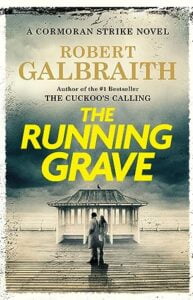
What does a mentally ill man claiming to have witnessed a murder twenty years before have to do with a couple of Members of Parliament and blackmail?
What I Liked
It’s a different world than the previous stories and almost reads a bit like a Victorian novel by Anne Perry. The MP, his family, the dysfunctional relationships between them, etc., are all entertaining. I liked seeing Robin go undercover and some sort of resolution of the relationship with Matthew.
What I Didn’t Like
The story starts one year after the wedding scene of the previous book, and it skips over a lot of the growing business—stuff that would have been fun to see, although it notes that Robin and Strike are not talking much about anything other than work. And there was the obligatory scene with Charlotte that has no more relevance than the crap with Matthew. The extra length to the book (almost 40% longer than the previous ones) added a lot of slippage.
An old enemy of Cormoran’s wants revenge, and the opening salvo is a severed leg delivered to the office. Cormoran can narrow it to 4 likely candidates, but which one would it be?
What I Liked
Digging back into the past to see where all four are now and what they are doing is awesome. Almost like a cold case with all the immediacy of a recent dismemberment. And there is some fantastic dark humour from Cormoran that is completely appropriate for his past and equally disdained by Robin because of her past. You also get to see the agency struggle to cover all the cases as it grows its business. But the best part is that Robin and Cormoran are beginning to share their backstories.
What I Didn’t Like
The whole relationship with Matthew seems ridiculously stupid. It’s childish and petty, all of it, and while it serves as a plot device to keep Robin and Cormoran from having other thoughts, it really diminishes Robin as a full character.
Leonora Quinn wants Cormoran to find Owen, her writer husband. He’s missing, but she’s pretty sure it is just simple neglect, nothing foul. He goes off regularly but usually returns in short order, if only to be with their special needs daughter. This time? 10 days without a word, and she doesn’t want to involve the police again, as they made too big a fuss the previous time when it turned out he was just with a friend. The difference is that this time, he’s written a thinly-veiled fictionalized biography about his publishing acquaintances that has ticked off most of them, and maybe one of them was ticked off enough to do something to prevent it from being published.
What I Liked
The tell-all premise is awesome, at first at least, and the darkness of the story as it progresses is quite solid. The agent is deliciously salacious. As I read it, I kept picturing a rougher version of Harriet Sansom Harris who played the agent on Frasier. Once the story widens out into a full suspect list, it flies along at a good pace with lots of leads to follow. Plus Robin gets a bit more to do in this one.
What I Didn’t Like
The initial darkness of the story doesn’t stand up to the overall explanation at the end, almost a little banal. And there is way too much time at the start of the book trying to find a) a copy of the manuscript and b) interpreting who it is even referencing (aka the list of suspects). But what I particularly don’t enjoy is the immature romantic stylings among the main characters. Not childish, exactly, although there are aspects of that too, so much as simply no emotional or intellectual capacity to deal with the basic aspects of a relationship. With a bit of comedy, it could rise almost to farce.
The Bottom Line
Come for the mystery, stay for the publishing personalities
Robin Ellacott has always wanted to be a private detective, and temping for one for a week seems like a possible dream come true before she goes off to be properly married to her new fiancé. She didn’t count on Cormoran Strike being both good and highly in need of office help for his new case — a brother of a celebrity who committed suicide wants Cormoran to find out if it really was suicide.
What I Liked
The case is deliciously messy, with therapy, adoptions, birth mothers, sordid histories, difficult families, etc. And for the first time when Cormoran and Robin both want the same thing but are afraid to say it outright, it’s fun to see them struggle to keep Robin past the first week (even if their reluctance to speak candidly is way overused as a plot device later). And I love the solution to the issue of the witness who couldn’t have witnessed what she claimed to have seen and heard, yet smacks of some semblance of truth.
What I Didn’t Like
There is a lot of confusion about what happened the night Lula died, and major players are relatively ignored for long periods of time with very little explanation of why. Some of it lacks a way to coerce cooperation if the person isn’t interested in cooperating with a private detective; some is just a red herring left to rot too long in the story.
Ah, January. When a young reader’s heart turns to updating all of his lists of various books to read, collect, etc. Okay, so I’m not exactly young and most people’s hearts may not turn that way. But mine does in January.
This past fall, I did a deep dive into Calibre, the ebook library manager program that I use. I’ve used the Windows version on my computer for about, umm, 10 years now, I think. I’ve often had multiple “libraries” of ebooks on my computer … ones that were waiting to be looked at, others that were actually part of collections / series that I’m working on, some from the library that I hadn’t sorted out yet when I would get to them. Tons of books I got way back in the heyday of Kindle ownership where people gave away dozens of ebooks free each day in the yearly teens of the new millennium. Plus books I had read, were reviewing, etc.
I found it hard to effectively manage my ebooks in multiple libraries, and I looked online for the forums, asked questions, explained how I “saw” my library and asked for tips on how to do it better. Which a bunch of fellow bibliophiles responded to with lots of suggestions. In the end, all of them basically said, “Put them all in one library and let the computer give you filtered views when you want to see different “sets” of books”. It is, after all, mostly a giant database with links to the book files.
I am now quite happy with the majority of my setup in the library. I’m down to 10 main workflow categories, all mutually exclusive ones that books “move” through from acquisition to having been read and reviewed:
TBR: Fiction
TBR: Series
TBR: Non-fiction
ACTIVE
REVIEWING: Backlog
REVIEWING: Current
FINAL: Fiction
FINAL: Non-Fiction
FINAL: Reference
FINAL: Did not finish
Admittedly, the TBRs categories are nominally huge but I won’t be reading all of them. Some of them came from a huge data dump of free books I got at some point, and while I weeded out a bunch (from 20K down to 10K), there’s probably another 5K to get rid of at some point. It’ll still lead me with about 20 years’ worth of reading. 🙂
But as I was playing with the recent additions, I realized that there are some other features I can add to the library manager that will actually give me some stats. Every January, I set goals, but somewhere as the year goes on, I kind of lose track. Dead tree versions are particularly problematic to keep track of, but even the ebooks get backlogged. But I went through basically everything I have from #5 to #10 above.
It brings my total up to about 475 books that are in the “read” stage or beyond, even though my actual reviewed list is a little less than half of that (225 or so). For the 475, I’ve added the years in which I’ve read them…goes back all the way to 1978, but there are lots in the last 7-8 years…and that gives me a bit of data to play with and share. The reviews could be new or old, but there’s a reason the backlog grew. 🙂
20 books read, 16 reviews
22 books read, 5 reviews
58 books read, 53 reviews
78 books read, 17 reviews
32 books read, 9 reviews
57 books read, 19 reviews
63 books read, 18 reviews
1 book read (so far), 0 reviews
So that means 137 recent books reviewed, plus another 88 old ones added to the website. That still leaves 47 to review from the last year or so, and another 187 in backlog.
Of course, I also have 332 ones to read “soon” in my “active” folder. Which I used to have all synched to my Kindle, which was looney toons to manage. So, I cut that back to about 20 for now. I probably should add a new category around 4B to the top set which is “Books to read this year”, and only pull 10-20 of those forward to the Kindle.
What I don’t know what to do is how to prioritize my TBR list. 🙂 Do I read the first / next one in each series? Or binge my way through like a rabid reader hooked on Netflix more than phonics? Do I set myself a rigid balance of Fiction to Non-fiction?
A lovely first-world problem to have, I know. What really warms my cockles is that I’ve managed to write about 20 new reviews each year over the last seven years (while still putting everything else up, and blogging almost 2M words), and averaging about 47 books a year. My goal is always 52, which I managed to surpass 4 times. And that’s just on the stats I *know* that I have so far. Other books will turn up and add to those titles, again mostly dead tree versions.
But for the first time in a really long time, I kind of feel like my library is mostly where I want it to be and I know what’s happening with it. Now I can start prioritizing dumping the dead tree versions of some old stuff while reading the 332 books I have in my active list hehehe