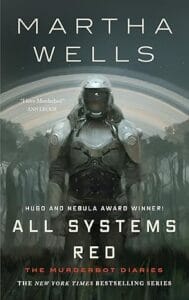
A security android has secretly hacked its governance module and is now autonomous. It continues to follow orders as if it is still being controlled by humans, while spending a lot of time bingeing serial entertainment (like episodes of TV space shows).
What I Liked
I had streamed the first season online, and so I had more of a sense of the characters than if I were starting to read cold. The story is much more streamlined here, which makes it fly along, and not too long. You still see the important interactions with the leader, the other SecUnits, and the ending.
What I Didn’t Like
Obviously, a multi-episode season can go far more into the various characters beyond the leader and the Murderbot itself, and so it did feel like it was a bit short in places. But other places where the show adds padding, the novella/short novel flies along better. There is very little about his previous experiences or his memory issues that are raised in the book, so you don’t get a sense of what he did before.
I find this post fascinating in multiple ways. It seems simple…what will my learning focus on in the coming year or two?
Except for just about every one of my A-Z headings, they involve learning in some way.
Except that I recently went through a huge analysis and research project to look at very specific types of formal educational learning that I might undertake, representing hours of work on my part to figure out just what was out there in the fields that interested me.
Except even when I look at the long list, which ones will I do simultaneously, and which ones will I do sequentially? Or as fallbacks if the others don’t happen?
Except that what I thought was my likely priority is not the list when I have to rank very different things against each other.
Let’s go…
Rebuilding / summarizing my list
Just to help keep things straight and not confuse formal education with simpler task-oriented learning, I’ll divide the list into three parts:
Formal certifications
Masters of Fine Arts / Creative Writing: Dalhousie/King’s College, UBC, Algonquin, Athabasca (BA Communications studies or BA English, or MA as Interdisciplinary Studies — build your own MFA degree … Writing the self; creative non-fiction; digital storytelling; narrative possibilities; and what I tell you may not be true (autobiography in a different lens)
Education: Athabasca (M.Ed in Distance Education)
Law: Redo old program, update old program (criminal, constitutional, contract, torts, property, ethics, dispute resolution, access to justice), Athabasca (Interdisciplinary … $$$), Carleton MA (Legal Studies … zzz), Coursera, Royal Roads MA (Justice Studies …. $$$$)
Utilitarian skills
Astronomy: Algonquin (2 courses), The Great Courses + Coursera, YouTube, books
GIMP Processing: Online downloaded course
3D Printing: YouTube, local experts
AI Software Development: Algonquin, online programming training (app development)
Photography: SPAO (formal and rec), Great Courses, YouTube
General interest
Baking, cooking, pastry arts: Algonquin
Mythology, sci-fi, world religions, world literature: Algonquin
Kayaking: Clubs
Psychology: Athabasca (BA), Algonquin (1)
Prioritization
For the training and learning options, I can apply the PACE approach to prioritizing:
PRIORITY
ALTERNATE
CONTINGENCY
EMERGENCY
OVERALL
GIMP (course)
Astronomy (TGC)
MFA (Dalhousie)
Psychology (TGC)
1. Formal
MFA
BA English
M.Ed (Distance Education)
Law (text redo)
2A. Utilitarian – Astronomy
The Great Courses
Coursera
YouTube
Algonquin + books
2B. Utilitarian – Apps, software
GIMP (course)
3D printing (local)
Programming (iOS/Web)
Programming (PC)
2C. Utilitarian -Photography
The Great Courses
YouTube
Henry’s +
SPAO
3A. General
Cooking (online)
Cooking (recipes)
Baking (recipes)
Pastry (local course)
3B. Psychology
The Great Courses
Athabasca (BA)
Algonquin course
Textbook
3C. Mythology, history
The Great Courses – Mythology
Algonquin course – Mythology
Algonquin course – World literature
Various – World religions
As I said, I did not expect my priority to be GIMP over Astronomy (TGC), the MFA itself at Dalhousie, or psychology. If I leave work with a large education allowance, the MFA would jump up the list as a formal commitment. But perhaps my thoughts on the priority is more driven by what I can do this year. I could, in theory, start on the MFA, but there is already a lot going on in the next year in our household with multiple health issues, changes in lifestyles, etc. An MFA on top of that seems like a lot. I also didn’t consider whether something that was an “alternate” for formal (like the BA English or M.Ed.) might go above the psychology too. The rows do rankings by column, but the columns don’t necessarily rank evenly from row to row.
If I look at my “learning” list from previous years, there are a number of little things on there that didn’t make the above list. Chair yoga, origami, etc. Nothing “big” enough to make the overall list. But something to consider on my future tracker if learning is limited to these headings, or will also reflect my NF reading, other hobbies, etc.
I was having trouble deciding what to write for “K”. Kayak is an obvious one, although I’ll come back to that in a moment. I considered going whimsical with kicking back or being kooky. Some sort of cute title that suggests that I shouldn’t take myself so seriously and instead try to find some silly things to do where I don’t have a stick up my butt. I’m not sure you can be spontaneously kooky if you’re “planning” it in advance.
Anyway, back to kayaks.
The short version of a long story is that I like being around water. I grew up in Peterborough but spent most weekends at Chemong Lake. I like calm bays, bullrushes (although we called them bowrushes), croaking frogs at night, campfires, no mosquitoes, the sound of nothing at times but perhaps some lapping waves maybe. Or being on a calm lake first thing in the morning, early in the evening. Maybe lying on a dock and staring up at the sky.
While Andrea’s family have a shared cottage, we don’t get up there often enough for me to declench and really just relax. I don’t quite relax as much just being near water if there are parking lots, boats, beaches, and people around. Walking around the parks or being next to the parkway doesn’t really do it for me. Sitting up at our friend’s place near Manotick is pretty good most of the time.
If I was sitting by a quiet lake, even camping in a trailer and sleeping nearby, that would likely do it. But visiting a busy lake or river isn’t enough. I need to be out on the water if it isn’t already quiet on shore.
The problem? I don’t really know how I want to get out there. It’s definitely not a canoe, as I’ve never really enjoyed canoeing. I have enjoyed kayaking however, so that is my go to option. Stand-up paddeboating could be fun if I could actually stand-up for long periods — or at all, really — but I can’t, so kayaking is probably the next best thing. My brother always loved those small sailboats, and I get the attraction. I might be okay with some sort of rowing scull if I knew more about it. I don’t know how good that would be on a lake or river with any waves though.
Anyway, I digress. It’s likely a kayak. That I have figured out. I think.
The next challenge is I have no idea which kind to get. Or rather, which variables I should weight to choose. Basically, I know from previous kayaking that my core is not very strong nor are my leg muscles good for sitting flat for long periods of time. It will get better, yes, but to start, I’m not doing flat options. I’m going to need some back support, and likely a bit more sitting “down in” than the simple ride-on-top versions.
Yet I’m also considering doing a long-haul travel option in a camper of some sort. Which might not have much room. Which argues heavily for one of the ones that come apart or even inflate. Do I get that immediately? Start with a basic one and then transition to a second one designed for travelling if my first doesn’t work well with my travel plans? I’ve got some good feedback from the kayaking groups. And from Trailhead at Fairlawn from their paddle shack about 18 months ago.
Except, whatever I did with the information Trailhead gave me, it’s gone from my memory and my tracking system. I am positive I wrote about it somewhere — my blog, Reddit, maybe in my OneNote or email. Gone. Can’t find it anywhere. And I was reasonably certain the brand was Pungo with a specific number of design like 120 or 150, but Trailhead doesn’t seem to carry those. Or at least they don’t now. I am pretty sure it was a recreational kayak with a wide base so that I wouldn’t flip given my weight (the wide base also ups the weight limit). I’m sure I had one that was rated to 350 or 375 lbs. Can’t find it now. Which isn’t a big deal, I’m not buying today. I’ll figure it out later this year.
I suspect I’ll buy one for the summer and try to go here in Ottawa at least once a week to get “going” so to speak. Fingers crossed anyway. I’m encouraged that my back is not screaming at me like it was last year, and that I’ll be in better shape too by summer.
So I guess K is indeed for kayak. Just no idea which one.
A college student drives off suddenly into the night, never to be seen again, while her car is found abandoned at the side of the road. Did she meet someone? Walk off into the woods? Commit suicide?
What I Liked
The main part is Jason Wade, a reporter who starts to link her disappearance to a broader storyline and a psycho who preys on women. The story jumps around a bit, with him as a newbie reporter trying to win a coveted full reporter job, and it backfires on him. Then he pursues it further, at potential further cost to him.
What I Didn’t Like
There are a couple of “complications” as plot devices that don’t work for me. The boyfriend has some info that he holds back that would help improve the search, or at least inform the search, and while the reasons are explained, they’re not very believable. And the ending is a bit stretched with poor cell service and heroic efforts by individuals. Didn’t really work for me.