There’s a serial killer afoot in New York, striking down pedestrians on the street. Edward X. Delaney is asked to quietly hunt them down.
What I Liked
Once the main investigation gets going, it’s interesting to see Delaney not only figure out whodunnit but also HOW to figure out whodunnit. Much of the methodology is old hat to anyone watching police procedurals or FBI movies, but when Sanders was writing it, it was all relatively new to the police world. I love how Sanders has Delaney involve both beat cops and civilians, finding ways to motivate them to help, and giving them both tasks and purpose. The reader knows whodunnit from the beginning, of course, and you see both sides of the crime — the perpetrator and his messed-up reasonings, as well as Delaney’s methodical approach.
What I Didn’t Like
The book moves a bit slowly at the beginning, and is complicated by Delaney’s personal life (his wife is dying of cancer). I found some of the perpetrator’s life presented as a bit over-the-top, which was part of the zeitgeist at the time (i.e., every serial killer has to be odd, almost perverse, in other areas of their life), but was far more impactful when they were focused on the mundane elements of his life. I know some readers loved the backstabbing politics of the police force, but it adds little to the meat of the case.
The Bottom Line
Watch out for harmless-looking pedestrians in New York
Harper’s future in a dystopian society is all mapped out. She’s an ace developer, and she’s expecting to get picked high for a great job in the annual Bid Day selection of who gets what jobs for life. Wealth, perks, clean living. Except she doesn’t get picked for the best job; she gets picked by no one, except for the last-chance job.
What I Liked
There are lots of other series that have a similar premise — selection to a specific group of young people. Except rather than ending up in the right house via a sorting hat or in the right faction by choice or volunteering to be tribute, this one has the opposite spin. The choice goes wrong instead of right. And Harper has to deal with her new life that is very different than she expected. There are signs that things in society are not all on the up-and-up, with hints of corruption at multiple levels. Until it becomes clear that even Harper’s bid day experience was rigged.
What I Didn’t Like
Unfortunately, her romance with Eli is rather predictable and some of the antagonists seem one-dimensional. The ending raises the stakes, but a bit too much of a gap for me from earlier, just jumps up too abruptly. I’ll still read more in the series, though.
Women are hired to work on code-breaking cyphers, amid a flurry of men with giant egos, poor mannerisms, and potential nefarious intentions.
What I Liked
Previous stories have trodden the same ground, although often in WWII. This one picks up after the war, focusing on the beginnings of the Cold War. Cat Killeen moves hundreds of miles to work in Arlington Hall, home of the Army Security Agency. The story follows generally a combination of her getting to work with someone brilliant but difficult at work, showing her aptitude for the work, and building a social life with some other girls who work in the same unit, with the requisite dating of someone from security intelligence (aka maybe a spy!).
What I Didn’t Like
The story was decent but a little short on action; it was the “cozy” equivalent of a spy thriller. There’s also a scene where things happen to her rather than because of her, and it feels like a lost chance for more agency in the protagonist. So the ending felt more flat than determinative.
Edward has left, leaving Bella to pine for him and find new ways to fill the hours. She takes new risks to feel alive, including getting closer to Jacob.
What I Liked
While it is obvious to the reader from the beginning that Jacob is a werewolf, the slow “build” that all the young guys that he hangs out with are a pack is fun. While it is commonplace for so many books now, it was great to re-read the twist that Meyer put on the franchise back in ’06. It’s fun to see the family worry about the connections, and even her dad and mom chiming in.
What I Didn’t Like
The trip to Italy is a bit over the top in places, while fascinating. The Discovery of Witches series does something similar, and is better handled than the excess shown here.
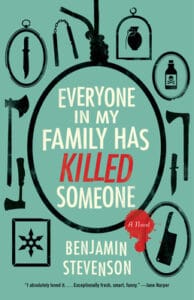
I feel like I don’t prioritize reading as much as I should. Reading gives me great joy, and yet I default to TV watching, doom scrolling, and silly things like work, eating, chores, etc. My wife gave me the book, BR00283 Everyone in my family has killed someone by Benjamin Stevenson, for Christmas and I went deep down the enjoyment rabbit hole. It was unique, it was unusual, it was delightful.
I have also been reading Elizabeth Wheatley’s Tears of the Wolf and Oath of the Wolf. They have also been excellent. I haven’t reviewed them yet, and therein lies a source of consternation for me.
Book reviews. I could have said B was for the book reviews as they go hand in hand, do they not? If you’re anal-retentive like me, yes, they do. I read it, I review it.
Except I am way behind on book reviews. I’ve done 283, which is amazing to me. I remember when I was back at 25 and 50. Now, how many are in the backlog, let’s see…there are 27 books on my Kindle in the “READ” collection, but I won’t review all of those, probably 22 or so (others were DNF’s or just reference materials I was looking at). Then I have another 31 that are relatively “recent reads” in the last year or so. Still fresh in my mind. Then another 63 from the previous year or two, and then another 186 that are sitting there. Taunting me from years gone by. So, that makes, lemme see, carry the one, and ummm…302 pending review. More than I have accomplished in the last ten years combined.
But I digress. I’ll make progress on that “backlog” this year, but it is a digression. The real question is…
What will I read this year?
I fear that I do not read enough non-fiction. I have about 150 books on my Kindle that are non-fiction, although some are more for browsing than complete reading. I put them there so I would remember I had them, like a Chair Yoga book. It isn’t the type of book you “read” so much as open on the desktop perhaps and apply part of it to a routine. But I threw it on the Kindle so I can flip through and see what’s there. My biggest challenge for NF reads is that I often feel like I want to highlight as I go. Except the Kindle is designed to save those highlights in a separate file (MyClippings). Which means even if I synch the book back over to the PC, the highlights are still ONLY on the Kindle in a separate file.
I’ve been experimenting and I came up with a couple of options. If I read it on my PC, and make highlights there, they stay with the file. Alternatively, if I do it on my Kindle, I can run a plugin to Calibre that will lift “annotations” from the MyClippings file and put them in an extra field in Calibre. Either or both would work. It’s “easier” if they’re just in the file itself, if I go back later, but harder to find perhaps; alternatively, the annotation highlights in a separate file make it really easy to write a review and lift stuff out, but often out of context.
I’m leaning toward setting aside 30 minutes every day to just read non-fiction. I’m currently working my way through a Harvard Business Review collection about toxic workplaces (I know, riveting, right? I like it, though, seeing how academics and other experts approach issues that I myself face as a manager, and how they explain their views) and highlighting as I go on the Kindle. If it works, I’ll stick with that method as the Kindle is portable; if it doesn’t work for my subsequent review and blogging, I’ll likely open the file directly on my desktop. I tried to get it to an old iPad 2 that we have, but alas, not quite the tool I wanted.
But I think I can at least categorize the main areas of Non-fiction that I’ll delve into this year, and I’ll push myself to do 14 books. I should have a biography in there somewhere but maybe I’ll count that instead in the fiction category (there’s a few options below where a person could show up in rebel, for example).
PolyWogg’s Reading Challenge for 2026: Non-Fiction
R
E
A
D
I
N
G
Writing
Astronomy
Exercise
Mental Health
Retirement
Finances
Career
Goals
Business
Women
Recipes
AI
Creativity
Software / Tools
I’ll come back to the non-fiction side of things again when I get to my L is for Learning post. 🙂
Let’s talk fiction
My goal is 50 fiction books a year, although if I was totally honest with myself, 300 would be my real goal if I thought it was attainable. 🙂 I am struggling with how to read established series, to be honest. So many different books out there by different authors, all of which interest me, and yet I also want to read series. The only series I feel “finished” on probably is Sue Grafton — all 25 of her Kinsey Milhone alphabet series (A is for Alibi, …) plus two of her older books that nobody ever mentions, both of which were quite good and I’m glad I chased them down.
But I would love to read all the Nancy Drew and Hardy Boys books, plus a full-on deep dive into a year of Sherlock Holmes and all the new books — they may not be canon, but they are often fun. Or I could go “legal” (Grisham, Berhnardt, O’Shaugnessy, Gardner), sagas (Archer), fantasy (P.C. Cast, Jordan, Wheatley), action (Child, DeMille, MacDonald), forensics (Cornwell, Reichs), light (Evanovich), British sleuth (Francis), procedurals (Jennings, ), westerns (Butcher, L’Amour), etc. And I’m not even talking hundreds of sci-fi books in the Star Wars and Star Trek universe, cozies, other types of detectives and sleuths, etc. It’s a lot.
Huh, I just realized that my latest review isn’t even complete — I forgot to code it properly in the HTML file, so that it will show up in the indexed pages. Sigh.
But where was I? Oh, yeah, deciding what to read this year between established series and new authors or standalone books. Obviously, duh, the answer is both! 🙂
PolyWogg’s Reading Challenge for 2026: Fiction
R
E
A
D
I
N
G
Banned book
Childhood favourite
New release (2026)
Best of 2025
Infrequent genre
Canadian author
Canadian setting
Award winner: 1950s
Award winner: 1960s
Award winner: 1970s
Award winner: 1980s
Award winner: 1990s
Award winner: 2000s
Award winner: 2010s
Classic
Bestseller list
Legal
Police
Amateur sleuth
P.I.
Vampires
Fantasy creatures
Romance
Science fiction
Star Wars
Star Trek
Time travel
Fantasy adventure
Personal discovery
Rebel
Serialized novel
Western
Edith Wharton
Writing under an alias
Brothers
Sisters
Spring
Summer
Fall
Winter
Humour
History
Women
Mystery
Geography
Indigenous
Series
Gift / Loan / Recommended
Holiday themed
Some resources that I’ll draw upon from earlier Reading Challenges: