As I get closer to my actual retirement date, which is now within the next 20 months and likely within the next 12, I’m starting to figure out what I’ll do in my so-called “third act” after I retire. Writing is a clear goal, no problems there. Kayaking, hopefully. Astronomy, definitely. Travel is an easy yes, but I’m still figuring out what form that will take — RV? series of trips? Hard to say.
For my “personal” websites of ThePolyBlog.ca and PolyWogg.ca, I have a decent handle (I think) on the two sites, how I will use them, etc. But I was thinking about new posts for 2026, thinking of including a bit more personal journaling, and so I picked up some resources from the library and elsewhere for some “extra” things to go back and revisit from my long ago planning days for the blog.
Scott Green has a book in The Blokehead Series, “397 Journal Writing Prompts and Ideas” (2015), and I’m adapting it a bit from the original premise. It is about keeping a personal journal or diary, and that is pretty much what my ThePolyBlog site is — my online journal. While the prompts might prove useful, it was more Chapters 1-3 that interested me, as it deals with the basis of journaling in general, elements of a good journal, and the benefits of journaling.
I wanted to see if it captured my “zeitgeist”, so to speak.
In chapter 2, Green says:
First and foremost, you have to ask yourself as to why exactly you are writing the journal, or the certain topic that you’re trying to write about.
For my sites, I think that breaks into two parts. First and foremost is why I write / journal at all; the second is why THESE topics.
Green suggests some reasons / benefits of journaling:
It clears your mind;
It helps you understand yourself better;
It helps you remember what you’ve gone through;
You get to remind yourself about the good things in life; and,
You get to improve (/practice) your writing skills.
The fifth reason is fundamentally why I write anything. Because I can and because I want to get better. So writing is practice, in any form.
The third reason — remembering — is there in part for certain things, like travel or my photo gallery. The fourth is for experiences I want to capture when the moment is fresh, so I can revisit them later. And mostly positive, so sure, remember the good things.
For me, the real reason is a bit of 1 and 2, together. Yep, it helps me declutter my brain AND understand myself better, but that’s not really “it”.
Overall, writing about my life or ideas helps me understand the world. By working through descriptions, by choosing how to frame the explanation, by simply journaling at all and figuring it out in my brain so I can put it down on the page, I process my world. By figuring out how to explain myself to “others”, I sometimes surprise myself with what I actually think, not just what I was more unconsciously manifesting.
Oftentimes, it is that “something” bothers me — an opinion I heard that doesn’t seem quite right, but I can’t quite figure out why. Or a story that doesn’t sit well with me. OR THERE’S SOMEONE SAYING SOMETHING WRONG ON THE INTERNET and I can’t let it go mentally. I don’t care about the “issue”, I only care about why it is triggering something in my brain.
If I take speed cameras as an example, they bothered me. I wasn’t quite sure why. Safety? Good. Photo radar? Fine. Other uses? Fine. So why was it niggling at my brain? It took a bit for me to figure out before I eventually wrote about it in full. But writing about it helped crystallize my views. It helped me dig deeper into my thoughts around rights, minimalist government, efficacy in approaches, and limited use of heavy hammers where other tools work better. Writing helped me structure my thoughts more clearly.
In short, I do it primarily to help myself better understand the world. Secondarily, I write about stuff I already understand to help others have a possible framework to aid in their own understanding.
The question is…what parts of the world do I want to understand?
I confess, I committed cultural appropriation; I stole a Christmas tradition from Iceland.
Most avid readers have probably heard of Iceland’s Christmas Eve tradition, Jólabókaflóð. Well, okay, they probably don’t know it’s called that. Nor even that it translates as “Christmas Book Flood”. But the idea is that people exchange books on Christmas Eve, and then spend the night curled up reading. Often combined with a hot beverage (like hot chocolate). Apparently, it is tied to WWII when lots of things were rationed or unavailable but paper was easily found, so books were a go-to choice. Equally interesting, the publishing industry in Iceland even gears up for it with new releases every year.
So did I write and release a book in Iceland? No.
Did I go to Iceland and get adopted by a book-giving family? Also, no.
Did I gift or read books by Icelandic authors? Wait, wait…oh. Also, no.
Okay, fine. All I did was buy a bunch of books for my usual shopping targets, give the books to them all wrapped up, and say they were from “Book Santa”. It’s a start. More like lazy cultural inspiration, I suppose.
The books I chose
I was inspired, in part, by the idea that the books themselves should be ones I, as the giver, should choose, not ones they asked for or were on their reading list. It should be “new” to them, perhaps.
Which means I failed entirely for Andrea. She had the book The Testingby Joelle Charbonneau on her “to be read” list on GoodReads, so I went for it. The book is set in the Great Lakes region, as a dystopian future, and is reminiscent of the series Divergent. The main character, Cia, is about to be tested for a Commonwealth graduate program of future leaders. The first of a trilogy, I went for it simply as one I knew she would like.
For Jacob, it’s a bit harder. If Jacob wants a book, we normally just get it. He often asks for certain books as gifts, which often as not are also part of series that he’s already reading. I didn’t want to do that though. I wanted the “surprise”. But he doesn’t have a large ongoing list like Andrea, so I went searching for something a bit more fantasy-like that had good buzz. Legendbornby Tracy Deonn is the first of a trilogy called The Legendborn Cycle, with books 1 and 2 out with good buzz / reviews and book 3 coming out in March. Add in the fact that it has ties to the King Arthur legend, and it was an easy “yes” from me.
After that, things got tough fast. I don’t have much experience buying books for other people, not even the remaining five on my short buying list.
I have some insights into my brother-in-law Dean from his TV and movie watching, and The Compound by Aisling Rawle seemed like it might interest him. It was another favourite of the year on some lists for contemporary / pop culture, and was even a Good Morning America book club pick, too. It’s a story about a young woman, Lily, who lives in a dystopian future (natch) and goes on a reality show for fame and fortune. The premise is a blend of Big Brother (living in a compound) and the typical Survivor twist (doing tasks to earn rewards for your team or yourself). Plus, of course, people get voted off the island out of the compound to whittle it down to the finalists. I snagged an ebook version for myself too and actually read it while I was in Peterborough. I don’t know if he has started it yet, but it’s quite good. It’s the first book by the 27-year-old author, and I’ll read more from her. Dean would probably have preferred it on his Kobo, but it’s not clear how easy that would be to gift to him electronically, nor how to wrap it on Christmas Eve. 🙂 Paper it was!
For my sister-in-law, Becky, it was a bit easier. She, Andrea and their mother frequently share and trade the same books, often with a historical bent plus some romance and/or mystery. Kate Quinn and other authors figure prominently in the swaps, as does WWII, women in non-traditional roles, etc. I chose Great Big Beautiful Life by Emily Henry as it has all three in spades, although perhaps with a bit more romance than they would typically choose. The main characters are two authors vying to write a biography of a former-tabloid-star-turned-recluse, now in her 80s. The mystery is what happened back in the day, plus the romance between two very different authors. It was on many year-end lists, which seemed promising.
For my niece, Grace, she’s into fantasy, and I know some of the other books she is reading. I wanted something a bit different, and I fear I might have gone TOO different. I chose Bury Our Bones In The Midnight Soil by V.E. Schwab, who also wrote The Invisible Life of Addie Larue which was excellent. So why do I think it was too different? Well…it advertises itself as being about immortality and hunger and involves a woman in Spain in 1532, another in London in 1827, and another in Boston in 2019. Part character drama, part feminist critique, part horror thriller? I’m not completely crazy, as Schwab is a great writer, and the book did make a lot of year-end lists too! But a feminist horror drama? We’ll see how she likes it. It’ll definitely be different. Heck, even the publisher calls it genre-defying. Hah!
For my mother-in-law, Marney, I mentioned above that I know some of her reading tastes from the books she shares with her daughters. Historical, mystery, romance. I had three reasons for choosing My Friends by Fredrik Backman. First and foremost, it has this intriguing-sounding storyline about a famous painting that has three little figures in the corner of it that nobody ever notices. But the main character, Louisa, wants to find out the backstory of those three figures so she drives across the country to try and figure it out. History, art, mystery, it sounds cool. Second, you’ll notice a theme: it made several end-of-year lists for 2025. But thirdly? I tripped over Fredrik Backman as an author about 18 months ago when a video of him giving a speech at a writing convention went semi-viral. I’ve been intrigued by him ever since, and have other books of his on my reading list, just haven’t made it to them yet.
Of course, if you want to see the original video that sparked my interest, here it is. Not super polished, but still engaging and funny. “Being a writer is the best way to get paid for being insane.” Yep, I hear ya.
The “last” on my list was my father-in-law, Ron, and his was perhaps the easiest of all. He reads a lot of crime novels, as do I, as well as legal thrillers/procedurals. That made choosing The Perfect Marriage by Jeneva Rose relatively easy, I just looked for one that I might enjoy myself! I don’t remember the author, but this is a re-release and re-edit of a book about a female trial attorney defending her husband on the charge of murdering his mistress. It got some surprising buzz, despite being a re-issue, and showed up well in a recent list I was looking at of legal thrillers on Amazon, seeing if there were other writers whose names weren’t Grisham, Turow or Bernhardt that I should consider. I do worry that the premise sounds a bit like Presumed Innocent, by Scott Turow, played by Harrison Ford in the movie. Except in that one, he was the main character, a prosecutor now on trial and his wife was supportive, not defending him. I’ll see if I can snag a copy from the library to read too. Apparently, a sequel is coming out called The Perfect Divorce.
Now, here’s an interesting quirk. I said Ron’s was the last book, but that isn’t exactly true. I didn’t know who else might be there for dinner on Christmas Eve or over the holidays, when we might be opening the presents from Book Santa (Becky, Dean, and Grace didn’t arrive until Boxing Day). I needed one more book as the “extra” in case someone else arrived, so I could include them. Which in and of itself is a challenge. How do you pick a book for no one and everyone? Well, it wasn’t exactly no one, I did have SOMEONE who was a likely candidate, so I went with something I thought might appeal to them.
I’ll confess that I really like Jeffrey Archer’s writing style. I’ve read probably 20 of his books over the years, and always enjoy the fast pace and the breezy narrative. They are highly accessible, certainly never flag with pacing issues, and well, they’re not exactly heavy trodding. They’re relatively light and fun. I hadn’t realized that he had a series of detective novels for a character named William Warwick, but hey, why not get the first one? Nothing Ventured by Jeffrey Archer seemed like a good compromise. As it turned out, we didn’t need an extra gift for a surprise guest. But I figure that books should NOT return to sender, ever, and Book Santa only exists one day a year anyway in this realm (hey, it’s my cultural appropriation slash inspiration, I can make up new rules on the fly!). So I gifted that one to Ron, too, as I know he has read other Jeffrey Archer books.
Wait, there’s one more book
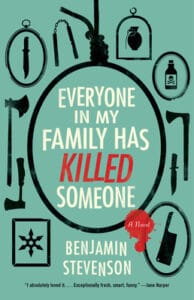
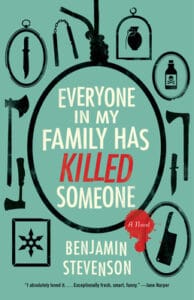
Andrea got me a book, too, so I could be part of the book flood. Except, like Jacob, I don’t really have much of a “book acquisition” list. If I want a book, I usually just get it. But we had both seen a book advertised on Facebook videos: Everyone In My Family Has Killed Someone by Benjamin Stevenson. Funny enough, I had thought it sounded like a great idea for a book, and I wanted it, but never actually ordered it. The book is awesome. It has a wicked style in it, told by a narrator in first person past tense but who openly breaks the fourth wall every couple of pages in a fantastic way. I’ll do a full review, but I’m giving it five stars. There is a serious plot hole that the book glosses over in one spot, which the narrator kind of admits is not a great answer to the obvious question, but I didn’t even care. The rest of the pieces tie together in obvious and not so obvious ways, with callbacks, and misdirections reminiscent of a great magician. He does something with one line that he repeats in two places and while you’re looking for the trick, he does it right in front of your face, and you still miss it. It’s brilliant. In any other book, the plot point would be deadly; here it’s a minor sin. And yes, like the tradition is supposed to unfold, I read it over the holidays, staying up late to finish it. Even though I had a cold and was nursing an abscessed tooth.
I talked about the “new tradition” with Andrea, we’ll see if the books for others resonated with anyone. If not, maybe Andrea, Jacob and I can do it still, just the three of us. I like the idea of doing it almost like drawing names, though, that each person would have to get someone’s name and perhaps a suggested genre, but would have to find a book on their own aka no “lists” or suggestions. I suppose they would have to rule out authors they have everything by or something, I don’t know. Or again, maybe just the three of us.
I liked doing it, even if Icelanders might come for me.
I have been posting over the last week or so about possible study options for various topics in my retirement. Lifelong learning, and all that. One area that I would be interested in is astronomy, although I have some challenges figuring out exactly what form that study would take.
Formal Canadian degrees
I used a few index tools to look for astronomy or astrophysics programs, and I found about 15 or so options in Canada. I don’t need the degree, so I could take it from anywhere, but the prices frequently go up when you cross borders to be an international student.
None of the options in Canada are particularly great for online completion or even my situation.
Ontario Tech University (Oshawa) has four variations of Bachelor of Science degrees (AP, physics) or Bachelor of Science and Management (AP, physics). Queen’s (Kingston), Western (London), York (Toronto), St. Mary’s (Halifax), Waterloo (Waterloo), University of Calgary, and University of Alberta (Edmonton) all have Bachelor degree options. Waterloo throws in a minor, Western offers a specialization. All of them are generally four-year degree programs, standard science programs and curricula. I could probably do a series of AP / astronomy-only courses, skip the electives and other courses, as a mature student or something. But I’d have to do the application process, share my high-school transcripts and diploma and they wouldn’t care that I did an undergrad or grad degree because neither were in science.
Which is also the problem with two master’s programs — Queen’s and Waterloo (or the Ph.D. @ Queen’s). I have a friend who did an Medical degree at age 40 at one of two universities in Canada that have med degrees that don’t require a science undergrad to get in (Western and Calgary, she went to Calgary). Neither the Queen’s or Waterloo programs let you in without a science undergrad. Preferably with some solid algebra and calculus at the university level. My 99% in high school calculus was enough to bypass calculus at Trent for econometrics, but probably wouldn’t be that useful 40y after exiting high school.
So not online, four years in total, AND I’d have to figure out a way to take courses without all the extra science-y and math-y stuff.
Not much of an option.
Coursera has entered the chat
I took two courses previously through Coursera, including one on meta-literacy and one on video games from a cultural studies perspective. The meta-literacy was alright for the time; the video game one was remarkably substantive (I thought it would be a bird course, but it had some decent academic lifting going on).
Since then, Coursera seem to have altered its model a bit more, or at least the money and credentials side seems to have shifted. There are fewer full-credentialed programs than I remembered, as I thought there were more diplomas and stuff available, particularly for computer programming and such. I also thought there was a couple of science programs available, although I didn’t remember exactly how the “Coursera-hosted courses that are cross-listed with full universities” model worked. The video game course was offered by the University of Alberta for full credit if you wanted to go that route. I didn’t at the time. Now, I wanted to know what was available.
Basically, there are about 128 astronomy courses available in Coursera in English. At least, that’s what the search engine on Coursera itself says. Unfortunately, if I search for astrophysics, I get a slightly different total AND some of the courses are supposedly in English but as I scan through, some are either in another language (like Italian) but with AI generated dubbing (pass) or they’re in another language with subtitles (also pass). If I use the astronomy search results only, it tells me there are:
47 beginner classes;
36 intermediate classes;
18 advanced classes; and,
26 mixed-level classes.
With 49 different educational partners in total, of which 36 have either only 1 or 2 classes offered. For recognizable names, CALTech offers 2, Yale 5, Rice 13, and, drum roll please, the University of Colorado at Boulder has a whopping 27 classes. WTF? Here’s their list:
Course Title
Level
Comment
Pathway to Space
Beginner
Politics, comms aspects
Space is Everywhere
Beginner
Comms
The Business, Politics, Policy, & Players of Space Programs
Beginner
Politics, comms
The Sun and the Total Eclipse of August 2017
Beginner
Visual research
Our Place in the Cosmos
Beginner
Intro overview
Universal Theories
Beginner
Intro to universe
Getting There and Going Beyond
Beginner
Intro to spacecraft
The Physics of Emergence: Introduction to Condensed Matter
Beginner
Intro to materials
Modern Topics in Condensed Matter Physics
Beginner
Intro to materials
Phases of Matter: Solid, Liquid, Gas and Beyond
Beginner
States
Optical Engineering
Advanced
Stretch as it contributes to telescope optics for visual observational astronomy
First Order Optical System Design
Advanced
Visual astronomy
Design of High-Performance Optical Systems
Advanced
Visual astrronomy
Optical Efficiency and Resolution
Advanced
Visual astronomy
Spacecraft Dynamics and Control
Advanced
Design/engineering
Spacecraft Formation Relative Orbits
Advanced
Building/engineering
Advanced Spacecraft Dynamics and Control
Advanced
Building/engineering
Kinematics: Describing the Motions of Spacecraft
Advanced
Applied theory
Kinetics: Studying Spacecraft Motion
Advanced
Applied theory
Spacecraft Relative Motion Kinematics and Kinetics
Advanced
Applied theory
Spacecraft Dynamics Capstone: Mars Mission
Advanced
Applied theory
Control of Nonlinear Spacecraft Attitude Motion
Advanced
Applied theory
Spacecraft Formation Flying and Control Capstone Project
Advanced
Applied theory
Advanced Capstone Spacecraft Dynamics and Control Project
Advanced
Applied theory
Attitude Control with Momentum Exchange Devices
Advanced
Applied theory
Spacecraft Relative Motion Control
Advanced
Applied theory
Analytical Mechanics for Spacecraft Dynamics
Advanced
Applied theory
I confess that the group of courses is NOT what I was expecting…three courses on journalism, politics and the nature of the space race? Two general-interest / introductory courses on the universe are “normal”, I expected those. I did NOT expect 4 courses on optical design elements (presumably linked to telescope mirror quality) nor 14 on spacecraft design and operations.
Sooo, that’s not the right route. I went back to the original list, exported the list of courses to Excel, ran some reconfigs on the data to put it in a table, and voila — 128 entries of which 4 are fully free, 59 have a free trial, 64 have a “preview option”, and 1 is just simply “new”. The time durations and levels are a bit more granular:
Beginner: basic course of 1-4 weeks = 14 courses, moderate investment of 1-3 months = 32 courses, and serious commitment of 3-6 months = 2 courses;
Intermediate: basic course of 1-4 weeks = 15 courses, moderate investment of 1-3 months = 18 courses, and serious commitmetn of 3-6 months = 3 courses;
Advanced: basic course of 1-4 weeks = 9 courses, moderate investment of 1-3 months = 8 courses, and serious commitment of 3-6 months = 2 courses;
Mixed: basic course of 1-4 weeks = 1 course, moderate investment of 1-3 months = 23 courses, and serious commitment of 3-6 months = 1 course.
Of course, obviously, I wouldn’t be taking them all. I just wanted to do a deeper dive to know if it was a viable option. Most degrees are 10-12 courses across a spectrum, and while I’ll have to figure out which ones are basically variations of the same course, I think there are a few that are pretty good starter ones for me to consider.
So, about that cost thing
There are four “free” classes, including Astro 101: Black Holes (University of Alberta), Space Medicine (Duke University, Statistical Mechanics: Algorithms and Computations (École normale supérieure), and Imagining Other Earths (Princeton). The first and last ones could be interesting.
The rest? The new, or at least current, Coursera cost structure is very different from what I expected. As I mentioned earlier, I noticed fewer degree programs, and previously, I was only looking for free courses to audit or pseudo-audit. However, I basically have three ways to consider the classes, and none of them would seem amenable to anything to do with an educational allowance under WFA from work.
Option 1 is to pay per course — most are about $70 each. Some keep the costs down by marking things with AI, which makes me a bit leery. I was also surprised to see some courses showing up as being in English but actually in a language like Italian with AI-driven dubbing. Nope. But $70 is generally okay as a start. The ones with free trials or previews have decent “look inside” options to see what the course looks like, type of modules, etc.
Option 2 is to pay per month — somewhere around $80 or so Canadian, but as an “all you can eat” buffet of courses. Of course, the limit for yourself is more one of time and availability. I’d love to start courses immediately but I wouldn’t have the time yet.
Option 3 is actually better if I were fully retired. If you pay for the year, the price drops to about $560, or about $48 per month (instead of $70 or $ 83). That’s not bad — a year’s tuition for 3-4 classes compared to $280 doing them individually doesn’t look as good, but if I were to do 3-4 at the same time or a series of ones that are 1-4 weeks, I could crank out a few and come out ahead. Basically, if all the classes were only $70 each, I’d need to do 8 in a year to come out ahead. Although some of the classes are NOT only $70…technically they START at $70, but some go as high as $120 or $130. I think I’ll be tempted to try a couple of the ones I want for sure, and then figure out afterwards how many I might want to / can do at a time.
Soooo, I have a list of 128 courses that are nominally “astronomy or astrophysics” related, and I might pick 10-20. Or I could go a different route.
The Great Courses
I also wanted to see what I remembered from the offerings on the program, “The Great Courses”. I’ve done part of a psychology class with them, as well as some photography work. And when I run “astronomy” through their list of offerings, I get 30 courses. But they are not the “same” type of list as that of Coursera. Although maybe it isn’t quite as simple as that.
For the list of 30 courses at The Great Courses, there are ten that are pure astronomy:
Understanding the Universe: An Introduction to Astronomy, 2nd Edition
My Favourite Universe
Introduction to Astrophysics
Life in Our Universe
Black Holes Explained
The Life and Death of Stars
Dark Matter, Dark Energy: The Dark Side of the Universe
Experiencing Hubble: Exploring the Milky Way
Experiencing Hubble: Understanding the Greatest Images of the Universe
What Can the James Webb Telescope See?
Four general intro classes, some stuff on black holes and stars, a bit on dark matter, and then moving into astrophotography and imaging of the big space telescopes. Not quite enough rigour for me on the formation and structures, but it’s a start.
The interesting thing is that they have 14 “history” courses that include some bits of history “of” and “with” astronomy:
The Remarkable Science of Ancient Astronomy
Great Heroes and Discoveries of Astronomy
The Birth of the Modern Mind: The Intellectual History of the 17th and 18th Centuries
The Olmecs: Mesoamerica’s Mysterious First Civilization
The Queen of the Sciences: A History of Mathematics
The History and Achievements of the Islamic Golden Age
Secrets of the Occult
The Middle Ages around the World
Maya to Aztec: Ancient Mesoamerica Revealed
Conquest of the Americas
Greece, Rome, and the Birth of Western Philosophy
Introduction to Greek Philosophy
The Other 1492: Ferdinand, Isabella, and the Making of an Empire
The Greek World: A Study of History and Culture
And then there are six other classes that I pegged as “science”:
Radio Astronomy: Observing the Invisible Universe
The Joy of Science
Great Ideas of Classical Physics
Chaos
Einstein’s Legacy: Modern Physics All around You
Change and Motion: Calculus Made Clear, 2nd Edition
Now, what did I mean by “Coursera doesn’t have the same courses”? They do have the introductory astronomy classes. And I’m sure they have courses on ancient history, including Greece and the Roman Empire. But Coursera doesn’t consider any of those history or mythology courses to have anything to do with astronomy. But the material absolutely does, of course, as the growth of various nations around the world developed science and philosophy together, often intermingled with religion and politics as well. All were trying to answer the fundamental questions about the nature of our existence in relation to the broader universe.
Once I retire, I’ll have to narrow the options further, but at least I have a good starting point. Which, I realize, is what I’m doing right now…trying to figure out some of the options. I’m seeing which ones are viable so that if/when I have to make a decision, it will be clear what the options are to consider. I’ve even ruled a few things out as I went, which is huge. Enough to get my brain around it at least.
Athabasca University offers its full-course catalogue as online courses, and given their range of offerings for the interdisciplinary program at the MA level for law-related studies, I thought I would do a deeper dive into what they have listed.
Undergraduate courses
They have some 754 courses listed across 69 “sub-faculties”, although I confess that most hold little interest for me.
Accounting — 10 courses, not bad, and I could see some interest for one on not-for-profit accounting as well as principles of auditing, but not something I’m willing to pay for probably. I’ve done that stuff in my career, could do something online on Coursera for a refresher.
Administration — This looks a lot like my undergrad program, with 11 courses. None attract my interest, just noting they’re there.
Anthropology — There are 25 courses and a fairly robust program. Not anything I really want to spend time learning, but nice looking program.
Art History — Three courses, two by time and one on Canadian visual culture. Very interesting looking, but not compelling.
Astronomy and Astrophysics — I was super excited to see that they had a category for this, even if it ended up only being three courses. Until I saw that two of them are just project proposals, meaning only a single course, which is an intro to Astronomy. Could be worth taking, but there are lots of free versions of equivalent material online.
Communications Studies — 22 courses and like anthropology, a pretty decent selection. Mass media, communication theory, computing, information literacy, social movements, pop culture, cultural policy, etc. There’s a decent-looking one about Digital Storytelling, albeit a bit basic.
Computer Science — Not surprisingly, there are 42 courses listed for undergraduate-level work. It’s not a bad listing, but there is better out there. It covers the basics, plus a bit more, but not what I’m looking for, a little too bland.
Criminal Justice — While I had already looked at the law-related graduate courses, there are a few at the undergraduate level that look interesting, such as victims of crime, the psychology of criminal behaviour, civil liberties and individual rights, offender rehabilitation, and sex crimes.
Education — There are 8 courses listed, and I wasn’t expecting to be that interested. But there are several that might be kind of enlightening, including a history of the Canadian learning society, the purposes of adult education, training & development in organizations (all three close to my day job) and a fourth on law and ethics in education.
English — wow, I was NOT expecting 35 courses. Novels, short stories, poetry, plays, drama, Shakespeare, America, composition, links to film, and six or seven in creative writing for different forms.
Philosophy — There are 17 courses, with five or six tied to ethics, any of which would be interesting, although potentially repetitive.
Physics — There are 8 courses, and none go anywhere near the astronomy side. Very disappointing.
Psychology — I am very excited by 41 courses in Psych, more than enough to keep me busy if I wanted to spend two years blasting through some courses after retirement. They even have ones tied to the study of career development, learning, adult development, learning through life, and even one in forensic psychology. They all look awesome.
Religious Studies — There is a good one on comparative world religions, as well as one on death and dying in comparative religions. There are 3 more, but nothing compelling.
I skipped over economics, finance, governance, history, HR management, labour, sociology, and legal studies, although all of them had some interesting options.
Graduate courses
For the graduate courses, they have 335 over 85 sub-faculties. Here are the ones that interested me enough to dive deeper:
BOLT — Short for Blended and Online Learning and Teaching, at first glance it seemed cool. In brief, I thought it was the policy and issues surrounding online learning. Except of the 9 courses, 5 are directly tied to K-12 issues, 3 more are relatively K-12 in scope, and one that is a bit larger in focus. I would love to look at issues such as the complete history of Athabasca University being established, running online platforms, engaging with standard learning advocates, professional education seekers, etc. Even teachers, professors, and professionals who all assume they know how to teach in a digital world even if they don’t. They have a doctorate option in distance education, but more aggressive than I’m looking for, really.
COMP — They have 41 courses, of which about 10 look interesting. But to be honest, I can’t tell. I don’t know what I need yet.
Graduate counselling and applied psychology — There are 18 courses, and like their basic psych program, some interesting elements outside of the counselling element. Like health psychology and “the vital role that health psychology plays in helping people make lifestyle changes, cope with health-related issues, and maintain a positive identity if the face of chronic health challenges.”
Governance — They have four courses, including governance and leadership (meh), innovative public management (maybe), global governance and law (intriguing) and privacy and transparency in a networked world (cool).
Legal Studies — They have six courses that are weird — when I looked at legal issues earlier, it was all around political economy and political studies approaches to interdisciplinary issues. This “heading” is all about drafting legislation, which is highly technical.
Interdisciplinary Studies — They have 33 official INTD courses, but almost all of the courses could be included as electives. You could even build your own MFA degree (Writing the self; creative non-fiction; digital storytelling; narrative possibilities; and what I tell you may not be true (autobiography in a different lens).
MDDE — Building off what was above in BOLT or other distance education, there are 34 courses tied to a M.Ed. in Open, digital and distance education. If I were doing it for work, two-thirds of the courses would be relevant. Foundations of adult education; experiential learning; technological apps; adult education and lifelong learning; international issues; mobile learning; and AI are just some of the courses that would interest me.
So, is that “it”? Just a list of courses?
No and yes. 🙂
No, it’s not it. But “yes”, it was a good starting point to see if they have a bunch of courses that interest me, and they do. Assuming courses run about $2K each, if I did get a 17K education allowance from the government upon retirement, I could do 8 classes or so at their expense. I confess that’s kind of attractive. There are at LEAST 50 that I would consider. Prioritizing would initially seem a challenge.
Unless…
I consider an actual degree. Like the M.Ed in Open, Digital and Distance Education. It definitely ranks up there on the substantive side with a MA in Legal Studies or even an MFA. The content would be amazing to have time to dig into, and would help future books I have planned on skills in Canada and adult learning.
If I went the thesis route, it would be five core courses, two electives and a thesis (worth four courses). If I went the coursework route, it would be five core courses, five electives, and a Capstone project. (11 courses in total).
Let’s see, then. For the core curriculum courses, the first would be obvious (an intro course). The second, research methods, is one I would try to get out of actively. I’m not paying $2K to take an intro to quant and qual research methods or how to critique research. The eval is also just three assignments plus participation in discussions. Snooze. The third is about foundations of instructional design, and is a bit about basic pedagogy with addons for the ODDE components; seems okay. Then it gets interesting. I have to make two decisions. First, I can EITHER take a further course in ID tied to ODDE or a course in leading and managing ODDE. Ah, ID it is. Then, I can either take a survey course on current tech apps OR technology in ed and training. Umm…aren’t those the same course? Oh, nope, they’re different. The first is how to use the technology, the second is how to plan for implementation. Planning it probably would be.
Then I would have between 2 and 5 electives. High on my list is adult education and lifelong learning.
This course will explore different adult education theories and philosophies, including “for-credit” learning in formal education; workplace learning; informal, self-directed learning; and public pedagogy (i.e., informal learning that takes place in public spaces, popular culture, and political struggle). We will also consider the role and purpose of adult education for the individual and for society. Readings have been carefully selected from older, foundational literature, along with readings that explore more recent issues in adult learning. The readings will help us consider contemporary issues and realize that the study of adult learning has its own history.
Athabasca University course description
It’s basically me. That’s what I’m looking at with these courses. Except from a societal perspective. I would gladly sign up. There are others on mobile learning.
If I get money to study, it could be worth it. If I don’t, maybe a course or two.
However, there are others I could consider as well. I don’t NEED a degree (M.Ed or otherwise), and you can take individual courses as “non-program” students. Decisions, decisions.
For those who know my sordid history (hah!), I went off to UVic Law back in ’91. I didn’t actually want to be a lawyer in the normal sense. I didn’t want to be in court prosecuting or defending the innocent or winning liability cases. Some people dream of that, and that’s okay. Whatever floats their boat. For me? I knew I wanted to do something government-related. And, at the time, there had been a few smaller municipalities in Ontario who had hired lawyers with MPA degrees too as their combination city solicitor and city manager/administrator. At the time, it seemed perfect for me! Municipal. Government. Law. Yes! Looking back, it was a stupid thing for any city to do and if I was their lawyer, it would be the first thing I would recommend avoiding. There’s a reason why cities have in-house lawyers to advise the city manager and council on what they can do, within their scope, and what they should avoid doing in certain ways. To use the cliché, any city manager who is also the city lawyer would have a fool for a client.
But part of my challenge was that I knew little to nothing about what “government” work looked like, and I loved law. A combination degree seemed like the perfect solution. Unfortunately, I didn’t like law school. I couldn’t stop seeing the “people” in the cases and being enraged on their behalf, even if they had been dead for 70 years. They were wronged! A helpful constitutional law professor pulled me aside at 6m and let me know that part of my frustration was that nobody else could see the people anymore in the cases, just the legal principles. If I could still see them at 6m, I would continue to see them throughout my schooling and beyond. Not a good thing, not a bad thing, just a decidedly different approach and result than what the rest of the students were experiencing.
Eventually, I did a co-op with the Ministry of Education in BC and…dun dun dun…I loved it. I spent most of the summer doing case summaries of education-related cases but also some side policy projects here and there. When the summer was over, and I was going back to school, I was offered a contract for part-time work. I loved all of the work. But it made me start to question if I really needed to be a lawyer. Three people in the unit were policy analysts, while only 2 were full lawyers. And I liked the policy work just as much. As I did the fall semester, with a full course load in public admin, it was like returning home. I could breathe easier; I liked the coursework better. I got it without really trying; it all made sense to me. Even organizational behaviour as a paradigm, which some people hate in public admin.
Something left undone
In ’93, I started a public admin co-op with the federal government, loved the work, and stayed for a second term. Then some contracts. Until finally I got a permanent, indeterminate job. In international. What? Wait, there’s more.
I went from municipal to an international focus; from policy issues to administration of programs and logistics; and from legal cases to general relations. Within the first 30d of working for the feds, something weird happened…I was given a special project to coordinate a presentation on the Short- and Medium-term Outlook for the Asia Pacific Region — aka, what would happen in the Pacific countries over the next five years, politically and economically? It was kind of fun, lots of interactions with the full policy team, it was work I could do, and there was a sense of both purpose and heightend urgency. The deck went to “Cabinet” although I only had a vague sense of how Cabinet committees worked…I was pretty humbled to realize that the deck I slaved over for most of the month, with lots of late nights, had been presented to full Cabinet. All of the Cabinet Ministers. And the Secretaries of State. And…dun dun dun…the Prime Minister. And not just some random memo that might have been on his desk for 30 seconds. No, this was a full 45-minute presentation and discussion of MY deck. Well, okay, so I did all the econ slides and somebody else wrote the political slides, but it was MY deck. And we published it as a book with a cover. Colour slides throughout. For ’93, everybody was REALLY impressed with what we had, even our PCO overlords in the Foreign and Defense Policy Secretariat and the Clerk were complimentary of our work, even if all I heard was “the PM saw my work!”.
Eventually, I stayed in Ottawa working for Foreign Affairs and CIDA, and completing my MPA degree at Carleton. As I finished the degree in ’04, I wondered if there was still an itch to scratch on the law school side. I considered doing UofO law school and trying to work part-time or school part-time, etc. But I realized that I didn’t need a law degree for anything I was planning on doing in government, not even really sure I’ve “used” my MPA formally anywhere in there (sorry, my MA in Public Policy and Administration). Still, the learning is all rolled together in my brain with my real-world experience. I decided…I liked law, but not law school per se, and if I did anything, it might be more legal studies than law school. I set it aside. But the occasional itch remains.
I don’t feel like I “failed” somehow by quitting law school. It was more a byproduct of choosing a career in the public service at the time rather than waiting until later. I had found a niche that I wanted to pursue. And my mental compromise was that I promised myself I would at least finish my Master’s. That would have felt a failure to leave unfinished, although as I said, I didn’t officially need it for my career. A BA from Trent was perfectly good.
And yet, on an irregular basis, I find myself dipping a toe into the legal world. For example, I wrote a long post about speed cameras and how the law, legislation and administration interacted in ways that I found troubling. I don’t find myself often agreeing with Doug Ford, as Ontario’s premier, but politics makes strange bedfellows. So, even with my general deference to government decisions, I found the approach of municipalities to be, well, wrong. Ethically, legally, administratively. Professionally, even, just bad government. Ford revoked the authorization to do it, claiming it was all a cash grab, and I’m not sure if that is totally true for the reasons, but I agreed with the decision. Other traffic calming methods are not only more effective, but also don’t trigger the same ethical, legal, or administrative challenges.
Or on the public service front, I am troubled by some of the decisions of the PS Labour Relations and Employment Board. Decisions that seem to have gotten the basic legislation wrong. That created situations that are completely unworkable on the ground, with perverse outcomes. One that came out in the past week is completely laudable from the perspective of advocacy for persons with disabilities, and completely wrong on administrative and legal grounds.
How do I know I still have the itch? Cuz cases like this make me…umm…animated. 🙂 I’m literally frothing at times. “HOW THE F*** DID THEY GET IT SO WRONG?”. This isn’t rocket science. It’s black letter law. And while the law can change, most of these bad decisions will simply be overturned on appeal or further legal challenge, so all it really does is force the parties to negotiate different outcomes or have it drag on for months and months to get to what the original verdict should have been. There’s one tribunalist who was smacked around by their bosses after the first three months, where she regularly made decisions that were outside her authority, got overturned repeatedly, had numerous complaints filed by the employers and employee reps, and she’s still working for them. These are not lifetime appointments; they’re three-year service contracts. But well, she’s still there. Not the same one who just messed up disability law, as I digress. The point though is that I react strongly to case decisions that most people would yawn at, if they even saw them.
More broadly, I generally don’t believe in regret. Life is lived forward, not backwards, and we make the best decisions we can with the information we have in front of us. Phrases like “I wish I had known then what I know now” seem silly to me. Really? You’re going to lament an information gap? That seems like a lot of real estate to give to a minor problem to live rent-free in your head.
So I don’t regret not continuing with law school. I don’t regret trying it either. But I do feel sometimes like there is an itch to scratch a bit more, or perhaps a mental bucket that I would like to fill somehow. Without going to law school.
What can I do instead?
Well, I can do law school. I know, I just said that I wasn’t going to law school. And both are true. I could DO law school without GOING to law school. Let me explain.
Part of what pushed me off certain types of academic studies in the past is the realization that I don’t need another degree. What I’m really looking for is a professionally-curated study guide. Like the syllabus for a university or college course. Someone who knows the material, knows the environment, and knows the areas that people need to understand to “get it” has already prepared a curated guide to studying that area. Formal school learning is usually a combination of 4 things:
Formal “book” learning from reading texts, following the course outline;
Engaging with the material with other students and teachers in class (aka a collaborative learning component);
Engaging with the material through papers and essays; and,
Being tested on the material through assignments and exams.
If I have the course outline/syllabus, I can do #1 on my own. It’s basically what you do for auditing online courses or watching YouTube training videos. Some online courses with Coursera allow auditing students to post comments (#2), engage with other students, etc., but it is usually minimal. I write blog posts all the time (#3) where I, for example, have read a section of a psych text or watched a lecture, and I’m engaging with the material. Or even a chapter of a non-fiction book that I’m “working” my way through. But I don’t do the last one at all…I have no need for accreditation beyond my own learning desire.
So if #1 and #3 are open to me to DO law school studying without GOING to law school, I could in theory scratch some of that itch. The trick is getting law school course outlines. Like most graduate disciplines, the course outlines are not often posted online. If you’re enrolled in the course formally as a student, you can easily see the full syllabus through an online portal; if you’re outside as a random internet user, you can’t get to it.
But if I COULD get them, what would that look like?
Law schools in Canada generally have the same base curriculum for common law, and it hasn’t changed since I went to law school 30+ years ago.
Criminal law is the same across the country (unlike the US, where it varies by state), and so it is easy to study the various acts in the same way. An individual professor might add a small slant to it, focusing on specific areas (sexual assault) or specific types of issues (mandatory minimums), but most of the material will be the same. And they’ll likely opt for one of two main textbooks to use, plus course packs.
Constitutional law is relatively similar in that it is the Constitution across all of Canada. However, provincial cases may figure more prominently in the “variable” portion, or they may link it to public law in general, spend extra time on the Charter, etc. I find it interesting that way back when I was a student, the Charter wasn’t that old (less than 10 years) and they were debating whether it would be a sword or a shield, and how s.1 would work to prevent “technical” violations of procedure from tanking cases as it does in the U.S. Many cases in recent years have moved that needle in ways that nobody predicted back in ’91. Lawyers were still in the honeymoon phase.
There’s a set of interrelated courses that are offered in different ways by each law school in Canada. Primarily focused on legal research and writing, they often intersect with procedure, advocacy, the foundations of law, policy, and the interpretation of legislation. Some even raise it up and call it “administrative and regulatory law”, although that is usually a second-year course in more fulsome coverage. There might be two courses, five mini-courses, etc. Nothing too terribly different in any of them overall, as they trod the same general grounds.
Contract law was deadly for me. I could not stay awake for it. It bored me to tears. But it’s relatively the same across the country. If they have a joint program with an MBA, they might have some extra insights to incorporate, but not usually.
Tort law is a hybrid area. While all common law applies across the realm, so to speak, there are some unique statute-related torts that differ in each province. Tort exams are legendary in law school for fantastical elements and are almost ubiquitous in nature. Imagine if you will a scenario, perhaps in this blog post, where I am writing about a recent decision of the PSLREB. I go to the site to check a fact, and as I do so, I am re-enraged by a line of the tribunalist. I am so upset that it triggers a cardiac event, and in a panic, I knock over a scotch and soda onto a heater at my feet. My apartment has been cold of late, some issue with the central heating, so I’m running a heater with no cover on it to stay warm. The heater catches fire, and I grab it with my bare hands, singing my fingers while still in full cardiac distress. I rush to the window, and drop it out of my apartment to the street below. It hits an air conditioning unit on the way down, knocking it loose and pulling the cord from the wall, knocking over an expensive Ming vase that was sitting nearby. The air conditioner unit and fiery heater unit land in the backseat of a passing convertible, whose driver swerves and strikes an elderly man walking around the neighbourhood with no clothes on. Analyze all possible claims for compensation and identify the major arguments for the plaintiff and defendant. You have 30 minutes. It’s a wild ride for the whole year.
I’ve left Property to the end because it is generally province-specific. There are similar principles at play across the country, outside of Quebec, and some provinces have codified part of property law, while others have left it entirely to common law.
I did notice that something interesting has happened in the last thirty years. Other first-year classes have cropped up. Several offer a course on Indigenous issues. And not a mini-course, a full-year class. Several law schools offer a separate course, often shorter, in ethics, professionalism, or dispute resolution. Two other courses are transnational law and access to justice, but only at specific universities. I have no idea how extensive they cover either topic.
So where does that leave me? Essentially, it means that if I could get outlines for Contracts, Criminal, Torts, Property and Constitutional Law — the five biggies — I’d cover almost all of first-year law. If perhaps I could get UVic’s Tort law syllabus, AND they also had course packs available, say at UVic’s bookstore for $250, I could perhaps read through all of the Torts material in a few months from the coursepack and/or pulling courses online. I could even blog about sections as I went. Not from a “this is the law” perspective but more from “does this seem fair/just” perspective or even just “is this interesting?”. As a future writer of mystery and legal fiction, I could think of it as really boring research. 🙂
But, as I said, the trick would be to get access to the syllabus for a first-year curriculum. I’ll worry about other years later. Soooo, do I have ties to any law school that might, perhaps, at least CONSIDER sharing their syllabi? Well, I was a student at UVic some 32 years ago. I’m sure they won’t remember me (only one of my professors is still listed as active faculty!). But if I present my case to the Dean? I assume the answer will be no, but if you assume a “no”, you never get. I sent an email off to her on Thursday, we’ll see if I get a response.
What else is out there?
The Great Courses has some law-related courses, and there are lots on Coursera and elsewhere online. The problem is that they are not based on Canadian content. I could take a whole course on Constitutional Law, and if it is solely focused on German laws, not that useful. Or what’s going on in Africa. Or the US. I might find it INTERESTING, and would enjoy a comparative course, almost like “comparative religions” except the religion is rule of law. There are some little itches to scratch there, but nothing satisfying.
I found four programs that are more rigorous, Canadian, and more likely to generate my interest. Also, with the chance that my retirement would come with a formal education allowance for tuition, I focused on the main colleges and universities. Some are online, one is local.
Starting in the West, Royal Roads has an MA in Justice Studies and it can be done mostly online. As with the MFA options in Canada, it includes a small residency requirement at certain times (10-11 days here and there). It looked interesting, although I initially thought it might be a little more “government-positive” than I might want (with the military background). Thesis track, course track, interesting courses. More open-minded than I thought, or at least covering the right topics. Oh, wait. Domestic tuition is … umm … $28K. Yeah, that one is NOT happening. I have an itch, not a need for open-heart surgery. Wow. Although they do a very nice job of putting the whole program schedule online. With lists of courses that I could consider replicating elsewhere. 🙂
Athabasca University doesn’t specifically have a legal studies or law program, but it is “interdisciplinary” in nature and has a pretty “open” approach to online courses, finishing everything virtually, etc. They are, traditionally, the most distance-education-enabled university in Canada, after all. I have it on my list to come back to just to see what other areas might interest me. Today, it is just for legal studies. Their MA in interdisciplinary studies has some broad strokes that would work — community studies, equity studies, global change, or heritage and social history — with a bit of sub-specialization. For example, if I look at global change (aka globalization by its old name), there are electives available in:
GOVN 540 – Global Governance and Law (3)
GLST 652 – Democracy and Justice in the Context of Global Capitalism (3)
GLST 611 – Social Movements (3)
GOVN 677 – Privacy and Transparency in a Networked World (3)
That would be only 12 credits out of a required 33 (4 courses out of 11), but there would likely be a research or thesis component too, and other courses on history or politics that would / could weave in “law” elements. It’s not bad. Except they charge $2K per course. Or $22K for the full MA. That’s not impossible, particularly if I’m getting $17K as an education allowance. I’d balk at the $28K above, partly as it is not exactly the program I would want. But I could tailor Athabasca quite a bit. And that’s only one program that I’ve considered so far. Definitely an option.
For the online options, the third one to consider is Wilfrid Laurier. My wife did her undergrad there, so there’s a sentimental attraction. Except the issues is the focus. It’s not so much legal studies; it is a MA in Public Safety. It describes itself as focusing on five pillars — border strategies, countering crime, emergency management, national security, and public safety GIS and data analytics. I have interest in border strategies from a labour mobility standpoint; maybe some stuff on countering crime for investigatory techniques; emergency management techniques and options for handling disasters; and virtually no interest in national security or data analytics. So, WLU does not make the cut.
The ones listed above are online and somewhat geared to professionals in the field, more so than to full-time students.
Yet there are lots of other university programs out there in Canada that would meet my need, albeit on-campus programs. Ultimately, I’m interested in learning, not moving. But, in the immortal words of Obi-Wan Kenobi, “No, there is another.”
The Princess Leia of Legal Studies
I’m in Ottawa, and there is the University of Ottawa Law School, but that’s not what I’m talking about here. Instead, I’m talking about Carleton University’s Master’s of Legal Studies program. Yeah, I know, why didn’t I start with them since I am an alumnus? Well, you’ll see.
The program is under the Department of Law and Legal Studies (no, there is no JD option). And there are three options for an MA degree:
5 credits of straight coursework;
4 credits of coursework and 1 credit for a research paper; and,
3 credits of coursework and 2 credits for a thesis and oral exam.
I’ll go sideways for a moment. I like writing. It’s my passion. And I have no trouble getting words on the page. Some people balk at large research papers or even a thesis; not me. Back in ’96, my brain was in work mode, and I wrote what was supposed to be a 25-page essay on APEC for a MA course with Carleton’s international development program. I was counting on some loopholes for the page count as I bit off more than could be chewed in 25 pages — the history of APEC from 1989 to 1994, aka the first five years, and what it had evolved into after 1994 with the introduction of Leaders’ meetings. I figured I’d probably end up around 30 pages plus a bunch of charts, maps, and tables in annexes that I wouldn’t count towards the total. The professor agreed, no worries.
I was almost done, maybe around 90%, and took a writing break to work on my bibliography. I checked the syllabus for the exact preferred citation style, and I tripped over a small reference to the length of the paper. 25 pages, as I knew. Double-spaced. Right…wait, what? I was working for government, we didn’t do ANYTHING double-spaced. My paper was close to 35 pages single-spaced plus all the annexes. F*** me. I apologized, wrapped it up fast, and ignored another 10 pages of analysis I had planned to do that probably would have pushed me to 50 pages. There was nothing out there like it in academia, as I had sources most people didn’t. But it would have been about 100 pages double-spaced, I reckon. Tightening might have brought it down to 80. Yeah, I am not worried about being comprehensive or word counts.
I would be nervous, as most people would, with an oral defence, but not overly so. I don’t have a lot of experience with it, but most defences are relatively safe spaces for two out of three professors to let you talk, show your work, so to speak, and then poke you with a sharp stick once or twice. It’s not like a Ph.D. defence, and honestly, I would even be willing to consider that along with the much longer 300-page thesis, if I hadn’t made several people promise to shoot me first.
I just don’t know if I’d be THAT interested in writing that much, vs. a broader-based curriculum (the coursework option) and some blogging. The research paper would be about 40 pages, the thesis about 80. With the thesis requiring some primary research. Well, probably. I don’t have a lot of ideas for a MA thesis topic, but I do have one. I fear, however, that it is more Ph. D.-level than MA-level.
When I worked for the Ministry of Education in B.C., I summarized a lot of cases involving teachers, unions and the Boards of Education. The scenarios were quite often similar. A teacher, usually male, had engaged in behaviour that was deemed inappropriate. The BoE, in response, imposed some form of penalty ranging from reprimand to suspension to termination. The teacher would complain to the union, the union would provide a lawyer, they would challenge the penalty, the Court would hear the complaint, and the teacher would be put back in a classroom with some modified penalty less than what the BoE imposed. These were not questions of semantics. In some instances, male teachers walked into the shower area of the high school girls’ locker room while the girls were showering. The teacher said they were supposedly checking for plumbing issues, or some nonsense. It was BS, everyone knew it was BS, but when the judges went to look at the law and labour agreements, labour law trumped anything that the BoE relied on to protect the students. Sure, there were cases where the evidence was wonky, or the situation was questionable, but most of the cases were relatively clear-cut. But the BoE couldn’t fire the teachers outright.
So, as a thesis topic, I would be interested in reviewing cases in a jurisdiction to see how they were resolved and what was deemed more important — the labour rights of the teacher or the safety rights of the student? I became very jaded with the actions of teacher unions reading all these cases, and these were only the ones that made it to court. Thousands of other cases were settled outside court, often with less-than-termination results.
Yet here’s the kicker. If I took, say, Ontario as the jurisdiction. I’d probably have to spend 10 pages (double-spaced!) just introducing what the Ontario legislation requires. Then perhaps another 20 pages talking about union contracts. And another 10 talking about the rights of the child both domestically and internationally, as well as criminal provisions. Call it 50 pages and I wouldn’t even have started the analysis yet, I would just have the framework. Then I’d have to pick relevant years — would I look at the 1980s vs. now? All of the cases since 1950? The last ten years? I spoke to someone who did something similar for their Ph.D., and they had a grant with students helping them summarize and code all the cases for several parameters in order to be able to do statistical analysis of other variables at play. She had several students helping her for almost two years. Before she even got to the analysis and writing stage. Which is about what is needed to do the job properly. And I wouldn’t want to do the job superficially.
Or perhaps I could look at the issue of timeliness in something like the PSLREB decisions. There is clear legislation about deadlines for grievances and the Board regularly waives the legislative deadlines. In other cases, they hold to it religiously. With no real rhyme or consistent reasoning other than a cursory nod to estoppel. It is a VERY technical area. And very manageable, likely even able to be contained within a research paper. But do I care that much? I do, personally, but it’s more like a light irritation, not an obsession.
Or what about Automated Speed Cameras? I definitely have views on that! But do I want the rigour of a research paper or thesis? Or do I just want to cover a series of law courses as a general foundation for myself?
If I go the coursework route, there are 10 required courses although I have to put a small asterisk on at least one of them.
I could consider one of their specializations i.e., Accessibility, African Studies and Latin American and Caribbean Studies. But I’m not sure what would interest me in that vein. I could see some interest in LACS trends compared to broader North American trends, maybe some stuff related to colonization, heritage, minorities, etc. Something big, like the use of the death penalty, or something more nuanced, like their approaches in law and/or practice towards sexual assault and exploitation.
But for the general coursework, they have six themes and research areas (marked with *):
Citizenship, Human Rights and Political Economy *
Conflict Resolution
Gender, Sexuality and Identity *
Crime Governance and Security *
Globalization, International Law and Transnational Justice *
Law, History, Culture and Humanities *
The titles are too general to scream “take me!”, so I’ll have to examine the course offerings. Excluding the Research Essay and MA Thesis “course” codes, there are 23 other courses in the calendar. Two are relatively required — Theories of Law and Social Transformation (as a general foundational intro course) and Legal Method and Social Inquiry (essentially qualitative research methods, applied to legal studies). Both are classes that I could try to be exempt from…for Theories of Law, I have two undergrad courses, a year of law school, and an actual Carleton course in administrative law. However, they are more likely to be interested in my MA courses in political economy, as they are closer to the same PoV. For qualitative research methods disguised as social inquiry, I have undergrad and grad courses already in research methods. I doubt they’ll waive the requirements for either and those would be tough to maintain interest in at this point in my life.
But there are 21 more courses, right??? Exciting and new? The Love Boat of academia? Well, hmm. Maybe I’ll play with the ordering a bit.
The Canadian Constitution
Law, Regulation and Governance
Law, Economy and Society
Law, State and Politics
Law, Crime and Social Order
Historical Perspectives on Law and Society
Crime, Law and Security
Crime, Social Change and Criminal Law Reform
Police and Capital
Law and Gender Relations
Feminism, Law and Social Transformation
Race, Ethnicity and the Law
International Economic Law: Regulation of Trade and Investment
International Law: Theory and Practice
Human Rights, Citizenship and Global Justice
Consuming Passions: The Regulation of Consumption, Appearance and Sexuality
Legal Theory and Contemporary Issues
Tutorials/Directed Readings in Law (can take twice)
Contemporary Topics in Legal Studies (can take twice)
So the first two are a bit dry, and based on the wording in the calendar, they would likely NOT let me take #1 anyway (since I have ConLaw as part of my law school program).
#3-6 are essentially political economy classes applied to law. I am not a giant proponent of political economy as a discipline, even though it is quite popular. I find it lacks sufficient granularity (or as the academics say, predictive power) to apply to specific situations rather than historical trends that depend quite often on political PoV and assumptions. I have little interest in doing more PE classes.
#7-9 are interesting options from the viewpoint, perhaps, of using social reforms as an agent of legal reform.
#10-12 are more diversity issues that are important but do not resonate with me for more studies. Similarly, for #13-14, which are about international law. I’ve been there and done that between DFAIT and CIDA, I don’t feel the need to revisit it. Human rights is hugely attractive generally, but not enough to do a general course in it.
#16-19 on the list are basically “contemporary issues” in different forms, with one on consumption (and some odd elements on appearance rather than actual sexuality like prostitution or public nudity), and then three for PE treatment of general issues, a seminar, and a reading course option.
Which leaves me…uninspired. Sure, I could look at crime and society theory. Maybe I might even sustain my interest for a course. An online one that I was auditing on Coursera perhaps? Not one where I’m doing weekly readings, doing presentations, small assignments and some sort of essay. Snooze-arama.
If I contrast with the MFA option, the MFA pulls me in for the technical learning and the substantive learning. Or applying it to poetry or even romance writing. Legal studies tied to tattoos and regulation of appearance? Probably not. Send me a short article summarizing or get ChatGPT to do it. I don’t need to shell out thousands of dollars on a course for it, even if someone else is paying the monetary freight.
Where does that leave me overall?
I suspect that Obi-Wan Kenobi was right again. These are not the droids I’m looking for.
I think I have 6 obvious options:
Hacking the law school experience and just reading 1L materials myself;
Coursera courses from around the world;
Royal Roads focus on justice;
WLU’s focus on public safety;
Athabasca’s focus on interdisciplinary studies; or,
Carleton’s uninspiring but traditional academic program, mostly tied to political economy.
I think I would consider the hack first; Athabasca second; Carleton third; and maybe Coursera-like courses fourth (albeit on a smaller scale). Royal Roads and WLU are out for now.
I just have to decide if formal learning is what I want for legal, or if I am going to go a different direction in retirement (like the MFA options).
Stay tuned. I need more research before I start prioritizing.