Since I broke my TIC series chain at 12 yesterday, I start series D today. And today’s is about taking the day off to spend time with Jacob and Andrea. Our original intent was Parc Omega as the main plan, and we didn’t plan it very well earlier. You need to buy timed entry tickets, and by the time we realized that, the only openings were for lunch or afterwards. I would have preferred to be there earlier in the day, eat lunch afterwards or during, and then stop somewhere like Petrie Island on the way back. But no worries, we bought for 2:00 and planned to go mini-golfing in the morning after basic errands like groceries.
Except by the time we were ready for mini-golf, it looked like it was about to rain. And the forecast for the afternoon for both here and Montebello showed a high probability of showers. Would the animals be equally “out and about” if it was raining? Was it worth the trip? In the end, we rescheduled both activities and stayed home.
For the morning, we went with playing board games, namely Centrix (which we bought through a kickstarter campaign). Plus a few games of Squarrels (like “squirrels” but you are having quarrels over acorns, hence the name). Then we had a brain wave…what about Lone Star for lunch? We had been talking about it for dinner sometime soon-ish, at Jacob’s request but with no objection from Andrea or I, and we substituted in lunch. While it wasn’t “fast” for prep, it was really good, as always.
By the time we were done, it was time for a chess class for Jacob that we had expected to have to skip but he could do since our vacation day was now a staycation day. When we finished that, Andrea and I were ready to play Dice Forge, the big board game we play when we have extra time for setup and play. But Jacob wasn’t up to it, and instead wanted to play video games.
Generally, that doesn’t work well for three of us with a big split screen, and the first attempt — regular Minecraft — was a bust for screen size. But we could play Minecraft Dungeons together, and Andrea didn’t mind it. It’s a bit mindless running around stabbing and shooting things with arrows, but as a cooperative game play, it’s highly functional. It worked well, and we played together for 90 minutes or so. Jacob was happy. 🙂
In other news, while Jacob was doing his chess class, I wrote a blog entry for my big astro reading project, Astro Echoes. And it turned out okay, even with 2500 words to cover the year 1941. Some really interesting stuff, and I think the project will be really fun and enlightening as I go. I even edited it slightly and sent it off as a draft submission for our local astronomy club’s monthly newsletter.
I feel good about the variety of choices made today for family, for my blog, for fun in general.
Today I choose to take the day off to spend time with family.
Most of my posts in this series are about “my” choices, things that are mostly within my span of control. Things I do with my computer, for instance. I don’t have to consult anyone, it’s not a “joint” decision, it is just me.
But with schools in Ottawa re-opening, the question comes from the school board as to whether we intend to send our son back in September or not and that is not a decision that “I” can make on my own, it’s a joint decision of mainly Andrea and I, but Jacob is involved too. We wanted to know what he is comfortable with, what his concerns are, etc. And it helps that all three of us independently came to the same decision in this case. Jacob will do remote learning in September rather than return to school.
During a broader discussion with family during our vacation, when we were still mildly “on the fence” while hanging very firmly to the “stay home” side, I was asked, “What would I need to see to feel comfortable sending Jacob back?”.
A great question, and perhaps not a fair one to answer, as I’m not sure even with all of the best scenarios in place that I would choose to send him back. But I want to work through it, even just as a mental exercise.
I had thought about looking at the variables more holistically in terms of what makes sense for safety for teachers too, but I haven’t. I don’t need to, that’s not my responsibility to decide. I don’t mean that harshly, I just mean that I don’t have to imagine a full solution, just my part of it. And my part is just my kid. School boards and teachers are in far better places to gauge what they need to do for their own safety. I don’t need to figure out their risks for their families, budgeting for the school board, rules around opening and closing with individuals, or even if they need to check for a kid’s temperature every morning. I could, but that really doesn’t affect much of my own decision, and since the local schools aren’t doing it anyway, it’s kind of all been decided.
I didn’t need to frame the decision for EVERYONE, just for us. And here’s how I saw it for my part of the joint decision.
Understanding risk
I confess that I have a bit different understanding of risk than most people, partly as I have managed corporate planning in government for a number of years, including risk. This means that my view of risk is a bit more nuanced.
Most people fall into one of two categories for understanding risk:
Those that think risk is primarily about probability i.e. what are the chances of something happening?
Those that think risk is primarily about outcome i.e. if something does happen, what impact will it have?
So for COVID-19, the first group wants to talk about low infection rates, incident rates, flattening the curve. The second group wants to talk about the potential for death if they do get it and the differentiated impact on various groups such as by age.
But, to me, the risk around COVID-19 is a lot more complicated when applied to an individual situation like my household, and more specifically, my son returning to school, than a general population risk.
For us, there are a number of specific variables:
P/E: This is the probability of being exposed to the virus. If you’re in quarantine, the risk is low, since you’re not coming into contact with anyone. If you’re hanging out at a bar with all your friends, the chance of coming into contact with someone with the virus goes to high. In a school environment, I think we can safely say that the appropriate rating is probably medium (possibly high for SOMEONE in the school to be exposed, not necessarily high for an INDIVIDUAL in the school to be exposed directly). Not guaranteed, but not zero either. There is no way to keep it to zero, you’re dealing with other people. Of course, if you take into account the number of families involved, and that many of them have younger kids who will not social distance (variable 4), the likelihood of spread is almost guaranteed, but that doesn’t mean a higher grade like Jacob’s (Gr. 6) will see definite exposure. On the other hand, if the schools were checking temperatures every morning, that would be a pretty big way to reduce the P/E from the population rate to a specific school rate.
SoG:The next variable is the size of the group. Obviously, the scale is linear. If you are exposed to 0 people, you’d be low, just like P/E. But whereas P/E is more about macro indicators, this one is more about cohort size. If you have 0 kids in your classroom, you are low; if you have 15 (a common recommended size by medical people), you would be medium; and if you have 30 kids, it goes to high.
T: T is for time. The duration of possible exposure increases the risk. Coming in contact with someone briefly is unlikely to result in infection, it isn’t airborne in the normal sense. So, let’s say minimal contact is low, sustained exposure is high, and anything over probably 20 minutes up to an hour is probably a medium.
SD: This is the social distancing variable, but because it is a mitigating technique, the scale seems almost reversed. If you are fully socially distanced, the rating would be high (fully mitigated); if you’re not socially distancing, it would be low (no mitigation); and in the middle is medium mitigation. For a school environment, I think this completely varies by grade. Up to grade 3, I think most teachers, parents, social media, everyone except the die-hard “school must open!” fanatics would agree that kids up to grade 3 are unlikely to fully respect social distancing. They’ll do their best, both the kids and the teachers, and inside of a week or two, it will be a complete failure. They just don’t have the mental discipline or judgement to overcome basic social instincts. But how kindergarten kids handle social distancing is not particularly relevant to my decision, as Jacob is going into Grade 6. There’s still the contagion effect from members of his cohort having family members in other grades, but that in and of itself is not directly relevant. Within Gr. 6, I think there will be enough peer pressure to relatively enforce social distancing. I have less confidence when the kids are in the bathroom or at recess, but Jacob is not a highly social animal.
M: M is for the masks. Any barrier to the transmission is part of mitigation, same as SD, and I think we’re talking the same scale…no masks / no mitigation = low; full PPEs / full mitigation = high; anything else is in the middle at medium, even using non-medical masks. For Grade 6, I think we’re in the middle.
S: In addition to social distance, and masks, your other mitigation is regular sanitization of not only the space but also simply washing your hands. If you can wash regularly, HIGH mitigation; if not, LOW mitigation.
RII: This is the risk of individual infection. There are lots of macro details about how likely a kid is to get sick, blah blah blah, but that is a population estimate. I don’t need to know that, I need to know what the risk is of my son getting sick. Is he more prone to illness? Are there behaviours or conditions that increase his individual risk of infection? Since we’re back to the main variables, not mitigations, this scale is normal (low for low, medium for medium, high for high risk, completely straightforward).
ROI: This is the risk of specific outcomes for the individual. Separate from the risk of infection, if the person is in frail health or has a compromised immune system that might let the disease run rampant quickly through their system, then they have a much higher risk. Another way to think about it is directly related to long-term care facilities with the elderly. They might not individually be at higher risk of infection, even with some of their health concerns, BUT they are at much higher risk of experiencing the worst outcomes of the disease i.e. death, if they do get sick. They won’t simply get bad flu, they’ll die. And so it makes no difference if there is a macro indicator that says the survival rate is blah; the only thing that matters is whether that specific individual will be at risk. Obviously, low/medium/high is the simple scale again.
RIG: This is one of two variables that gets closest to “high-risk” households, separate from any risk to Jacob himself. In short, what is the risk of infection within the group i.e. our family unit? If Jacob is perfectly healthy, but I’m really prone to infection, then the contagion effect for him to me is really high. If we’re all super healthy, it’s low.
ROG: The second part of that “high-risk” household is what is the risk of specific outcomes for the group Jacob is part of…even if we can generally fight off infections, BUT once infected, if we’re prone to things going through our body fast, then we’re high risk.
A formula for comprehension
While I’m not talking about doing any real math here, there is a way to quantify those risks:
Risk of school = [Probability of Infection {P/E, SoG, T} – Mitigation {SD, M, S}] X Impact {RII,ROI,RIG,ROG}
So what does that mean for the option to send Jacob back, taking into account what they have in place?
On the probability of infection, we start with the probability of exposure, and I think we’re talking MEDIUM risk of direct exposure. It won’t be 100%, won’t be zero, and there’s not much you’re going to do on it outside of macro indicators for the neighbourhood or city. It is, in short, what it will be. Unless, again, they were to test temperatures at the door every morning. In effect, screening out high risk cases on a daily basis before they even enter the classrooms. Without it, it’s just the population estimates.
For the size of the group, the province has done nothing to cap class sizes. Which means up to 30 kids. That is a HIGH risk by my evaluation. It isn’t entirely clear to me if they will be truly cohorted either, and by that, I mean with a single teacher. Or if instead, the teachers will still rotate. If it does, it’s kind of like the warnings about sexually transmitted diseases…you are having sex with every person that your partner has ever had sex with before. So, your kid might be in a class of 15 (great!) but if their teacher is rotating to other classes, the exposure vector isn’t really for a 15-person class anymore. They are exposed to every kid that your teacher has taught in the last two weeks. Lots of comments were received in the consultations where parents were concerned about options for “family cohorting” i.e., if they had a kid in grade 2, 4, and 6, could they all be in one class (like a one-room schoolhouse of old) so that they would only be exposed to the same kids, not three classes. Nope, no such mitigation. But since it is already HIGH, and family cohorting only exacerbates the problem overall, I don’t have to worry about “extra” risk.
Time is a crapshoot. Literally, anything over an hour is problematic, and probably 20 minutes. There is virtually (no pun intended) no way to avoid that risk, and so it has to be HIGH in my view.
So our PoI = MEDIUM, MEDIUM, HIGH. Of course, that is assuming no mitigation in place. If you send the kids back with no mitigation, large numbers of people in close contact for long periods of time, yep, you’re going to get infections. You don’t need math to understand that situation, you just have to watch the news.
But the main thing that allows people to send their kids back to school is mitigation.
For social distancing, this is going to be related to a bunch of things. If there was a cap at 15 kids, you’d be able to space out in a classroom. At Grade 6, I think J would be able to show enough discipline to be able to maintain that space. Would it be pleasant? Nope. But he could do it. Except that is NOT what they gave for mitigation in the schools. No cap on sizes, so social distancing can’t be done in the classroom. There just isn’t the space for it. If it was 15 kids, great. But without that ability, the mitigation is LOW.
On a related note, the options for buses are a giant mess. Great that they are on the bus for, on average, less than 20 minutes. So exposure is limited. But the buses have multiple age groups so not all will be wearing masks, social distancing will be impossible without extra busing being available, and enforcement may be non-existent since the driver has to actually drive the bus. There was NEVER a chance I would let Jacob take the bus, I don’t think. I just couldn’t see ANY mitigation that would compensate for the intense risk of exposure during the commute. It’s the same thing for my wife…she doesn’t drive, but she will NOT be taking public transit, I will drive her wherever she needs to go. If she isn’t taking public transit, Jacob is not taking a school bus full of kids.
Of course, the second option in the mitigation is about masks. And their intent is for the students to wear masks. Generally speaking. Great. Except Jacob is struggling with his mask. As most informed people know, “Just Do It” is great for a Nike slogan, not so good when you’re dealing with anxiety-based disorders or asthma-like symptoms. It isn’t just a question of mind over matter if you can’t control your mind. He feels like he can’t breathe in the double-layer cloth masks; he’s relatively okay in the disposable surgical-style masks. But Andrea and I can go about an hour before we’re dying. And Jacob is going to wear it for most of 6 hours? Yeah, that ain’t likely. So while masks are great, when it comes to Jacob individually, I would say that the mitigation will be LOW for him.
Sanitizing everything sounds awesome. Even with the likelihood of it being done the way most schools are done now which is as cheaply as possible. And I read a stupid math attempt by a teacher who thought all her kids would line up to go to the bathroom at the same time six times per day and wait while each one washed their hands so it would take literally hours per day. Except that is the stupid math that prevented people from doing assembly lines. You don’t have everyone go at once, you have one person go and do it while everyone else keeps working. They don’t spend 15 minutes in line each time while other people are washing their hands and they don’t wait until everyone is done to go back to their studies. Maybe in younger grades you have no choice. But I can trust my son to go wash his hands and come back. But more importantly? Why would that be the model anyway?
When I go to my local computer store, and I walk in the door, they have a portable sink right there. It has water in it, I can wash my hands, good to go. Portable toilets have options for sinks with water in them. I don’t need my kid going down the hall to a common washroom for 300 kids and touching everything in there. If he has to go to the washroom, sure, there’s not much choice. I don’t see them coming up with mitigation where every classroom has its own portable toilet somewhere (although, if you were in a portable classroom only used by that cohort). But washing your hands regularly? You don’t need to leave the classroom to make that possible.
Would Jacob’s classroom have that? Nope. So I have to again give it a LOW mitigation rating.
So at this point, we have MEDIUM, MEDIUM, HIGH probability less LOW, LOW, LOW mitigation. If I was exceedingly generous, I could say that comes out to a MEDIUM risk overall. But when dealing with probability, you go to the highest rating and the lowest mitigation which is almost non-existent in some cases. I think, in all honesty, Jacob’s risk goes to MEDIUM-HIGH.
The impact on the household
This section is a bit more challenging to write as some of the details are not mine to share. So let’s sum it up as the risk of infection for the individual is probably LOW, risk of outcomes for the individual is MEDIUM, risk of infection for the group is MEDIUM, and the risk of outcomes for the group is HIGH. As an example, I have aspects of diabetes (I bop around the near-to diabetic group and pre-diabetic group, but not formally in the diabetic group), family history of heart disease, and blood pressure issues. There’s other stuff going on, but those are the main factors. That likely puts me in the MEDIUM-HIGH category just for me, before I even take into account some respiratory issues.
That means the overall impact on the household, if Jacob gets infected and likely infects us, comes out HIGH.
An almost no-brainer for our family
So HIGH risk and HIGH impact? Yeah, that was almost a no-brainer for us. But here’s the thing. It is also devastating for social interactions. And Jacob already has some isolation factors to deal with, with COVID exacerbating them. We WANT him to be back in school, but we simply can’t take the risk. And we are fortunate enough that we’re working from home, but that doesn’t mean it is easy by any stretch of the imagination, it is definitely added work to keep him on task, even as he enters grade 6.
Other parents will have different interpretations of risk, different factors, and truly “your mileage my vary”.
But today I choose not to send my son back to school in September and instead do virtual learning. It helps that both he and my wife were of the same view, I can’t imagine households where they differ and how you resolve something so fundamental. As one popular mean put it, there are no good options.
Will that be my decision until a vaccine? Possibly. Or maybe something will change. To go back to the earliest question, for me to even have considered it more actively now, I think I would have needed to see:
No busing. The risk of transmission is just way too high, and not just for those using it.
Temperature checks on every student entering the building. A parent saying “Oh, I’m sure they’re fine” as they drop them off is NOT sufficient. And to be honest, I think the parent should have to wait until the kid is “approved” to enter. The school can’t be responsible for tracking down a parent who has left for work and can’t come get the kid. And if the kid has a temperature, they should be gone for 3 days minimum before they return, assuming no other symptoms. If that’s not feasible for a family to manage that level of uncertainty, they need to find another solution rather than transfer their risk to everyone else.
True cohorting limited to 15 students with a single teacher for the day. The cap on the student size allows good social distancing and a single teacher protects everyone.
Sanitation solutions in the classroom. Ideally, this would be a portable sink, but barring that, some sort of formal hand sanitizer option could be sufficient, I suppose.
Mandatory masks. This would likely be a deal-breaker for Jacob, but I don’t see much way around it. Certainly, if they are out of their desks, the masks should be on…for going to a washroom, or a sanitation stand, travelling anywhere in the school, they need masks. If, while at their socially-distanced desk, they want to remove, I think that would have to be allowed.
Desk-based resources. If you are using equipment or reference materials, everyone needs their own copy somehow. You can’t be sharing resources.
Time-based outdoor breaks or vastly improved ventilation. I don’t know if it will help, but I think fresh air every 45 minutes would be helpful. No idea how that works when raining or when the snow comes. Maybe it’s a large covered area outside that stays dry and snow-free. Maybe it makes no difference. Maybe improved ventilation would be sufficient so they aren’t trapped in a bubble of exhalations, like getting off an airplane.
And yet, with all of that, it wouldn’t change our high-risk household. And that might be the only factor that matters in the end. Even if it is “low-risk” in the forefront, like going grocery shopping, it would still be an “optional” risk. I still need groceries, but Jacob has a perfectly safe virtual option to learn from home. It’s not a good choice, it’s just a safe choice.
My son is not the type of kid who always asks for stuff as soon as we set foot in a store, and he never has been. Sure, he has some great toys in the way of an XBox One S, a number of games, and a new laptop a few months ago for his time for school-from-home, but he isn’t a particular hoarder of anything commercial except books. He isn’t generally very materialistic.
But he is going through social withdrawal or cabin fever of being cooped up. Because our house is at higher-risk than average for COVID-19 impacts, we have minimized most vectors pretty aggressively. Andrea rarely went out in the first 12 weeks; Jacob didn’t go anywhere commercial at all. I’m the sole vector and my outings tend to be for food or groceries. Or to work twice to pick up and drop stuff off. We’ve gone for a few drives around the city, but that’s about it. Oh, and visits to friends out on the river to go kayaking and have a BBQ night.
Today, he hit a bit of a wall. He’s bored, and lots of little things around the house that Andrea and I are doing are not a lot of fun. We’re in a minor purge mode, and that requires cleaning up and cleaning out certain areas of the house, like parts of the playroom, where some of the stuff is his. And I know that pain.
I too am getting decision overload on some of the clean up where every item is a question mark…do we want it, do we need it, are we going to regret getting rid of it…we’re not stupid enough to ask if it brings us joy, but well, it’s a painful time for 100s of mini decisions in a row where the consequences are not super high, just annoying. In many ways, it’s also about making choices about how we want to live and want we want to prioritize keeping. We play a lot of board games, so that’s a big area of our storage in the playroom, which has caused us to shift a bunch of stuff out of there like CDs that we never listen to anymore. At least not in CD form. Almost all of them are ones I have ripped and copied to iTunes, and if we don’t, well we have an iTunes subscription anyway. It’s not like we can’t hear a song or album we want just about any time of the day (with a few small exceptions like if I get a Garth Brooks hankering one day). But we also have Amazon Prime, free versions of Spotify and this little thing called the internet.
But I digress. I’m just saying that without friends to play with on weekends, as most aren’t on Fort Nite then, he gets a little rangy. And it’s cumulative. This afternoon it hit a peak. We were supposed to go get new sandals, but we pushed that to tomorrow. I was going to go to The Butchery for meat and Canadian Tire for a small bookcase, but that was not exciting him. In short, he just had a combo case of cabin fever and boredom, and moving well nigh into the mopes.
Time for Plan A.
We’ve been working on it for the last couple of weeks. He does NOT like wearing a mask, he says he finds it hard to breathe, and with his asthma and/or small lungs, that’s not surprising. He can get out of breath pretty easily and the psychological triggers don’t help contain it. So we’ve been working on looser fitting masks, pushing him a little more and more each time we go out, and I even bought a bunch of disposables that are lighter than his cloth one. Not as effective of course, but well, we have to work with what we have.
We took him to convenience stores yesterday for popsicles, and while it was a bit of an initial bust, that probably worked in our favour. He went to a pharmacy near our house, a pharmacy at College Square, and a dollar store at College Square, each one brief intros to shopping with a mask, and then finally guaranteed success at a Mac’s store. I almost said Mac’s Milk, but it hasn’t been called that for years, I know.
With those experiences in place, it was time for the big guns.
Today we went to Chapters. And we made a big production out of it too. Or, well, to be honest, I made a big deal about it. He brought some of his gift cards that he hasn’t used, I brought two that I had, and in we went. We were on a hunt for books for him that go beyond his existing series. He has a whack of books that were the next ones in his series but I’d love to find him stuff beyond the core series he reads now. Heck, if I could get him watching Star Trek, there are literally hundreds of books in those series. I might be able to get him on to Star Wars though, food for thought.
Anyway, when we arrived, we headed to the kids section but Jacob is pushing the upper boundary of his reading for the 8-12 set, so perhaps it was time for teens. A guy working there asked if he could help us find something, and while Andrea and Jacob were inclined to say no, I saw it as an opportunity to make it big. So I said, “Yes, please!”.
I explained he had read a whole bunch of series in the 8-12 range, from magical animals to dragons to anything with gods and demi-gods. But we had no idea where to start in the teen range, and we wanted to avoid getting into the sex and romance side of YA/Teen. As an aside, Andrea and I read a series called the House of Night, and it had a bit of a Harry Potter feel to its premise of a new vampire going to a vampire school, which lasted until about Chapter 3 when the main character saw her arch-rival performing oral sex on her boyfriend in one of the darkened corridors in the school. Not exactly Harry Potter! Andrea’s not sure he’s ready for The Hunger Games, but the guy did a great job of giving us some other ideas (teen versions of Cat Woman and Batman origin stories, for example) and then roping in another coworker. They asked Jacob lots of questions, came up with several new series to try and shut down potential interest in others (one was a little too adult for middle-grade in her view, and maybe even badly categorized).
But we went big. Lots of new books, Andrea went and found one too (The Tattooist of Auschwitz, oh that’ll be a light beach read!), and I found a couple that are for Jacob but I’ll read them first to make sure they’re okay for him. I Am Number Four, The Fifth Wave, and an animal magic book called Wild Magic. I remember the #4 movie, and it blew chunks as I recall, but the staff assured us before I even mentioned it that the books were good and to ignore the movie.
All in all, a very positive upbeat outing, we got some good stuff, renewed our Chapters membership just so I don’t order everything from Amazon, and we broke his “mopes” for awhile. More importantly, he succeeded in going out for almost 30 minutes or more with his mask on, and while it was pushing his limit, he did it. Not exactly a “normal” outing, but a lot more normal than anything else he has done in four months.
And his success with the mask bodes well for going shopping for sandals tomorrow. We’re all good. All it took was a little spoiling, with a bit of ulterior motive delivery in the background.
Today I choose to spoil my son to help break his boredom.
As I wrapped up the previous post, I said the next one was optional for some people, hence why I kept it for last. In reality, photography in general is probably not optional, everyone wants some mementos. But there are FIVE big questions you will have to decide when it comes to photography.
A. Professional or not?
Picture this scenario. You’ve just spent six months planning what is likely the biggest event of your life. It probably comes third behind buying a house or buying a car in terms of the total cost, but maybe even second if you’ve never bought a NEW car. And the amount of work you put into it is way above the research you likely did on houses or cars. It’s BIG. And it all takes place in a single day. No rewind. No take-backs. No do-overs. We’re live, baby.
In 5.
4.
3.
2.
1.
Action!
And when that action is happening, who is taking photos for YOU?
Because you know you want some good photos to remember the day forever, to capture some of the moments. And YOU’RE not taking the photos, you’re busy. Your closest family isn’t taking the photo either, because they’re probably in a lot of them. So who are you asking to take the photos?
Sure, you can ask an extended family member or a close friend. They may be good, they may even be talented, but they’re probably not trained to do it. They may never have even done a wedding before. Are you really asking them and trusting them to get it right the first time they try it?
I know, I know exactly what you’re thinking. Well, it’s all digital now, right? Take a pic, if it isn’t great, take it again, right? Simple. But here’s my two cents…if you think just anybody can take the photos, and you’ll be happy with them, then you have decided two things:
1) The camera must be doing all the work; and,
2) The amount of money you spend on a photographer is not related to the amount you spent on the rest of the day (i.e. you’re really treating it as a separate expense, it’s not part of the rest of your investment for the day, hence optional).
For me, it was a no-brainer. I wanted a professional photographer because I know the camera doesn’t do all the work and the photography expense was part of my investment in the day. They went hand-in-hand.
Now, if you’re not sold on going the professional route, that’s your call. I would recommend against it, but your wedding, your choices. I will give you a couple of other points to think about before you decide. First, remember too that you are putting a lot of responsibility on the shoulders of someone else to take the photos. What if the photo of great grandma Bertie doesn’t turn out that well, and that was a KEY photo for you? What if they are so excited and nervous, they mess up big time and get hardly anything? You’re probably not paying them much, if anything, so you’ll get what you pay for…but are you willing to put that weight on a friend or family member? If you remember back to when I wrote about the cakes, we wanted something simple, just a simple cake made by a friend. Didn’t care about icing, or wording, or pictures, or anything. It would just mean something because it was made by a friend (plus it would be REALLY tasty hehehe). She was worried that if it didn’t turn out, it would ruin our day, which was completely the opposite of what we wanted. Nevertheless, she went WAY above and beyond what we were asking or hoping for…but she didn’t get much chance to relax for the day. And she missed the ceremony, which I feel guilty about…so remember that you are asking them to WORK your wedding. Which might be fun for about 30 minutes, and then after that, it is just plain work.
Second, you aren’t paying someone to take photos. You’re paying someone to capture the right photos with the right exposure and lighting, and to do so while staying as unobtrusive as possible. To fade into the background if possible. Obviously, they don’t when they’re taking posed shots, but our photographer took pictures during the ceremony and I was only vaguely aware of him. Equally, there is a shot of me with my mother getting ready, and I have no real memory of the photographer being around to take it. There is an art to taking photos without being in everyone’s face while they’re doing it, and inexperienced people rarely have it.
Third, if you are thinking of going this other route, do a dry run of sorts. Get a few of your wedding party together one weekend with your family member or friend, or whoever is going to take the shots at the wedding, go to a venue on a nice day, and take about an hour’s worth of photos. These are the EASIEST photos to take as they are posed. Everyone knows to look at the camera. Everyone knows when the photo is being taken. No chance of a candid shot catching someone at a bad angle. Then look at the photos and decide — are they “good enough”? Do they have good lighting? Are they, for lack of a better benchmark, the best photos you have ever had taken of you? A good photographer will give you good shots, regardless of your clothing or setting. They’ll make it work.
What do the photographers often have to contend with? A pressure-filled situation, dealing with Bridezilla and Groomzilla and their extended family, wrangling them all together, getting them to listen, and being able to decide on the fly between three different lenses, two different settings, and choice of lighting equipment to make it all work. To get it right the first time, cuz we’re LIVE, baby!
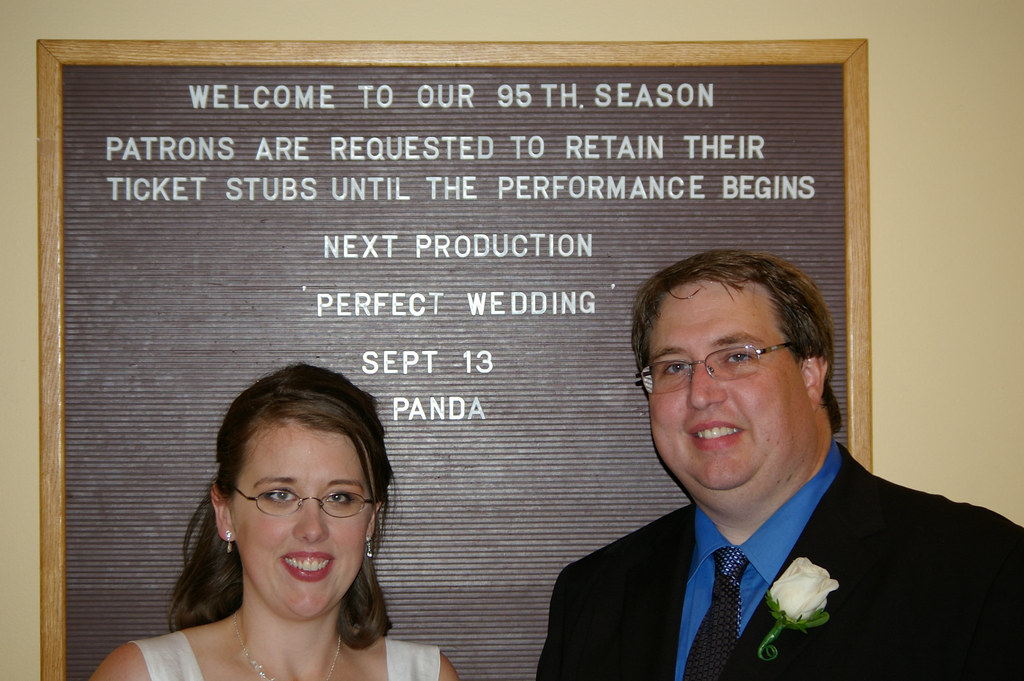
Often, experienced photographers have already dealt with contentious family issues too. Like, for instance, the parents are divorced, dad brought some skank that he left the mom for, mom is there with her boyfriend of the week, there are extra kids involved, and someone wants “the family photo”…experienced photographers know what to ask in advance, and then mix and mingle people at the session to both ensure the bride and groom get the photos THEY want, without starting a family war. People are being rotated in and out quickly, aren’t sure which one is supposed to be “the” big photo, and thus aren’t fighting to be in it themselves while keeping someone else out. Equally, an experienced photographer knows how to deal with the slightly larger bridesmaid who doesn’t look quite as comfortable in sunshine yellow as the three size 2 bridesmaids beside her, and to help them feel both comfortable at the time and welcoming of the photos afterward. I’m a larger guy, and the thought of 1500 pictures of me is borderline dread-inducing. But it’s a wedding, everyone will be taking shots of my new wife and I’m supposed to be in most of them. Like an accessory. Know what? The posed ones that the photographer took are ones I even LIKE, and I almost never like photos of myself. For instance, I have (at least) a double chin because of my size and body shape. So head shots are not my favorite thing either. Yet, as an experienced photographer, he knew that the best look for me would be leaning forward, with my head tilted up. Guess which photo is our “wedding photo”?
Okay, that’s the end of my sales pitch for hiring an experienced professional photographer.
Now, for a second, let’s look at the business model for wedding photographers prior to about 2003. Digital wasn’t very sophisticated yet, so the truly high-end photographer was still using film. Which meant they had total and complete control over the entire process. They took the photos. They developed the negatives (or had them developed). Then, they would go through small proofs with you, and you would order your prints from them. Along with books, enlargements, etc. It was basically a complete monopoly in each situation, a monopoly of one-to-one once you chose them. Then digital came along and people started asking for copies. The digital copies. And disruption entered the photo business.
While many photographers hung on to the old business model, others broke it into discrete elements:
Fee for working the wedding and reception (hourly or set rate for the day);
Fee for basic development of a “core” set of prints, including some retouching;
Fee for providing copies of some set number of e-prints, often in limited quality for format (i.e. low res for web, not good enough to blow up or do 8x10s);
Fees for providing other levels of quality of prints; and,
Fees for printing certain books or “photo” sets.
Basically, they created an “a la carte” menu, but if you wanted the same as traditional, you would just take a+b+e. It could add up quickly though, and it really didn’t meet my needs/desires. I was looking for other business models.
A friend of ours had found a photographer for their wedding by advertising at the local college in their photography program for someone who was looking for more experience, a set price for (a) above, and all the digital prints would go to the couple. Worked out for them, but it’s also a bit of a risk — what if the budding photographer screws up, because they’re not that experienced? Does that matter to you?
It mattered to me. I wanted more experience than that. Plus, not for nothing, every professional photographer out there will tell them (just read the blogs or discussion forums) that trading “exposure” and “practice” for their craft is really bad business for the photographer. It undervalues their output, which is what they’re selling. Some photographers are REALLY quite passionate about it, in the same way people complain about the exploitative nature of unpaid internships. Now, in my friend’s case, the photographer was paid (albeit cheaper than full-time photographer) and did a good job (one photo in particular is contest-quality, in my view), so it was win-win all around. But a bit more risk than I wanted to take. I wanted the best photos I could afford.
In our case, we reached out to three companies. One of them was very traditional. They would give us low-res photos for our website, but only a small number, and not good enough for even printing 4×6″ prints; everything else would reside with them, and if we wanted to print books or prints for anyone, we would have to go through them and pay the relatively extortionate prices that they all charge for that end of the business.
A second company was a bit more digital, and people would be able to view and order prints online, but again, we could have SOME prints electronically, but not very many. Most would reside with the company and if we wanted more prints ten years from now, we would go through them. All rights rest with them, and to ensure it, they hold all the files.
We kept poking around, and a friend of ours who had been married a couple of years before gave me the name of his guy. Bill was a retired press photographer, and while he liked working as a photographer, he had no real interest in controlling all the production factors for printing. Lucrative, but not the business model he wanted to spend time managing.
Instead, he charged us an upfront fee for the day to take all the photos, a combined rate to give us some basic retouching electronically, and about 1500 photos or so for us for the day. Full digital images, including the RAW image for about 500. He’d basically go through and weed out where he had, say, four copies of the same pose, or where one of the people was squinting or picking their nose for example. But everything else? It was all ours. He even offered to hook us up with some of the high-end printers, if we wanted to, but he noted that most people just used regular retail sites like Black’s to do their prints. No one else even came close to that kind of deal. So he was basically offering us (a) + (b) above, with complete copies of the e-versions and we could do what we liked with them.
And since I was adamant I wanted digital copies of everything so we could reprint at any time we wanted, and didn’t want to be locked into a supplier for life, it was an easy choice of the three.
I confess I had a bias against the previous model. Back when my father retired some 20 years before, my siblings and I got together and had some group photos taken. It was all film-based, we got some proofs, and we did a large blow-up of the best of the bunch. We could have ordered more stuff individually, and we all thought about it but never got around to it. Fast-forward about 10 years, and my father had passed away. I was interested in getting a set of pics made for each of us, and I tried to reach out to the photographer. Guess what? He wasn’t a photographer anymore. Sure, he had tons of boxes of photos and negatives sitting in his basement, a flooding disaster waiting to happen, and there were no backups. He wasn’t even sure how long it would take to find them. I was asking him about buying the whole set — proofs and negatives — and he didn’t really want to sell me the negatives. So, in the end, I cheated. I just scanned the proofs I had. I didn’t want big blow-ups anyway, so scanning was fine for my purposes. I’d rather have had control of the negatives for the future, but well, that wasn’t his business model. So when it came time for our wedding, I wanted full digital versions both for archival purposes AND to be able to put them on the web or print at will. Am I likely to print often? Of course not. But I paid for the photos to be taken…I wanted the flexibility to be able to control what I did with them later. I couldn’t enter them in contests or anything, or sell them, they weren’t “fully” mine, but they were fully licensed to me for our use.
B. Video
Originally, when people started offering videography for weddings, it was a bit hit-and-miss in my view. At the low-end, it could look like the movie, The Blair Witch Project, with shaky handheld cameras and rapid cuts. In the middle, people would take modest quality cameras and put them on tripods with a “set” view for the ceremony, speeches, and most promisingly, the first few dances. I have a video camera, and I shot video of my brother’s wedding and it isn’t bad, but far from professional. I also used our little hand-held camera to capture my sister-in-law’s ceremony and first dance, and it is good for the ceremony (a bit basic), but looks BAD for the first dances due to low-light conditions. I used the same camera at my wife’s friend’s wedding, same time-frame as our own wedding, and I had to edit the ceremony and dance videos to even make them VISIBLE due to similarly low light. Okay as a souvenir, but not ideal. At the high-end, people were walking around with the cameras you see camera crews doing roadside interviews or weather reports with, which isn’t surprising since often they were the same cameramen using borrowed equipment from the TV station.
Fast-forward 10-15 years, and you have huge growth in video due to the high-quality you can get from cellphones now. And so videographers have had to up their game. The big trend is the use of GoPro on small stands (easy to get closer to the action) and, wait for it…drones. Of course, drones only make sense if you have a venue that includes an outside component that will benefit from a birds-eye view. You might try flying a small drone in a church during the ceremony, but it’s a recipe for disaster and distracting, plus the Minister will likely freak on you. But it can be quite impressive.
Personally, I think a lot of the smaller cameras now make the “added” value of professional videography a lot lower. It’s hard to do it unobtrusively as the big cameras come with huge lighting options, but if you can get close with a cellphone, or a stand-alone DSLR, why not? Some of the DSLRs will even shoot in HD and even 4K. Way overkill for what you need, but if all you’re doing is putting it on a tripod somewhere and letting it run for awhile, that’s not rocket science and may not be worth the larger cost to have it done professionally. Just personal preference though — it wouldn’t be worth it to me, I’m fine with the photos.
C. Venues
One of the benefits you frequently get with a professional photographer from the area is knowledge of all the different venues around…ones that look good in early morning or late afternoon, ones that are great in case of rain, ones that aren’t 20 couples all lined up waiting to get in for their shots that day (there’s an arboretum in Ottawa that looks like Grand Central Station on Saturday afternoons in July — there are BRIDES and GROOMS everywhere!).
We did a few impromptu shots near our wedding venue, as a block from the site was a place my wife and I considered our “corner”. When we were first dating, we both lived in the same neighbourhood. I lived on Nelson Street, she lived on Besserer. If we were going somewhere, maybe out for dinner or just over to the market or the mall, we would meet “at the corner” — i.e. Nelson at Besserer. It was about the same distance from both our places and en route to commercial areas, so it was a good place to meet. On the way home from work, we’d frequently part there too. Later at night, I’d walk her home, but if we were just commuting, it was “the corner”. So we took some pics there, nothing that really stood out, just for fun.
We then moved on to more formal pics (having done a few at the theatre already) to a site that is actually under a bridge in the downtown on a walkway. I know, I know, you’re thinking, “Under a bridge?”. Partly why it is popular with certain photographers is that it isn’t super busy, and the backdrop is cool. But more importantly, it’s also covered (i.e. dry) with lots of natural light coming from the sides. I was a bit doubtful at the start, but it turned out great. Plus, we did some shots at the boat with various configurations at the bow of the boat.
D. Photo checklist
So, one of the first “planning” questions that you will get asked by the photographer is if you have your “list” of desired shots. They’ll take lots, they’ll have ideas of their own, etc., but do you have a “set” playlist so-to-speak of your greatest hits? There are obvious ones:
Bride and groom;
With parents, alone and together;
With both sets of parents;
With siblings, etc.
And so you’ll likely come up with 20 or so “must-haves”. And a good photographer will keep that list handy, ticking them off as they go, although it will be interspersed throughout the day. You may, for example, decide that you REALLY want a good shot of you dancing with your great grandfather, and that will happen near the end of the day. But you may also want some of you getting ready, and that should be on your list.
I sort of screwed up on our list. We had the standard shots that we wanted, and since we don’t have multiple sets of parents with extra spouses running around, there was no family drama to work around in that sense. So we wanted shots of us, shots of us with our families, shots of our friends (mostly candid), and shots of some of the milling around at the ceremony / reception / etc. (all candids). For formal stuff, we wanted Andrea getting ready, me getting ready (an addon), the ceremony, after shots at the theatre, shots at our corner, formal posed shots with the wedding party and parents, and some posed shots at the boat. Easy peasy lemon squeezy. We didn’t do a shot-by-shot list, and often those are discouraged anyway as they get a bit pedantic at the loss of spontaneity. The photographer worries about it, you should not be during the big day.
How did I screw up? I oversimplified something. Let me show the progression:
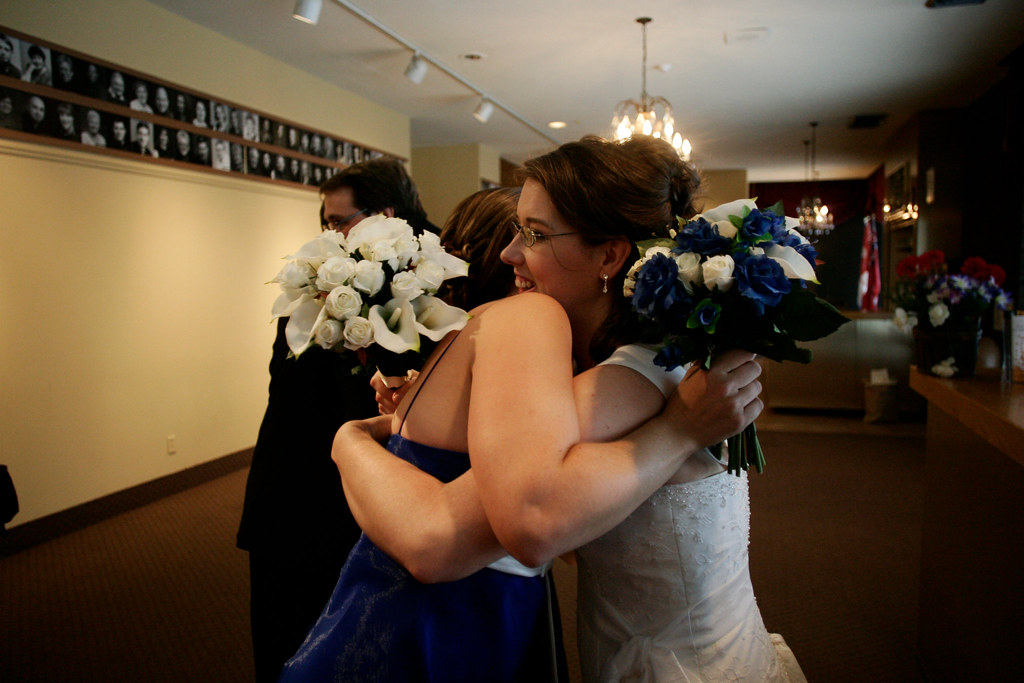
Andrea getting ready:
Pre-ceremony i.e. me getting ready:
The main ceremony:
Post-ceremony “meet the couple”:
Formal pose at the theatre:
Under the bridge:
Now, if you look at that last photo, you’ll see a small, well, imbalance I guess. Andrea and I, check. Her parents (in between us), the maid of honour in blue (her sister, plus her husband up tall and her daughter), her grandfather and my mother. Or, put differently two from “my side” of the family and six from “her side”. We didn’t try to take all my siblings for these photos, as we would catch them later at the boat.
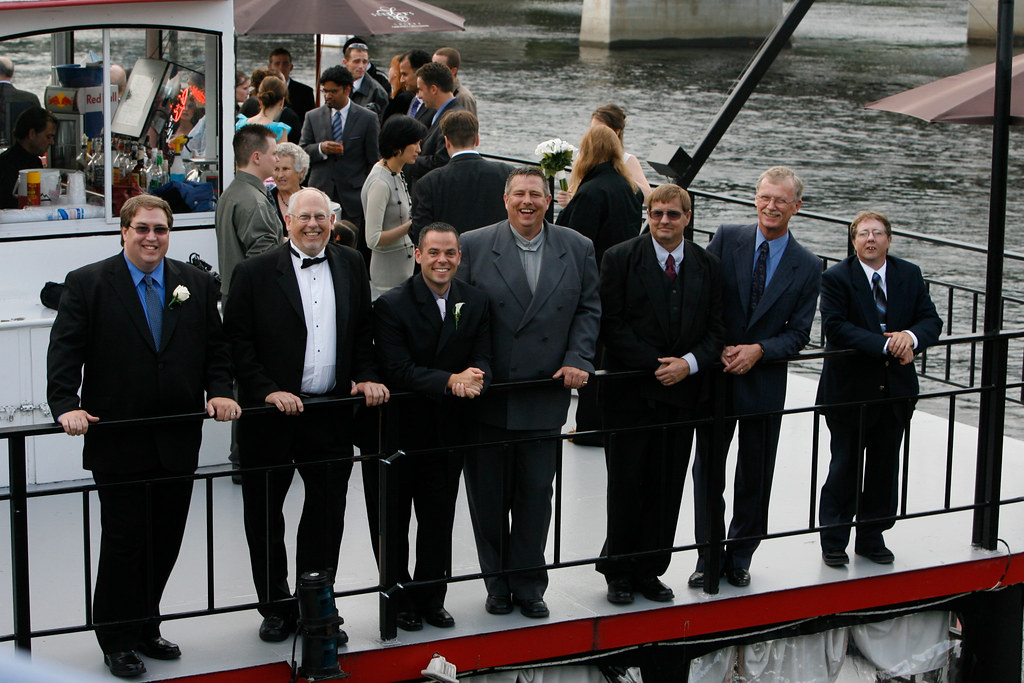
And that’s where I made my error. I said, “Okay, check, we have Andrea’s family covered, now we need to make sure my family is covered”. Except, we didn’t have ALL of Andrea’s family covered, we only had immediate family. I had over-simplified in my head. We went off to the boat, did a bunch of photos at the front of the boat. Mostly with my family. Andrea with her new brothers-in-law, my mother with her grandchildren, different siblings and their families with and without us, all the new sisters-in-law together.
The photographer was up on the dock, looking down and snapping away:
For my family, they are some of the best photos I have ever seen of us, partly as it had been so long since we did that kind of posing with all of us. The one with my brothers? Awesome.
We were starting to run a bit low on time. All those photos and milling about were taking precious minutes. I passed by one of my new cousins, and she asked if it was time for them yet. And in my head, even that question wasn’t enough to trigger a re-consideration. I had in my head “Okay, we have all the photos of Andrea’s family plus now my family, soon it will be time to do all the friends and guests at once.” I didn’t even twig to the idea of Andrea with all her extended family. We would love to have photos of her with her cousins, great aunt and grandfather, aunts and uncles, etc. And because I had checked off the “Andrea and family” box, at least mentally, we moved on to the “friends” photo.
A better checklist would have solved that problem. And, to be honest, that’s also not on the photographer. Bill was up on the dock, we couldn’t even communicate very well, he had no idea who we were rotating in and out, he was just snapping away for us. At the end, I would have said quite confidently we had “everything”. Sigh.
Now, here’s a small question-mark. How long would you want your formal photographer to be around? Most suggest they stay until dinner and then bail. Why? Because they’re being paid by the hour (or a set rate for the day), and that day is getting pretty long for them. They were working while the bride was getting ready, as early as 11:00 for us and well nigh on to 6:00. We wanted him to keep doing candids and the first dance, which created a small wrinkle. Once he was on the boat, it wouldn’t be easy for him to just “hop off” and go home. So we arranged for the boat to dock early (after dinner, after some dancing) so he plus a few others could “escape” for the night. Then we danced some more and called it a night. While some parties routinely go until 2:00 or 3:00, ours was over in advance of midnight. I’m a bit disappointed with some of our dance photos, but it was also a difficult lighting situation and we didn’t want to lug all that extra equipment around on the boat too. Good enough, sure, but a little more difficult than it would have been if we were at a traditional venue.
Oh, and by the way? If the photographer is working through dinner, it’s kind of a good practice to feed him or her. 🙂
E. What and how are you printing?
Back in the pre-digital days, your choices for printing were rather limited. You went with a photographer and they would have a predetermined set of printing options — a big book for you, some smaller books for the parents, and options for producing individual prints for lots of people. All with extortionate mark-up rates.
Now, you have a plethora of choices. There are tons of sites out there with basic photobook options — not photo albums where you insert photos, but actually printed books based on what you upload. And almost all of them come with some pre-set wedding themes and mockups to use as well as an option to let THEM design it for about $10-$20 more. Or you can go with ones that are specially-focused on wedding photobooks. It’s all a bit DIY, and you may be better off letting someone else design it for you if you know someone good who won’t ask for your first-born child as payment. Again, there’s some choice involved.
Or you can just print a bunch of photos and stick them in photo albums.
Extras
I will also mention a few other things to consider as you’re working through your photography needs.
1. Ask those extra amateurs to take a whack of extra photos and share them with you. We had a nephew, niece and family friend all taking lots of extra shots and they gave us the e-versions. One of my favorite photos from the boat — a semi-posed shot — is actually from the friend, not the formal photographer who was shooting right next to her. His are good, but just for timing of shutter snaps, his missed part of our smile and hers was perfectly timed.
The same family friend also thinks it is a great “gift” to give to the couple — copies of the photos from the wedding, sometimes even before a professional photographer has shared any.
2. It isn’t really required anymore since so many people have smartphones, but some couples will put small special cameras (like pinhole cameras or just small digital ones) on each table and ask the guests to fill up the memory card through-out the night. My experience is that there are interesting ones where you see people interacting who only met through the wedding — like your high school best friend talking to your wife’s grandfather — but the overall “benefit” of the photos is a bit low to justify the expense.
Instead, give people a URL or have them share on FB, say ten photos they take at the wedding with their smartphone. Turn it into a small challenge. Tell them too that the bride and groom CAN’T be in any of them to make sure they get all the candid ones of the crowd.
3. Plan ahead to use your photos in multiple ways. Lots of people get their shots, share a few on FB, print a brag book for the parents and a souvenir book for themselves, and they’re done. Not me. I’ve done the books. I printed some smaller prints for souvenir frames for the wedding party and parents. I put them on my gallery website. I re-used them to produce a calendar for my wife, with all 12 months having shots from throughout the whole six months of experience planning and having the wedding. I copied them over to a digital photo frame so they can run randomly. Some people do mugs, or puzzles, or handbags, or notebooks, or fridge magnets. Maybe NONE of those things appeal to you, but I bet you can think of some other use besides just photo albums.
4. Find something creative to do for the photos when they’re being taken. There are lots of shots out there on the web where people have pretended they were running from something, and the photographer photoshopped in Godzilla. Or there’s the somewhat overused photo booth idea. If you can, find something meaningful to you. I even just loved the rocks in our formal pics as props. I’ve seen some great shots online where people took pics in classic hotel lobbies or lounge rooms with a bunch of different heights, and an old-fashioned filter added to the shots. Throw in a couple of props like gin bottles and Tommy-guns, and you have something fun and different. Don’t go crazy and try to have everyone in a giant tree, but you can do something other than the standard everyone in a row.
Just saying…
And that’s what we did. We organized our wedding in six months, and even though people told us we were crazy, everything we “needed” worked out. A few compromises here and there, but nothing that was a deal-breaker for us. We just had to remember that inflexibility in one area (six month window) meant we had to be flexible elsewhere (venues).
Whew. The WEDDING is over. Many times you thought, “What about eloping?”. Not because you didn’t want to do the wedding, but simply because you were TIRED of discussing EVERYTHING. I almost feel like planning a wedding is a great test for marriage. Because once you are married, you’re going to have to do a whole bunch of “joint” decision-making, and what better way to do it than to make you spend six months doing it UNDER PRESSURE? 🙂
Okay, I exaggerate of course. Partly as there were very few times in the six months where we were exasperated with each other, because we were doing it “together”. In fact, I almost feel like the planners and trackers helped ensure it WAS being done together. At this point, you basically have six things left to do, and the first two are often related.
1. Relax
After six months of having just about every free moment tied up with this big project, it’s time to relax. If you remember how.
2. Honeymoon
If you’re lucky enough to have the time, energy and money left to do a honeymoon, maybe the relaxing part will go together with the honeymoon. I know some people who wanted really aggressive active things to do on their honeymoon. For me, I wanted to do some things off the bucket list, sure, but mostly that was solved by going somewhere neither of us had ever been before — Hawaii.
Snorkeling, submarine, helicopter rides, volcano visits…all stuff on my bucket list and great things to do while we were there. But mostly? I wanted us not to be completely over-scheduled where we were booked all day every day with a timetable. We were busy, but in my view at least, not over-busy. You can see some of the activities (and photos) on some of my posts about our honeymoon (Honeymoon recap – Hawaii – Day 1).
Honeymoons are incredibly individualized activities, so there really isn’t that much to say that will help you. My only advice is NOT to try and leave the day after the wedding. We took a couple of days at home just to decompress, and I am so glad we did. It gave us time to pack, organize our travel stuff, charge batteries, water the plants, etc. I know lots of people who flew out the next day, and were dead tired for the first three days of their trip.
Sure, in order to get to this point, you had to:
Book time off work;
Book airline, hotels;
Pay for trip;
Pick up tickets;
Get travel insurance;
Arrange for house-sitting.
Etc.
3. Thank yous
Once you get back from the honeymoon, it is time to write out all those thank yous. Fortunately, you already have their addresses from the invitation period, and a tracker that lists all the gifts you got. Now you’re trying to write 50 or more thank yous with some personalized anecdote to thank them for their gift and for attending the wedding (assuming of course you actually BOUGHT thank you cards somewhere around the time you did your invitations and guest book arrangements).
4. Preservation
Guys, you might think I’m talking about basic drycleaning here for your suit. Nope, I’m talking about special cleaning / preservation of the wedding gown. You can take the gown to a special drycleaner who specializes (theoretically) in wedding gown treatments and your wife is going to research the crap out of the place and ask for referrals before entrusting them with her dress. It’ll be either draped and placed in a full-size garment bag, or more likely, placed in a special box designed to keep moisture out. And it will cost more than you think it should, but they have you over a barrel, so you’re going to pay it and move on. Think of it as part of the original cost of the dress. Why is she saving it like this? I HAVE NO IDEA. She’s not going to wear it again, hopefully, with her next husband. And over time, it’s probably not going to fit as well as it did when she starved herself into it the first time. Nor is it likely to be the style that her daughter will want in 25+ years, assuming she even has a daughter at some point. But it will be saved. Trust me.
Equally, she will save her bouquet. It will be dried in silica gel, and preserved. Again, as a souvenir.
Since we had a couple of days between wedding and departure for our honeymoon, we could worry about this during that time, rather than waiting two weeks when the flowers would have been clearly dead.
5. Announce
If you live in a smaller town, there likely is a tradition of putting a wedding photo and an announcement in the local newspaper. One of the sets of parents usually does this. Some of them used to be quite lengthy; most are quite brief now.
6. Store your documents
You got a bunch of docs when you were doing this whole wedding thing. Some were ones you generated — like programs and invitations, all of which you’ll want to save as souvenirs.
But you also got a wedding certificate, which you may need from time to time for legal purposes. Know what? We have no idea where ours is. Well, sure, we know it’s in our office, but we haven’t seen it in probably 8 or more years. We’re not sure if it is with our lawyer stuff, or real estate stuff, but we know it’s not with our “important government documents” stuff. It’ll turn up. If it doesn’t, I can get a copy from the city where it’s filed. But if we had saved it in the proper place to begin with, we would already have it. Just saying…
And with this post, I wrap up almost all the stuff from our wedding. There is one item left to discuss, but it’s optional for some people, so I’ve saved it to last.