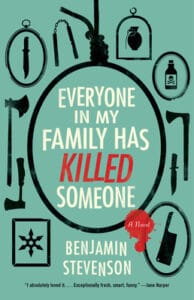
Ernest Cunningham, a writer who specializes in books on how to write, joins his family at a snowy retreat to welcome his brother home from jail. After he turned him into the police and sent him there.
What I Liked
The main character, Ernest aka Ern, breaks the fourth wall every page or two. Sometimes it’s foreshadowing, sometimes it’s narration, sometimes its commentary on himself, his life, the rest of the family, past events, future events, etc. It should be ANNOYING but is somehow delightful. Each section of the book is devoted to one family member, combining the current timeline with the past timeline where they killed someone (no, not all murders — car accident, patient dying on an operating table, etc.). And yes, even the narrator. When the first body shows up in the current timeline, things start to unravel in the family too.
What I Didn’t Like
There is a plot hole in the story, and not the one the narrator mentions (he mentions there is a giant plot hole big enough to drive a truck through, kind of as a literary joke), but it IS still there. Potential spoiler, but someone needs to be identified and conveniently, two people in particular who COULD identify him never see the picture. Normally, that would negate a star or even two, but the pieces hang together so well otherwise, I had to let it pass.
The Fellowship is running around trying to reunite in Salidar while Rand starts to marshal his forces against the Forsaken and the men they lead.
What I Liked & Didn’t Like
The book includes a lot of travel from point A to B, with not a lot happening in between that matters too much to the overall story. Siuan, Leane, Min, and Login are trying to travel to Salidar to meet the self-exiled Aes Sedai, with numerous minor incidents, including an encounter with Gabriel Bryne, who begins to follow them. Meanwhile, Nynaeve and Elayne are running and hiding, running and hiding, and end up working for a travelling circus (aka a menagerie) doing high-wire work and acting as the target for knife-throwing and arrow-shooting. However, while they travel, they also hunt at night in the Dream World where they encounter Moghedien, Lanfear and Birgitte. Two battles with Moghedien end up about as good as one can hope when facing a Forsaken, and even Birgitte is returned to the living realm.
Meanwhile, Rand leads the Aiel to Cairhien to face Sammael and the Shaido Aiel. Moiraine starts listening to Rand and obeying him, in exchange for talking his ear off all day long, sharing info and advice that he’ll need for the future. Sammael escapes but the large battle is magnificent, with a reluctant and departing Mat turning into a massive tactician who faces superior forces, unrelenting odds, and wins three major victories. So much so that men start to follow him, even if he isn’t a Lord. The info in his head gives him insights into battles he was never part of in his life, hundreds of years of history that gives him a tactical advantage, whether he wants it or not. However, it doesn’t help him understand how Melindrha, the woman sharing his bed, is — spoiler alert #1 — revealed to be a Darkfriend in the end.
However, the real climax is seeing Rand go supernova on Rahvin in Andor after he hears of the apparent murder of Morgase. He burns the castle corridors with Balefire while running through traps and other realms. Nynaeve joins him for the final battle, and — spoiler alert #2 — three more Forsaken seem to be addressed — Rahvin by Rand, Moghedien by Nynaeve, and Lanfear by Moraine.
Brad Shade is a former professional hockey player turned low-level scout for an NHL team from LA, scouting the European leagues and the Canadian minors. He plays in an old-timers game in Peterborough just before the coach and the team doctor get murdered in the parking lot.x
What I Liked
When I started reading the book, I had no memory of how I had found it or added it to my TBR pile. A hockey scout playing sleuth, with the murder set in Peterborough and the OHL? How could I NOT read it? I assumed I read that it was set in Peterborough and so I snagged it. Turns out that I had looked it up because it is the basis for the TV show Private Eyes set in Toronto with Jason Priestly as the lead character, Brad Shade. It ran for a couple of seasons, and I tripped over it on a bingefest. The show is watchable, if not high quality, so I grabbed the book to give it a go.
I should have started by saying that I’m not really a sports nut. I read mysteries set in and around sports, but it’s not really about the sports for me. About 20 years ago, I read Alison Gordon’s Kate Henry mystery series about a former Toronto sportswriter turned sleuth, and quite enjoyed them. I interacted with her a few times online through a discussion forum, which blew a friend of me away — I had actually CORRESPONDED with Ms. Gordon? Wow, he said. I had no idea who she was, I just bought her books as I liked the way she approached things in the forum. I feel like Brad Shade is what Kate Henry would have been if Alison had followed hockey instead of baseball.
I like Brad and the story for the most part. He’s trying to get a handle on a rising star in the OHL, and whether LA should draft him or not. If you’ve watched Kevin Costner in the movie Draft Day, or any episode of Friday Night Lights, you’ll understand a bunch of the concerns that Brad is looking at are designed to make sure their draft choice is solid not only for the hockey side of things but also the character side of the player. Brad figures out the full mystery and ties it all up in a nice bow at the end.
What I Didn’t Like
There are four things that took away from the writing for me. First and foremost, it is painfully obvious almost from the outset what the problem is with the player, and what the motive is that accompanies it, if not all the details. Yet it seems like for 80% of the book, Brad is in the dark. And while he should be in the dark about murder, this isn’t his first rodeo for a draft cycle. If it were set back in the 70s or even 80s, I might let some of it slide, but in 2012, it was hard to see how any part of it was supposed to “stay hidden”.
Secondly, even if the main “mystery” worked, the writing has some glaring red flags for point of view shifts and terrible foreshadowing. In at least four or five places, the “reveal” from Brad figuring something out is an opening line or closing line of a chapter where he says something along the lines of someone in the Star Wars universe saying, “If I had known Darth Vader was Luke’s father, I would have handled it differently.” They are these “exposition” dumps that just throw out a major plot point like he had no idea how to reveal it more subtly.
Thirdly, I started the book cold, so I had no idea what it was about. It took me three or four chapters in, something like 14% of the book on my Kindle to get out of exposition and into the mystery. There was a huge backstory about him having problems with customs in Europe that ate up the opening chapter that had NOTHING TO DO WITH ANYTHING. I don’t know how an editor didn’t cut all that or tell him to remove it. It was a giant dumping of backstory.
Lastly, I had a problem with the plot and pacing. Something semi-significant happens a week or two after the murder, and Brad doesn’t seem to twig to why it’s important. There are reasons to hide stuff, but not all of it. Then something HUGE happens, it reveals 100% of the answer to the mystery of who killed the Coach and 98% of why…dun dun dun…and Brad sits on it for two months so that it can all be revealed at draft day. But — spoiler alert — he’s fake blackmailing the killer who is UNSTABLE but Brad believes that he’ll do what he says for the two months. Huh? And the whole point of waiting is so that they can do something that makes them look good at the draft, and saves their job with the owner, while screwing someone else aka the real Code that anger in hockey dies slow. But he lets the unstable psychopathic murderer wander around for two months, some other bad people involved keep doing their thing, never tells his girlfriend who it was who tried to kill her, etc. It is freaking weird. The timelines could have EASILY been adjusted to line up properly with draft day, but instead, there’s this late lull in Act III. SMH.
Going back again for a moment, I grabbed the book because it’s based on the TV series. But as I read it, I didn’t even remember, because the book is so different from the series. However, I found myself excited that it was set in Peterborough…yet no mention of Peterborough’s actual team name (the Petes), which he probably couldn’t do, and the name of the arena is changed too, of course. But even for the setting in Peterborough, where he could have referenced more local stuff, there are literally only two references to Peterborough street names. Including one street name that he uses to suggest someone has an expensive house on the street — except there are almost NO expensive houses anywhere on that street. And there are any number of streets that could have been mentioned instead. Which made me realize that if he had set it in Oshawa or Ottawa or anywhere else, and changed three details, it would have been GenericCityAnywhereOntario. Not something to mark the story down, but the other issues dropped it down from a good four stars to three.
The Bottom Line
Very different from the TV show, but sports sleuths are fun
A young woman struggling to make her rent is informed that a billionaire she has never met has left her everything, including all the drama of his extended family.
What I Liked
With a feeling like Harry getting invited to Hogwarts, the book opens with Avery being notified that she’s in the will of one Tobias Hawthorne, philanthropist billionaire, deceased. She is summoned to the reading of the will in Texas, which, after some mild disbursements, leaves the vast majority to her. Hawthorne’s stipulation is a little bit like Brewster’s Millions — she gets the initial award, but to keep it, she has to live in the Hawthorne House with the extended family for one year, including four handsome grandsons.
Within days of the will, various members of the family start drawing their battlelines, and the grandsons and Avery start to play “Riddle Me This” with clues from Hawthorne to potentially other outcomes of the will. Of course, the biggest question for Avery is “why her?”, but it takes a while for that to be revealed (and it DOES make sense, once you get there).
The smaller storyline revolves around the fight for the money and influence that the people around her start to engage in, while the bigger story is the riddle and clues that Grandpa Hawthorne left behind. As I mentioned, the feel for the story is 1/3 Harry Potter with Avery entering a world that she could never even conceive of previously; 1/3 Brewster’s Millions i.e., you have to perform to get the full inheritance; and 1/3 Ready Player One where her and the four boys try to figure out the clues hidden around the grounds.
What I Didn’t Like
There’s drama with people from her old life that doesn’t work, but overall, it isn’t enough to detract too much. Although it is part of a series, the end of Book 1 feels like it really should have just ended there. Instead, it’s almost cliff-hanger-ish, as they start figuring out that there is still a Round 2 of the Inheritance Games.
The Bottom Line
A brilliant opening with a great vibe all through the book
Following the battle at the end of Book 3, Rand has the flaming sword Callandor, and everyone is waiting for “what’s next”, until the Pattern starts to form again.
What I Liked & Didn’t Like
Rand is drawn to the Waste land of the Aiel, Mat is drawn to a Red Door of prophecy that ties him to staying with Rand, and Perrin is drawn to Emond’s Field to save it from Trollocs and Children of the Light.
There is a LOT happening in Book 4. I like that Mat is trying to figure out his destiny, and that includes deciding to stay with Rand because he knows their destinies are entwined. I was NOT expecting Mat to go into Rhuidean (the all-seeing area) with Rand, and when he makes a deal after going through a Red Door, it isn’t entirely clear to him or the reader what deal he made. We’ll probably have to wait several books to find out, and it’s hard to watch him struggle with the unfulfilled desire to know more.
For Perrin, returning to Emond’s Field is all about him becoming a leader as ta’veren. Admittedly, the entire love spat with Faile is yawn-inducing, with her attempting to play games he’s not even sure he wants to be part of anymore, and her having no real idea she’s about to lose everything if she doesn’t stop. It’s averted at the last second, but the subsequent struggle with people asking him what to do when they already know is great to see for leadership and how he struggles to embrace it. It’s a little repetitive, but great to see all the tertiary characters forming a defense force.
However, after suffering through Book 3 without Rand, Rand’s trip to the Rhuidean prophecy / history world was awesome, seeing him go back in time to live the lives of the Aiel ancestors and to see their original lives. It is unclear to me, however, how it is that the Aiel Clan chiefs and Wise Ones, who have also visited Rhuidean at some point and experienced the same thing, managed / decided to keep the secrets hidden forever. Spoiler alert — they were Children of the Leaf, not warriors of the spear. There’s a “bland” nature to the post-Rhuidean world, with nothing much happening yet Rand is obsessed that he’s somehow out of time. The final bit with the Forsaken is fabulous.
Overall, I liked the book’s balance way better than the previous one, mostly because of Rand being in it, and for Perrin assuming a leadership position. Book 1 had 259 characters, book 2 had 255, book 3 had only 238 and I didn’t have any trouble following them as long as I have my handy little “team chart” (see below). Book 4 was a little harder with up to 437 this time out, and a lot of Aiel who may or may not be important for the long term (hard to tell). At this point, I’m tracking about 38 good guys and 36 bad guys (relatively even), and some 36 that are unclear but likely either positive or at least neutral. But continuity is weak in places (with names and repetition) and about 30% could be easily cut.