↓
 

The PolyBlog

My view from the lilypads

  • Home
  • Goals
    • Goals (all posts)
    • #50by50 – Status of completion
    • PolyWogg’s Bucket List, updated for 2016
  • Life
    • Family (all posts)
    • Health and Spiritualism (all posts)
    • Learning and Ideas (all posts)
    • Computers (all posts)
    • Experiences (all posts)
    • Humour (all posts)
    • Quotes (all posts)
  • Photo Galleries
    • PandA Gallery
    • PolyWogg AstroPhotography
    • Flickr Account
  • Reviews
    • Lilypad Library (Books)
      • Book Reviews (all posts)
      • Book reviews by…
        • Book Reviews List by Date of Review
        • Book Reviews List by Number
        • Book Reviews List by Title
        • Book Reviews List by Author
        • Book Reviews List by Rating
        • Book Reviews List by Year of Publication
        • Book Reviews List by Series
      • Special collections
        • The Sherlockian Universe
        • The Three Investigators
        • The World of Nancy Drew
      • PolyWogg’s Reading Challenge
        • 2026
        • 2023
        • 2022
        • 2021
        • 2020
        • 2019
        • 2015, 2016, 2017
    • Movies
      • Master Movie Reviews List (by Title)
      • Movie Reviews List (by Date of Review)
      • Movie Reviews (all posts)
    • Music and Podcasts
      • Master Music and Podcast Reviews (by Title)
      • Music Reviews (by Date of Review)
      • Music Reviews (all posts)
      • Podcast Reviews (by Date of Review)
      • Podcast Reviews (all posts)
    • Recipes
      • Master Recipe Reviews List (by Title)
      • Recipe Reviews List (by Date of Review)
      • Recipe Reviews (all posts)
    • Television
      • Master TV Season Reviews List (by Title)
      • TV Season Reviews List (by Date of Review)
      • Television Premieres (by Date of Post)
      • Television (all posts)
  • About Me
    • Subscribe
    • Contact Me
    • Privacy Policy
    • PolySites
      • ThePolyBlog.ca (Home)
      • PolyWogg.ca
      • AstroPontiac.ca
      • About ThePolyBlog.ca
    • WP colour choices
  • Andrea’s Corner

Tag Archives: health

Post navigation

← Previous Post
Next Post→

Changing my body – Thoughts about physical body metrics

The PolyBlog
September 15 2021

I posted earlier about keeping track of my body metrics (Changing my body – Baseline 21-001), and I feel somewhat, umm, undecided about them. Some seem obvious, like weight. BMI has some well-known issues, and I don’t really care about it, but it’s auto-calculated on every app, so I don’t care if it’s there. But beyond that? I’m not sure what I actually care about.

I have three separate apps that track measurements, and I’ve set them all up for now so that I can see what it looks like when I do my October and November updates. Essentially, I want to see what they show me for ongoing tracking, so for now, I’m tracking “everything” that each one does. Here’s what the three apps do collectively.

Area of the bodyMY WEIGHT appREMEASURE appBody Tracker app
YesYesYes
HeightYesYes—
BMICalculatedCalculated—
Body fat %CalculatedCalculated—
NeckYesYes—
ShouldersYes——
Bust—YesYes
Lower-chestYesYesYes
Stomach above belly button———
Stomach at belly button—Yes—
WaistYesYesYes
HipsYesYes—
Buttocks—Yes (but not used)Yes
Biceps (Relaxed)Right / LeftRight / LeftAverage
Biceps (Flexed)———
ForearmRight / LeftRight / Left—
Right / LeftRight / LeftAverage
Knee—Right / Left—
CalfRight / LeftRight / Left
Ankles—Right / Left (but not used)—
Feet girth—Right / Left (but not used)—

What do the measurements tell me?

So, I really like the My Weight app for the simplicity of entering weight measurements regularly. I like the screen it shows me, nothing too fancy, just simple everyday progress (or more accurately, whenever I choose to enter it, which isn’t daily, more weekly). The Body Tracker app has a very simplified interface too, and simplified measurements, but the big “advantage” of the app is that it lets me take front / side / back photos and has some basic features built in to let me do side-by-side comparisons at check-in. To “see” my actual change in body, which hopefully will eventually be visible. I don’t however have to use all the features of any app, just seeing what works.

But when I think about my body, I think some things stand out more than others as areas I care about. Weight is a complex beast compared to health overall as a better goal, but on the other hand, I’ve been experiencing some negative parts purely from weight (breaking furniture, for example). I’m more conscious of it of late and it’s bothering me, separate from the health concerns. While my weight hasn’t shifted much during COVID, I’ve lost heavier muscle tone and gained lighter fat in increased girth. And while I will obviously include Weight as an ongoing measurement, it’s really the girth that bothers me the most at present.

However, on weight, my earlier musings to achieve my target goal of 185 lbs in a little over 4 years were apparently way too ambitious. Based on medical research, the best advice is 5-10% change per year. At 5% reduction per year, it will take me 12 years to reach my goal. At 10% reduction per year, it’s a little closer to 6 years. I was thinking in terms of linear totals (i.e., the same amount each year), not the percentage per year, so that changes my timeline. I’ll have to alter the plan to make it where I want to be by age 62, or about 4-5y after retirement, and 8-9 years from now. That is a hard blow to take, to see that long a delay in achieving my goal, but it’s more realistic. At least I’ll see benefits all along the way at earlier milestones.

The apps can calculate fat % or BMI, not active tools I’ll be using, but they’re there. Maybe they’ll give me info, maybe they won’t. We’ll see.

For the neck, it’s a bit misleading. I don’t in theory care about my neck measurement, at least not directly. What I do care about is having multiple chins. I have a light beard right now, so it’s not as obvious (I’m not doing it to hide it, it’s just WFH laziness on my part). But if I shave, and I tuck my chin into my neck to “force” the worst possible look, it’s bad. “Fat-shaming role in a movie” bad. I know it’s there, and I’ve had it for a long time. One of my least favourite memories from my mother happened a bit after Jacob was born. She wasn’t being deliberately mean, more merely thoughtless, but she suggested out of the blue that I needed to start doing neck exercises to get rid of my extra chins. As much as I disliked the comment, she wasn’t wrong. In fact, when I got married, it was something I discussed with the photographer — how could we do some photos that wouldn’t show how fat my face was? There’s a reason why the best photo of the bunch has me leaning forward and looking up a bit.

So I’ll measure neck as I don’t quite know how to measure “chin” decrease…from 4 to 3 to 2 to 1? I confess I also have concerns that as I lose weight, the skin won’t retract with it for tone and I’ll be left with hanging flesh in places, including my neck or arms. I try not to dwell as that is an almost-envious problem to have because it would mean I had lost enough weight to see the difference.

Shoulders? I really don’t think I care. Maybe if I was trying to be a linebacker, this could be relevant? I’m not trying to increase or decrease it, so why track it? Only one of the apps asks for it, while another has a slot for it. But it is also one that requires someone else to measure as your arms have to be down at your sides, and that alone is enough for me to likely veto it. I’m trying to do most of the stuff on my own without burdening Jacob or Andrea too much in my tracking. It’s my obsession and problem, not theirs, and while they’re willing to help, I also don’t want to impose too heavily on their goodwill.

There are two measurements, bust and just below the bust (i.e., lower chest), and I’m rather bewildered about these ones. I am carrying a lot of fat to the sides of my breasts, and it’s visible in the pictures. I hate it, sure. And I definitely want to find ways to get rid of it. But if I go by measuring the bust area, in theory it will go down and then back up? Down as I lose the fat, back up as I put some muscle into pecs and lats. So I’ll keep measuring it, at least one of them anyway (likely bust), but I’m not sure how to interpret the numbers as to whether a dropping number or an increasing number is good/bad.

The next five measurements are all very inter-related, and some of the descriptions from app-to-app are conflicting about which is which for upper stomach, stomach, waist, hips and buttocks. Some of the waist definitions point to the belly-button, others go to the waist band of underwear, some call that the hips. Generally, the top one (above my belly-button) and the bottom one (around the butt) are really clearly different, but the other three get intermingled. For me? I care about three things. I want to get rid of my giant stomach. It’s in the way when I’m bending over, I can’t see my toes, blah blah blah. So at least one measurement that is around my stomach at the belly-button level has to stay. The next measurement is waist. Part of the challenge, tied to pant measurements for example, is that if you are thin and tall, you tend to wear your waistband higher than you do if you’re fat like me. My stomach wants to “push” the beltline lower, which is why you often see TV and movie characters “cinching” their belt under their beer belly. In the end, I don’t care what it is now, I only care what it is when I get closer to my ultimate goal in several years. I want to wear 30″ pants someday, and not because I’m so old that I’ve lost every ounce of tone or weight. And thirdly, just to close out, I want to get rid of my extra girth in the pelvic and butt areas. So a measurement around the butt area is probably a decent one to keep.

For the arms and legs, I get confused a bit again. Take biceps, for instance. I have a lot of flab in my arms right now, and so they seem “bigger” than they actually are. Ergo, I want that number to go down, right? Except, I wouldn’t mind if I could develop some decently noticeable biceps. I don’t want to be a body-builder or anything, but I would get some mental boost from seeing actual definition. So, the measurement should go “down” and then back “up”? But to what? Like I said, I want functional strength and some definition, not competition-style biceps. I confess I also have no idea what thick forearms would translate to in actual numbers or definition. As with other areas, do I want it to go down? Up slightly? I have no idea. On thighs, they definitely need to go down and then gain some definition, which a measurement won’t really capture. Similarly to forearms, what does a measurement around the knee tell me? Should it go down? Up? And finally my calves. With my diabetic numbers, I moved into wearing compression socks, and with that compression, the girth has gone down, as has the more marbled appearance I used to deal with from time to time. At times, I liked it, as my calves looked like tree trunks. But now that I’m wearing the compression socks, does the size matter? Should it go up? Or down? Or is it simply about definition again? I think it should go down for awhile, but I’m not sure what a “good” size would be.

Where does that leave me?

If I’m brutally honest then, and utterly ruthless, I need:

  • A weight measurement, to tell me how I’m doing more regularly than the monthly baseline review;
  • A neck measurement, as the only useful proxy for how many chins I still have;
  • A bust measurement, for context;
  • A stomach measurement, as the only one focused on the most significant area of girth;
  • A waist measurement, for context in the short-term;
  • A buttocks measurement, for eliminating some flabbiness on the front and back;
  • A thigh measurement, for flabbiness and simple sitting agility/pressure;
  • A calf measurement, for future compression sock conversations; and,
  • A bicep measurement, as a bit of an ego thing.

Since I want the first app for the great tracking related to weight, and I’m using the third app for the photos, the real question is whether or I keep the second app long-term. I’ve certainly shown there’s no need to include any measurements in the third app, as it is just not robust enough. I’ll keep it for photos, and weight, but likely not the body measurements. But if I compare app #2 against app #1, my problem with only using #1 is that there’s no option for a good stomach AND waist measurement, and while I could repurpose hips, there’s also no pure buttocks measurement area. If I go instead with only app #2, I can do all the measurements, but the weight aspects are not as visually appealing.

Overall, it seems like I’m likely to keep:

  • My Weight for the purposes of weight tracking;
  • ReMeasure for a smaller grouping of physical body measurements; and,
  • Body Tracker still for the photos.

As I said at the beginning, I’ll enter the measurements for now in all three, and re-evaluate once I get to November or December. Mostly what I’ll be looking for is how it shows me graphs and trends in an easy to use format.

I’m not convinced I know what all the measurements will tell me individually, but it’s a start.

Posted in Health and Spiritualism | Tagged change, exercise, goals, health, personal | Leave a reply

Workout attempt #21-002 Pre-stretch, setup, and pre-set routines

The PolyBlog
September 15 2021

After my workout on Sunday, Monday was my “off day” and so today, Tuesday, was my day to work out again. The BowFlex comes with a number of suggested workout routines, and I started with the 20-minute Better Body workout. It has nine exercises, and they recommend doing it 3x a week.

Initial stretching. As I mentioned previously, I don’t have a good stretching routine set up yet and today was the clear evidence of that…I did some hip and quad stuff, some arm and neck, and a bit of back arching, but I’m hoping to get it down to a “known” set of exercises that I’ll do as opposed to having to think “which ones” at the time. That’s on my schedule to figure out for next week. I did manage to test out the work-out mat I got at IKEA awhile ago, and it was great. Extra padding so my knees weren’t screaming, but still took a bit more work than I would like getting down on the mat and back up again afterwards. Sigh. Baby steps.

Exercises. There are nine exercises suggested in the BowFlex manual. I started with the Bench Press (#01) that helps with the chest, and did 1 set of 10 reps @ 60 lbs. I really wanted to up it to 100 lbs, but I’m trying to keep the various exercises at the same weight throughout the routine so I don’t have to make many changes. My intent, for now, is that on exercises where 60 lbs isn’t enough, I’ll try more reps and focus on controlled movements.

01 SE CB Chest - Bench Press

The next one on the list is the Narrow Pulldowns with Handgrips (#11). It’s aimed at the back muscles, and is also seated, but it requires turning around to face the machine AND switching to the top bar to be able to pull down on the grips. I ordered an extra set of grips (the machine came with two sets but there are 3 pulleys), and the new ones worked well enough. I actually like the grip a bit better (harder, knurled instead of foam). Same approach for weight – 1 set of 10 reps @ 60 lbs. Like the bench press, this one will likely need more weight or more reps pretty soon.

11 SE TB Back - Narrow Pulldown

The third one is called Crossover High Rear Deltoid Rows (#04), and I confess I really like this one. You do it while standing facing the machine and using the top grips, so compared to the previous exercise, the only adjustment was to stand up. But the cross-over means that you grip the two handles and pull them across your body, almost like you’re grabbing something and ripping it open. I did my 1 set of 10 reps @ 60 lbs, and I feel that is about right for this one. The exercise targets the shoulders.

04 ST TB Shoulders - Crossover High Rear Deltoid Rows

The routine then moves into arms with the Seated Biceps Curl (#16). The weight was fine i.e. 1 set of 10 reps @ 60 lbs, but the change from the last one is that I go back to sitting facing out, and I switch to the pulleys at the bottom (aka the squat ones). I found this one hard for form, and while I love the idea of increasing the weight and having an actual “real” bicep instead of the flab I have now that hides it, I won’t be increasing this one anytime soon.

16 SE SQ Arms - Seated Biceps Curl

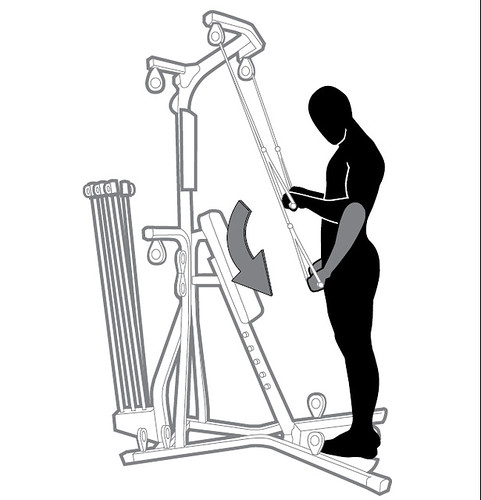
The exercise doubles up on arm exercises (as it does with legs and trunk to follow) and moves into a Triceps Pushdown (#14). Again, standing up, switching back to the top bar, which are two changes that don’t allow for a rhythm. I’m not entirely sure I’m keeping good form on this one, but I also won’t be increasing weight or reps either (1 set of 10 reps @ 60 lbs).

14 ST TB Arms - Triceps Pushdown

There are two leg exercises next, and I reordered one to the end and did the second one here. It’s called the Standing Hip Extension (#22). As you can see from the diagram, you’re supposed to put the grip in the arch of your foot and push it backwards while keeping the leg straight. You do one leg at a time, so it is 2 sets of 10 reps @ 30 lbs. And that is a solid amount of weight to start with, but the real challenge for me was my feet. I’m not very flexible, so to get my foot down there, lined up properly, standing back up, getting ready to go? Not really happening. With my shoes on, I couldn’t feel where it was on my foot; with just my socks on, I couldn’t get into position with the foot pulling back with my arch. But not to fear, there is a simple solution. You can put your whole foot through the loop so the grip is on the back of your ankle and do it from there. Again, as I said, I left it at 30, and I may have to reduce to 6 or 8 reps. Good for the butt, apparently, but only if your butt can take it. 🙂

22 ST SQ Legs - Standing Hip Extension Left and Right

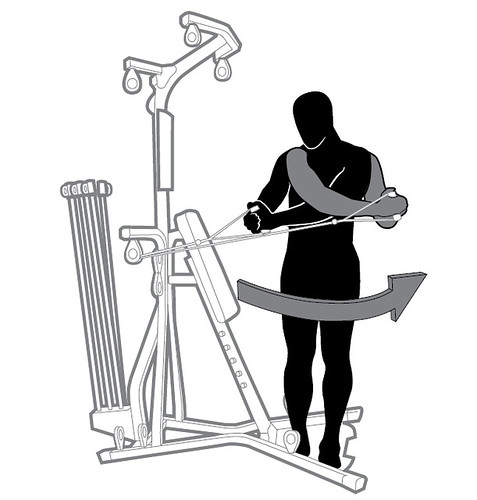
Next up were the trunk exercises and I started with Trunk Rotation (#19). On Sunday, I made the mistake of leaving it at 30 lbs each side, even though it clearly says NOT to do that i.e., start low. I thought 30 lbs WAS low, but not low enough. I struggled doing it with control, so today, I dropped to 15 lbs each side. Much better volume. I feel like this is likely a good exercise for me, similar to what a lot of people do with a medicine ball while sitting, where they basically move it from left to right and the person behind them picks it up and does the same. Then they reverse direction. It isolates it to your side abdominal muscles which are pretty weak for me. I don’t know that I will ever LOVE the exercise, but I’m fine to do it, at least safely.

19 ST CB Abdominal - Trunk Rotation Left and Right

The last abdominal exercise is the Seated Abdominal Crunch (#18). I love the idea of crunches because they so perfectly target the abdominals. But when you’re as fat as I am, crunches aren’t a lot of fun. And while it is good that people are no longer doing full situps, I’ve never felt I was very good at my form for crunches. This is almost foolproof, which is great. I did my set of 10 reps @ 60 lbs and that seems about right for now. It’s about all my stomach can handle. Interestingly, this exercise and the bench press are the two that I feel will define my sense of success. If I am progressing on these two, I’ll feel like I’m getting somewhere, even if the rest are crap; if I’m not progressing on these two, I’ll feel loathe to picture anything as progress. I think it is a holdover of years of bad sports experiences — real athletes can do bench presses and crunches, and I can’t.

18 SE CB Abdominal - Seated Resisted Abdominal Crunch

Last, but not least, is the Leg Extension (#20). While this one uses the squat pulleys too, it also requires putting the attachment on. It was pre-installed by the assembly guy, so I’ve never put it on before, and it was a pain in the patootie. I ended up having to get down on the floor and almost underneath it to see how it went in. I upped the weight to 100 lbs and did my set of 10 reps. But I didn’t feel like my form was very good to be honest. It felt more like a Macgyver-ed solution than that I had everything set up exactly correctly. It worked, but I wouldn’t say I was thrilled by it. And I think part of that is simple disappointment that I have to reconfigure for it at all, AND that it is the only exercise that uses that piece. So it will always either be the first or the last exercise.

20 SE SQ Legs - Leg Extension

How did I do?

My form was a little better, I need to figure out my stretching exercises a little more coherently, but overall, it “worked”. I did it, I felt like I got a workout. It took me longer than 20m to figure it all out as I went, but I was able to do it well enough. I even managed to remember to hydrate! I should have done more for my cooldown, but I just ran out of time.

However, it was also relatively clear pretty fast that the order of the exercises has a lot of unnecessary movement and resetting. The order can be improved for efficiency, as long as I remember to rest in between exercises like I’m supposed to do. I think a good order would be:

  • 19 ST CB Abdominal – Trunk Rotation (15, 15)
  • 04 ST TB Shoulders – Crossover High Rear Deltoid Rows (30+30)
  • 14 ST TB Arms – Triceps Pushdown (30+30)
  • 11 SE TB Back – Narrow Pulldown (30+30)
  • 01 SE CB Chest – Bench Press (30+30)
  • 18 SE CB Abdominal – Seated Abdominal Crunch (30+30)
  • 16 SE SQ Arms – Seated Biceps Curl (30+30)
  • 22 ST SQ Legs – Standing Hip Extension (30, 30)
  • 20 SE SQ Legs – Leg Extension (50+50 lbs)

In theory, it means having to adjust the weight only twice (after the first exercise and at the end) while also using the same grips in order — top bar, centre bar, and then the squats bar, before using the Leg Extension. If the leg extension is already in place, I can reverse the order and go bottom to top.

It wasn’t bad for my second workout. Onward!

Posted in Health and Spiritualism | Tagged change, exercise, goals, health, personal | Leave a reply

Changing my body – Baseline 21-001

The PolyBlog
September 13 2021

September 11 is the start of my new attempt at body transformation. My intent is to do all my measurements and photos on the first of each month, and so I’m a bit behind in a sense, but I need to set my baseline now. I have to start somewhere and there’s no real reason to delay until October 1st. So here it goes…

Physical baseline

Weight: 343.4 lbs … My highest top out was 350 even and that will be my overall mark from which I’ll do my formal deductions in the macro sense, so in a sense, I start already down 6.6 lbs, 158.4 lbs to go (4% of my goal). Yay me, hehehe

BMI: 47.9 (Obese Class III) [+4.8 since 2018]

Body fat: 53.5% [new baseline]

Neck: 20.25″ [+1.25 since 2018]

Bust / chest: 53.5″ [+.5 since 2018]

Lower-chest: 52.5″ [+1.5 since 2018]

Waist: 56.5″ [+1.5 since 2018]

Lower-waist / belly-button: 56.5″ [+2.5 since 2018]

Hips: 50.0″ [+2 since 2018]

Buttocks: 52.5″ [new baseline]

Right bicep (soft): 17.5″ [+.5 since 2018]

Right bicep (flexed): 18.5″ [new baseline]

Right forearm: 11.5″ [-1.5″ since 2018]

Left bicep (soft): 18″ [+1.5 since 2018]

Left bicep (flexed): 18.5″ [new baseline]

Left forearm: 11.5″ [-1.5 since 2018]

Right thigh: 28″ [+2 since 2018]

Right knee: 18.5″ [-1.5 since 2018]

Right calf: 20″ [+.5 since 2018]

Left thigh: 28″ [no change since 2018]

Left knee: 19″ [-2 since 2018]

Left calf: 20″ [no change since 2018]

Well-being baseline

Medical / sense of physical health: 3 / 10 [new baseline]

Social flexibility (willingness to do sports/exercise): 3 / 10 [new baseline]

Lifestyle (confidence for social outings despite obesity): 1 / 10 [new baseline]

Finances (related to obesity): 2 / 10 [new baseline]

Mental health (regarding health): 1 / 10 [new baseline]

Milestone tracking

  • COMMITMENT (Psychological)
    • Commit to the journey
    • Announce goal
    • Set up Seinfeld progress for plan
    • First workout for BowFlex
    • Setup bicycle machine
    • First week of 3 workouts
    • Average of 3 workouts per week in a month
    • Average of 4 workouts per week in a month
    • Average of 5 workouts per week in a month
    • Average of 6 workouts per week in a month
  • MEASUREMENT (Physical)
    • Set up tracking of weight and BMI
    • Set up photos
    • First weigh-in
    • First new pound
    • 10% of goal
    • 25% of goal
    • 33% of goal
    • 40% of goal
    • 50% of goal
    • 66% of goal
    • 75% of goal
    • 80% of goal
    • 90% of goal
    • 100% of goal
    • First set of measurements
    • First photos
  • PLATEAUS
    • Change of 1″ in waist
    • Change of 5″ in waist
    • Change of 10″ in waist
    • Change of 15″ in waist
    • Change of 20″ in waist
  • DIFFERENCES
    • See my toes past my belly
    • Tying shoes without effort
    • Kneeling without pain
    • See my abs / muscle definition
    • See difference in photos
    • See difference in clothing (275 / 240 / 205 / 185)
    • Fit into ~30″ pants
    • Hugs from Andrea and Jacob
    • Elimination of sleep machine
    • Elimination of compression socks
    • Elimination of medicines (4)
  • MONTHLY FITNESS TEST
    • Fatigue limit for all 26 exercises
    • Pushups
    • Expand fitness test

Photos

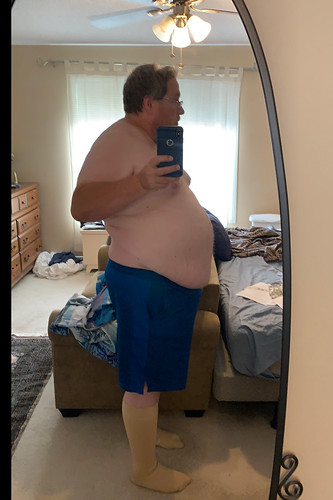
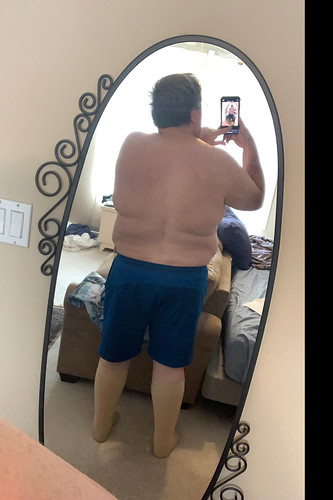
There’s no accountability without photos, however much I hate doing it.

21-001 Baseline front 21-001 Baseline side 21-001 Baseline back

And that’s a wrap. My new baselines are set. See you on October 1.

Posted in Health and Spiritualism | Tagged baseline, change, exercise, goals, health, personal | Leave a reply

Workout attempt #21-001 Stretching, chest exercises, cool-down and errors

The PolyBlog
September 12 2021

So this morning I decided to work through all the exercises for the first time and decide which ones I can do and at what power for now. A “starting” point, if you will.

Initial stretching. I don’t have a good stretching routine set up yet, so I’ll have to add that to my list. I did the basics:

  • Achilles Tendon and Calf –> Hands on wall, one foot back and lean in;
  • Qaudriceps –> Pull one ankle up behind your butt while standing;
  • Hamstrings –> Leg up on third step (almost horizontal) and lean towards feet;
  • Rotation –> Grasp alternate wrist, and rotate trunk to side;
  • Shoulders / lats –> Put hand up by opposite ear, and pull in on the elbow with the free hand;
  • Sternum, pecs, lats –> Hands clasped overhead and arching lightly back;
  • Neck –> Seated, with one hand under seat and lean head opposite direction;

I have a workout mat for later in my efforts to be able to do some basic yoga, and I’ll eventually incorporate Tai Chi stuff too but I’m a long way from there. Heck, I’m going to have to add a milestone that even my stretching routine isn’t taxing for me. Sigh.

On to the chest exercises!

Chest #1 — Bench Press…The first one in the book is the ever-popular Bench Press. It is designed to work the Pectoralis Major, Deltoids and Triceps. It is a seated exercise, as you can see from the diagram below that comes from the owner’s manual for the BowFlex PR3000.

01 SE CB Chest - Bench Press

It’s a good exercise, and I’ll keep it in my repertoire probably for just about every routine. There are two more in the book that change the angle of attack for the “decline” (downward) and “incline” (upward).

02 SE CB Chest - Decline Bench Press 03 SE CB Chest - Incline Bench Press

When I started planning, I thought the main question was going to be simply spreading the “load” so that I knew which areas I was targeting (chest, arms, etc.). However, while the gym is designed in a way that prevents having to do multiple “pulley adjustments” throughout the routine, it quickly became clear that those aren’t the only variables.

For example, it is easier to start with only “seated” exercises. It reduces the risk of injury in the early stages, in particular as it makes for very controlled movements. There are 10 of those to choose from in the list.

However, I had more or less expected that the exercises would generally all use similar grips and pulleys in a run. Obviously, they don’t. For the first three above, they all use what is called the “centre bar” i.e., the pulleys attached to the centre bar that runs horizontally across the gym. Which means switching from one exercise to another that uses the same bar is pretty simple — you’re already holding the grips! If you switch to the top bar for the next exercise, then you have to reach around to find it.

Not a big deal for the top bar option or the centre bar option, they’re not too far away. But switching to the squat/lower bar is a bit more work to adjust. For simplicity, it would probably be easiest if I do all top bar exercises first, then centre bar, and then squat bar ones. If I was doing the full 26 in a run, there would be 5 top bar, 10 centre bar and 11 squat.

If I tried to combine them in some semblance of order, it would mean 10 seated exercises to start, 2 with the top bar (narrow pulldown and reverse grip pulldown), 7 with the centre bar (bench press, decline bench press, incline bench press, seated shoulder press, triceps extension, and abdominal crunch), and 2 with the squat bar (biceps curl and leg extensions). The last one requires installing a separate attachment, but as the last exercise in a routine, that shouldn’t be too much of an imposition.

How did I do?

I ran through 16 exercises, 1 set of 10 reps, mostly with everything set at 60 lbs (30 per side). Plus some additional stuff at the end along with some other testing. Call it 9600 lbs for the main workout and another 3000 lbs, or 12600 lbs in total.

But I made four errors in the workout.

Form…I will still need a lot of work on that over time. Some of the exercises seemed easy from the diagrams, but even if I start with the easiest of all (bench press), the tips are not as easy to do all at the same time:

  • 90 degree angle between upper arms and torso;
  • Tighten chest muscles;
  • Limit and control range of motion;
  • Head back;
  • Keep elbows in front of shoulders;
  • Pinch shoulder blades;
  • Maintain spinal alignment.

Oh, and just for fun, you’re supposed to do them all slow — three seconds out, three seconds in. I know from earlier training, as well as numerous articles, that all of this comes together over time. Some recommend picking one and “nailing” it for muscle memory in the first few weeks, and as you get more comfortable, work on the other parts of your form. But as long as you are not going for much larger weights, i.e., keeping the entry-level down, you avoid risk of serious injury while letting you work on flow and motion at controllable weights.

Hydration…I’m an idiot. I honestly didn’t even think about it while I was working out. Obviously, I need to, but it’s been so long, and I was so focused on the machinations of the new tool, I didn’t really think of it as a normal “workout”. Easily rectified, just silly.

Constant weight setting…This is more of a choice than an error. In theory, of course, each of the exercises will be at a different weight / resistance setting so that you can tailor every exercise to your specific muscle group. It’s not rocket science, you are going to be able to do less weight on trunk rotations than on leg extensions. I set it low (30 lbs a side) and that was fine for the whole exercise except trunk rotations. I fatigued a lot faster on that one, and in fairness to the book, it did tell me to reduce for that one, and I chose to ignore it in favour of a smaller number of reps and ease of process. Long-term, I’ll be able to adjust all of them, and be more willing to as well.

One challenge that I mentioned earlier for me is the need to adjust settings, including pulleys and grips, and this gym was chosen in part because that is addressed through the design to limit the number of changes required. Four areas of change are still built-in though … switching from top bar to centre bar to the squat bar (and I’ve ordered extra grips so I don’t actually have to MOVE the grips too), seated vs. standing exercises where it recommends you remove the seat but I feel I can do most of them without doing that, attaching the leg extension (no option to avoid that), and the big one, changing weight settings. Whichever one is the most annoying is the one you “sort” your routine around to limit the changes required as you go.

Cooldown…I was taking notes, writing things up, trying to almost pre-blog as I went, and in all of that, I didn’t think about what the cooldown would look like. If you don’t do it, your muscles cramp up and you’re even sorer the next day. I didn’t really think about it in advance, kind of like the hydration thing, so I was about 20m post-workout and was like, “Oh, wait, I missed something, why am I feeling THAT there? Oh right, cool-down.” I did some basic stretching, and went for a walk around the block with Jacob, but I need a better cooldown routine.

But I did my first workout. Now I have a day off to recover. 🙂

Posted in Health and Spiritualism | Tagged change, exercise, goals, health, personal | Leave a reply

Figuring out exercises to do with the new home gym

The PolyBlog
September 10 2021

I mentioned yesterday that I have my new BowFlex set up now, and I want to start using it this weekend. While it is a “good problem” to have, my challenge is to figure out which exercises to do and why. For example, the manual that comes with it suggests 26 possible exercises for Chest (3), Shoulder (6), Back (4), Arm (4), Abdominal (2), and Legs (7). But there are some other variables at play, of course.

Of the 26 exercises, 10 are seated, which is likely not a bad place to start for me. There’s only one seated one for legs and one for shoulders, but all the others have multiple options. In the short term, seated exercises will take some of the pressure off the rest of the body, reducing the likelihood of injury too.

But for the muscles? I thought there would be more overlap for some of them:

  • Deltoids — 9, but some are all Deltoids, some are only specific ones;
  • Triceps — 7;
  • Gluteus Maximus — 6;
  • Teres (Minor and Major) — 4;
  • Biceps — 4;
  • Latissmus Dorsi — 3;
  • Pecs — 3;
  • Rectus Abdominus — 2;
  • Obliques — 2;
  • Supraspinatus, Infraspinatus, Subscapularis, Erector Spinae, Serratus Anterior; Quadriceps, Adductor Longus, Piriformus, Gastrocnemius and Soleus — 1 each.

My goal for the workouts is primarily overall toning and conditioning, but I would like to build up some strength and power too. Not necessarily right away, but I wouldn’t be against it. I know my short-term goals are going to be more reps at lower weights, which is fine with me.

Measuring progress and results

Obviously, the measures for progress are pretty simple for these types of machines…frequency of work-out, number of exercises, number of reps per set, number of sets, and weight. Ideally, all of those increase, just not simultaneously.

Results are a bit harder to come by for useful, practical indicators. My goals is overall well-being, but I think I’ll have to settle for some more traditional measurements (many of which I’m stealing from #50by50ish #50 – Lose weight – Part 8, off-scale success):

  • Weight;
  • BMI;
  • Neck size;
  • Arms (upper, bicep, forearm);
  • Bust;
  • Chest (below nipples);
  • Waist (1/2″ above belly button);
  • Stomach (belly button);
  • Hips (widest part);
  • Legs (thigh, knee, calf)

When it comes to more well-being indicators, I’ll go for a simple 10 point scale:

  • Social Flexibility — willingness to do other sports (1-10);
  • Lifestyle — confidence/openness to social outings despite size (1-10);
  • Mental Health — feeling mentally healthy in the last period (1-10);
  • Financial — Expenses related to size (1-10);
  • Medical — Overall feeling of physical health (1-10);

I do have some milestones that I’ll steal from that other list I had in the post linked above:

  • Initial commitment (Psychological)
    • Commit to the journey
    • Announce goal
    • Set up Seinfeld progress for plan
    • First workout for BowFlex
    • Setup bicycle machine
    • First week of 3 workouts
  • Weight measurement (Physical)
    • Ongoing tracking of weight and BMI
    • Ongoing photos
    • First weigh-in
    • First pound
    • First set of measurements
  • Overcome a plateau
    • Change of 1″ in waist
    • Change of 5″ in waist
    • Change of 10″ in waist
  • See differences
    • See my toes past my belly
    • Tying shoes without effort
    • Kneeling without pain
    • See my abs / muscle definition
    • See difference in photos
    • See difference in clothing (275 / 240 / 205 / 185)
    • Fit into ~30″ pants
    • Hugs from Andrea and Jacob
  • Monthly fitness test
    • Fatigue limit for all 26 exercises
    • Pushups
    • Expand fitness test

It’s good enough for my start, and Jacob and Andrea are going to help with my measurements and stuff this weekend. Onward! Oh, wait, I didn’t share the list of exercises that I’m choosing from:

1Bench PressChestSeated
2Decline Bench PressChestSeated
3Incline Bench PressChestSeated
4Crossover High Rear Delt RowsShoulderStanding
5Seated Shoulder PressShoulderSeated
6Shoulder ShrugShoulderStanding
7Lateral Shoulder RaiseShoulderStanding
8Shoulder Rotator Cuff (Internal)ShoulderStanding
9Shoulder Rotator Cuff (External)ShoulderStanding
10Standing Low Back ExtensionBackStanding
11Narrow PulldownsBackSeated
12Stiff-Arm PulldownsBackStanding
13Reverse Grip PulldownsBackSeated
14Triceps Pushdown – Elbow ExtensionArmStanding
15Triceps ExtensionArmSeated
16Seated Biceps CurlArmSeated
17Triceps KickbackArmStanding
18Seated Resistance Abdominal Crunch – Spinal FlexionAbdominalSeated
19Trunk RotationAbdominalStanding
20Leg ExtensionLegSeated
21SquatLegStanding
22Standing Hip ExtensionLegStanding
23Standing Hip AbductionLegStanding
24Standing Hip AdductionLegStanding
25Standing Leg Kickback – Hip and Knee ExtensionLegStanding
26Standing Calf RaiseLegStanding

Now, it’s onward!

Posted in Health and Spiritualism | Tagged change, exercise, goals, health, personal | Leave a reply

Post navigation

← Previous Post
Next Post→

Countdown to Retirement

Days

Hours

Minutes

Seconds

Retirement!

One of my favourite sites

And its new sister site

My Latest Posts

  • A red-eyed tree frog wearing a panda apron is stirring food in the Lilypad Kitchen.
    English Muffin Pizza in Four FlavoursJune 18, 2026
  • A red-eyed tree frog wearing a panda apron is stirring food in the Lilypad Kitchen.
    Cowboy Beef Dip with Salsa and Nacho CheeseJune 17, 2026
  • A red-eyed tree frog wearing a panda apron is stirring food in the Lilypad Kitchen.
    Rotisserie-Seasoned Chicken Thighs in the Instant PotJune 17, 2026
  • A red-eyed tree frog wearing a panda apron is stirring food in the Lilypad Kitchen.
    Sweet Chicken Curry Slow-Cooked with Mango ChutneyJune 16, 2026
    Sweet Chicken Curry: This was an adaptation from a diet recipe book for slow cookers, and was a pretty easy recipe (particularly using the slow cooker, but also just the limited number of items to chop / dice / slice). And the mango chutney is really the key to the sweet taste. I wasn't a big fan of chutney before, but it is awesome here.
  • A red-eyed tree frog rolling out dough wearing an apron with a panda image on it.
    Chocolate Chip Caramel Rolls baked in Brown Sugar and CinnamonJune 15, 2026
    Chocolate Chip Caramel Rolls: I snagged the base for this recipe from a "Taste of Home Fall Baking - Fresh from the Oven" cookbook. My first real attempt at a baking recipe, part of a new goal for myself.

Archives

Categories

© 1996-2026 - Paul Sadler aka PolyWogg Privacy Policy
↑