↓
 

The PolyBlog

My view from the lilypads

  • Home
  • Goals
    • Goals (all posts)
    • #50by50 – Status of completion
    • PolyWogg’s Bucket List, updated for 2016
  • Life
    • Family (all posts)
    • Health and Spiritualism (all posts)
    • Learning and Ideas (all posts)
    • Computers (all posts)
    • Experiences (all posts)
    • Humour (all posts)
    • Quotes (all posts)
  • Photo Galleries
    • PandA Gallery
    • PolyWogg AstroPhotography
    • Flickr Account
  • Reviews
    • Books
      • Book Reviews (all posts)
      • Book reviews by…
        • Book Reviews List by Date of Review
        • Book Reviews List by Number
        • Book Reviews List by Title
        • Book Reviews List by Author
        • Book Reviews List by Rating
        • Book Reviews List by Year of Publication
        • Book Reviews List by Series
      • Special collections
        • The Sherlockian Universe
        • The Three Investigators
        • The World of Nancy Drew
      • PolyWogg’s Reading Challenge
        • 2026
        • 2023
        • 2022
        • 2021
        • 2020
        • 2019
        • 2015, 2016, 2017
    • Movies
      • Master Movie Reviews List (by Title)
      • Movie Reviews List (by Date of Review)
      • Movie Reviews (all posts)
    • Music and Podcasts
      • Master Music and Podcast Reviews (by Title)
      • Music Reviews (by Date of Review)
      • Music Reviews (all posts)
      • Podcast Reviews (by Date of Review)
      • Podcast Reviews (all posts)
    • Recipes
      • Master Recipe Reviews List (by Title)
      • Recipe Reviews List (by Date of Review)
      • Recipe Reviews (all posts)
    • Television
      • Master TV Season Reviews List (by Title)
      • TV Season Reviews List (by Date of Review)
      • Television Premieres (by Date of Post)
      • Television (all posts)
  • About Me
    • Subscribe
    • Contact Me
    • Privacy Policy
    • PolySites
      • ThePolyBlog.ca (Home)
      • PolyWogg.ca
      • AstroPontiac.ca
      • About ThePolyBlog.ca
    • WP colour choices
  • Andrea’s Corner

Tag Archives: observing

Letting go of an observatory dream…

The PolyBlog
April 30 2020

I have this dream of a backyard observatory but I know it isn’t very realistic. Yet I let myself get excited earlier this week about a new possibility, and my COVID cabin fever let it go too far.

When some restrictions lift, we are hoping to get somebody in for a small backyard renovation project (landscaping, fence repair) and I was wondering if I could tack on an option to have a better set up for observing at home. I had a small epiphany that I thought gave me much more flexibility in how it could work and, as I said, I got excited temporarily. And then reality crashed in.

My current observing locations are limited

I’m in Nepean (a suburb of Ottawa) and it is not exactly a dark-sky option. My only spot for observing is the backyard which is close to houses, both front and back, which gives me a view to the South. I can see a bit to the SW, and high on the West and North above the neighbours. Nothing to the East as my house blocks that completely. Plus there are often house lights on in the neighbours’ places. In short, it is what it is and it’s the only usable site where I have regular and easy access.

My initial set up time was one of the major factors in choosing the scope I did — a NexStar 8SE, go-to mount in alt-az mode. No EQ, no counterweights to fiddle with, nada. For physical set up, I can be up and running in about 10 minutes. The problem is that those 10 minutes are after I get all my gear to the spot where I’m going to observe.

For RASC star parties, I load the car (10-15 minutes), drive to the site (45 minutes), and then I can set up while I am unloading. I then observe for at least 3 hours, it’s a big event, I’m the organizer, yada yada yada. It’s worth the effort. It’s not great “observing” for the night, you mostly show whatever planet is available to people, repeatedly, and then maybe show a few clusters, etc. Then I pack up (10-15 minutes), drive home (45 minutes), and take everything out of the car and into the garage or house (10-15 minutes). It’s not a light outing. Adding in my RASC duties onsite, it can be 90 minutes from the time I leave my house to the time I am viewing, and 75 minutes from ending to having everything unloaded again at home. Good thing it is only once a month.

For personal observing, I could drag my gear to some darker locations like the Fred Lossing Observatory in Almonte or the AstroPontiac site in Luskville, but that would be similar to the star party outing, except the driving part takes an hour or more to get there. I wouldn’t have star party duties, but I would have to drive into the site, figure out where to set up, a few extra admin steps. Again, about 75-90 minutes from deciding to “go” to viewing.

When we go to the in-laws’ cottage, I usually drag my scope along because it is a dark site, there are a bunch of people to show stuff to in the sky who appreciate the views, and I can observe for a couple of nights potentially. It’s worth the extra effort. But I confess, even then, lugging everything down to the car by myself and then back again at the end of the night is a lot of work.

RASC parties are about once a month, I might throw in FLO or AstroPontiac every other month, and a couple of times a year at the cottage. It’s about all I can handle, at least until I retire.

So observing at home is the next-best option. To be honest, though, the issue isn’t necessarily set-up time so much as the set-up time in relation to the viewing time. If I can view for a long-time then set-up times are worth it; if I can’t, that set-up time over-shadows my experience.

Set-up time at home

When I go out to those other sites, sure, there is a long lag time between the “go” point and actual observing, but the viewing is better in darker skies and I make it worth it — 2, 3, even 4 hours of observing. Some retired people in the club will go out on a Wednesday night when it’s clear and observe for 5 or 6 hours, including some imaging, because they don’t have to get up early the next day. I don’t usually have that luxury. But astronomy is a fair weather hobby — you need to seize the opportunity when a clear night sky appears.

Right now, in order to set up, I have to lug everything from my garage to the backyard and leave the garage door open while I do it. Which doesn’t excite me when I lost $3K worth of scope equipment last year when I accidentally left it open and unattended one night. But even if I address that risk by moving everything through the house, it is still a 20-30 minute job to get set up. At the end of the night, I frequently just move everything into the family room so I can get closed up fast (basic take-down) and worry about putting everything away later (detailed take-down). Of course, that also means it is a giant eyesore in the family room next to the breakfast table with everything in everyone’s way until I get to it. And if I have a chance at viewing the next night, I frequently leave it in place for a day or two to cut the second outing’s time.

I have to lug my scope, mount, tripod, couple of cases of equipment, observing chair (I usually don’t even bother), small table (often don’t bother), etc. I also have to find my phone, grab a camera adapter, go to the living room to get my power supply for the scope. It’s a whack of gear to move and all of it takes time. Thankfully, I don’t do any advanced imaging that requires a laptop, cabling, webcam, power, heat shields, table, chair, etc. I keep everything in a cupboard in the garage, but if the car is in there, it is hard to get in and out of the cupboard easily. I usually just back it out, which means I also have to pull it back in later. Obviously not a big issue, just one more step.

Let’s be generous and call it 10 minutes to lug everything and 10 minutes to set up. 20 minutes from the go decision to observing the sky, if I did it every night and had an efficient process. Plus another 20 minutes to put everything back. For me, that 40 minutes is only worth it if I can observe for at least 40 minutes and more likely 60-90. If it is something “quick”, it really isn’t worth my time. I’ve toyed with buying a backpack scope, something I could add an EP or two to and be able to observe in 60 seconds. But it’s not what I want to use. I want to use my real scope. Unfortunately, I am frequently not “free” until about 8:00 p.m. at night unless I make a special effort to be done earlier, and in the summer months, viewing doesn’t work until after 9:00 p.m. anyway. I can manage a couple of hours of observing on a good night, but most nights it would be way less than that with other things that fill my day. Exciting things like laundry, for example.

Jacob has a small scope and some accessories too if he wants to set up as well and he can’t stay up very late on a weeknight so that’s not usually worth it for him. I can use it myself, but that doesn’t change the calculation much. One less box to move than using my larger scope. It is a big difference in the amount of space it takes up in a car, but not in set-up time.

The attraction of an observatory

I’m a visual observer, mainly, not an imager and so my main interest in set up is actually not in an observatory. I would much rather have an open-air, non-claustrophobic set-up. A cement pad would be nice, sure. But walls and a dome? Not really. Almost every observatory I have ever been in seems “small” or “tight”. This is usually a function of both cost or available space to the builder. Two things that are at a premium in just about any build. For me, the two main attractions to having an observatory would be blocking light pollution and set-up time.

Starting with the light pollution, if you have one of those classic domes that you see on big telescopes in TV shows and movies, you can open a portal wide enough for the scope to look through while blocking all the surrounding ambient light. That is huge in light-polluted locales like a suburb. It doesn’t give you a dark sky, but it really helps.

Setup time though, as you can see from above, would be huge for me. My scope would be permanently set up and ready to go. I could flip a switch, put in an EP, run the alignment, and I could be observing the skies within 5 minutes. No lugging equipment everywhere.

The variables for building

I mentioned two variables above for why an observatory is attractive, but actually building one involves five main variables, in my view. I’ve read a lot online, and many of the views of experts add a host of other considerations about remote viewing, access to the building, materials, layout inside, etc., but those are really secondary considerations.

To me, the big factors are location as a proxy for functionality, size, cost, build options, and the appearance.

For context, I should mention that my backyard is a rectangular shape, running north/south. As I mentioned above, my house is on the east side blocking all views in that direction; there are houses to the north and west that block low horizons in those directions (particularly to the west); and I have a relatively clear view to the south with obstruction at the horizon. And, of course, I can see above me. We have a deck at the north end that occupies the whole width of the backyard, and steps in the middle of the deck down to the yard on the south end. The deck is about 20′ across the end of the yard by 16′ into the yard; the grassy area itself is about 20′ wide x 30′. Not huge, but not dinky either.

For location and functionality, the closer I get to the south, the more problem I have with the fence line for viewing low on the horizon but the more I can see to the north. Equally, the closer I get to the back fence to the west, the less I can see above the houses behind me. The so-called perfect location for an observatory would be to avoid all of this and put it on top of the house. Not happening. Past that, the next-best option would be close to the middle of the yard lengthwise (north and south) and right against the house. This would maximize views for north, south and west. The problem? That totally screws up the backyard for any other use. So that’s out.

When I set up my scope for a night, I usually set up on the deck itself. It raises me up a bit which helps with my views to the west. But because of the location of a BBQ, I’m in the middle of the yard width-wise (east/west). It works okay, although we added a gazebo on the deck, and its roof does obstruct some things. If I want more northerly views, I can set up on the lawn. Usually if I set up there, I do so in the general middle of the yard in case I can see “something” to the east past my house. Neither of those are options for me for an observatory though. One would be right in the way on the deck or getting to the stairs, and the other would eat up even more of the yard. I’d love an observing pad at either location, but that doesn’t work very well either. I either use a pier there and totally mess up things, or I need one big enough to have my wide tripod setup and walk around for observing, potentially stepping off it and twisting an ankles. We could lower it to lawn height to avoid such trips or ankle-twisting, but it still eats up valuable yard space, which my wife wants to conserve for our son to play in.

By the process of elimination, there is one area in the yard that I can use, which is about a 6’x6′ area next to the deck against the back fence. I’ve ignored it in previous considerations because it is too low for the west views. Equally, if I wanted to try going with a pre-fab model, the most popular ones (SkySheds) are minimum 8’x8′. I don’t have enough room, even if I liked them (which I don’t — doors are too small to get in and I find them cramped). However, my small epiphany was two-fold. First, I realized that I could raise that location off the ground and make it deck height, which would help with north, some east, and a little bit west. Not awesome but doable. Planets nearing the horizon would be lost but if they were up anywhere south in the night, I could grab them. I have wanted to check out Venus the last few months but it’s a 10-minute viewing to see it and 40 minutes to set up. Pass. If the Ottawa Valley Astronomy Friends had been able to set up in the parking lot at Chapters in Kanata, I would have driven out there one night with my family. It will likely be gone by the time I get around to setting up again, but I digress. It is a huge compromise on functionality, but it is the only space available to me, and it is at least usable.

I had always discounted this as even an option as 6’x6′ is pretty tight with my set up. The tripod sticks out pretty far, you have to walk around the legs, etc. If you had a second person wanting to look, it would be way too crowded. And a strong likelihood of kicking the legs, throwing off alignment. Raising it up to the deck wouldn’t help with that, still too small a space. Until I had the second part of the epiphany.

If I had a permanent spot, I could put in a pier. And with a pier, there would be no tripod legs. Nothing to trip over. In short, A MUCH SMALLER FOOTPRINT. And easily doable in a 6’x6′ space with vertical walls (no domes). Now we’re talking.

Enter the other variables

So, what would I need someone else to do? Well, I need them to extend my deck into that space. And pour the concrete pier. We’re hoping to have some landscaping work done, so if we bundled it somehow with some fence repair, maybe I could get the incremental cost down to about $1500? It’s a REALLY small space, but it still is going to require 2 new post holes, inspection, and a concrete pier. But after that, I could potentially do the rest?

If I went for something that was 6’x6′, and about 6′ tall, a nice little cube, it’s probably too big. It would seem large in proportion to the deck and block the view from the gazebo and family room window somewhat. Well, frak. Okay, I can’t go full-size custom observatory. That would be beyond my DIY capabilities anyway. I’d have to pay someone to do that and the cost would sky-rocket.

But I’ve seen some other ones that are “roll-away” observatories. Not roll-off roofs or domes, but actually the door opens and you roll the whole structure away. Basically, it looks like a telephone booth. But when you open the door, instead of finding a phone, there’s a telescope. And instead of stepping “into” the booth, the booth part is on wheels and you roll it out of the way so all you’re left with is a telescope on a pier.

I’ve seen some other designs called “motel-o-scopes” that look a lot like a very large birdhouse. Or a gigantic mailbox. In that design though, there is a supporting “table” that is permanent and wouldn’t work in my footprint.

But the pier and roll-away phone booth seemed like a doable/viable option. If I break it down into smaller pieces after someone else builds the deck and pours the pier, I would have digestible chunks that I could do myself:

  • Attach a plate to the top of the pier — some rods go in when you build the pier, you attach a plate that you can buy commercially using some standard nuts to level it;
  • Attach the mount from the tripod to the pier — easy peasy;
  • Build a frame for the phone booth — relatively easy;
  • Add some siding — wood siding is easy, not sure how to weather-proof it, but there are options;
  • Add a roof — a bit more challenging for me, but it’s small enough, might find something commercial to attach but can be built and shingled;
  • Add some interior insulation perhaps, sun-shielding if necessary, smooth panels — easy enough;
  • Add a door — custom size one out of plywood or something like a barn door design, or scale it up to fit a standard size narrow door, doable;
  • Add some wheels — this seems the most challenging to me as I’ve never done much with wheels but if I’m buying commercial options, not trying to DIY in tracks or anything, should be workable, might have to pay a bit more for easy over functional;
  • Build an adjustable floor to go around the pier and stop any critters or anything from getting inside from underneath — designs already exist with hinges, steel wool, and small locks; and,
  • Add a hasp to the outside.

I could commit to this. It would challenge me. My father or my brother Don? They could build it in an afternoon. Me? Probably a week, once I have everything worked out.

It almost sounded like a plan. But it isn’t. Because there are problems I can’t solve.

If I make it small enough, it looks like a giant electrical box. Which is ugly. You can try and pretty it up, but it the end, it looks like a box. Because it is.

If you make it a bit larger, then you can make it look like a small shed or house, it is prettier but it also starts to look imposing next to the deck and blocks some of the view from the family room window. Or as most people think of it, “Hey, you built an outhouse in full view of your yard.”

Plus, not for nothing, I can’t do that myself. I would need to pay someone else to do it, and the cost goes up considerably. Too high a cost for suburban viewing and a location in the backyard that is already a huge compromise on functionality.

So I got excited about an option that works for functionality/location and size, but not for cost, build options, or quality. Well, frak.

So what’s my backup option?

The two backup options I have are relatively separate. First, I could pour a cement pad somewhere. But again, I’m back to screwing up the backyard if I make it big enough to use with a large tripod. The pier can have a small footprint design but a full tripod can’t. So I guess I’ll use the lawn or the deck still. It works, it’s fine.

Secondly, I could put some sort of shed in the backyard. I looked at several options, including ones that would allow me to move my tripod in and out without having to break it down. In an ideal world, I could even leave my scope in it, even though it isn’t recommended to move your mount with the scope attached. I’d have to be careful while doing it, but it could be done. Some people have bought commercial systems where it is set up on a cart and you wheel the whole thing out. But that adds too much cost and instability for what you get, in my opinion. And doesn’t really make much sense with my set-up.

Unfortunately, the more I think about it though, the less comfortable I am with putting my scope and accessories in the shed. It wouldn’t be fully insured without expensive extra riders, the deductibles are too high, and I don’t want to deal with losing any of the stuff anyway. I was willing to adjust if I could build it in with a small pier and padlock the crap out of it without it looking inviting to someone.

Equally, I have the same space limitations for a shed. If it is big enough to house things while put together (like my scope), than it is too big, ugly and/or takes up too much space.

Conclusion

I guess I can forget about an observatory. I guess it is kind of the classic clichΓ©…you can have it cheap, nice, or good. Pick two. Or in my case, one. Same for the shed. Sigh.

I really have to stop thinking about this and just accept the limitation. I get excited too much and then the resulting crash is too hard.

Posted in Goals | Tagged astronomy, goals, observing | Leave a reply

FtU #03 – My astronomy hobby – Here’s looking at you, universe!

The PolyBlog
June 6 2019

So my current depressive episode was finally triggered by an astronomy setback when a bunch of my eyepieces were stolen. And there are two ways to look at that event if I was searching for meaning. First, I could wallow, and take it as the latest in a string of negative experiences the universe had thrown my way to discourage me from sticking with the hobby (which I did for a while). Or, second, do a more micro examination for a time that it happened just after my best seeing ever (AstroLog 2019.002.1 Best. Viewing. Night. Ever.) and therefore I had a huge “high” just before to help me get through the low. Neither are particularly insightful views of the events — frequently shit just happens — but it did put astronomy in my cross-hairs for review during my depression. I have already outlined some of that history previously, so I won’t repeat it here. I’ve moved on. Instead, I chose hope, with some inspiration from an internet friend named Loren who is doing amazing things with his iPhone and small scope.

Soooo, as part of my FtU approach for June, I made some proactive decisions and steps on my hobby.

Solving my eyepiece problem

I discovered somewhat happily that I didn’t, in fact, lose all of my eyepieces. I had forgotten that I had added one awhile ago to my collection, a Baader Planetarium Hyperion-Aspheric 36mm eyepiece that is supposedly well-suited to use with my phone to take pics at the scope. It’s a bit on the large size to have as my only eyepiece i.e. it only has a magnification factor in my scope of about 56x, which is about the same as basic intro-level astro binoculars. It shows a HUGE chunk of sky, but not much detail. Certainly not very good for planets. And about half the power of my usual “go-to” eyepiece of a Delos 17.3mm. But the point is that it didn’t fit in my case with all the other EPs, so I didn’t lose it when they were stolen. I still have an EP to use.

There is also a small ironic/dark “silver lining” in the clouds…for the sake of explaining, let’s assume there are five levels of eyepieces with fives being top of the line and ones being cheap but usable glass. When I bought my scope, I was using inheritance money and so I splurged a bit on a couple of really good eyepieces. They’re a series called Delos made by Televue. A pretty good field of view, adjustable eye relief and rotations for dioptrics, with eight strengths in the series from 17.3mm (about 117x magnification in my scope) all the way down to the high-powered ones of 3.5mm (a magnification factor of 580x for my scope, but nothing I could ever actually achieve). I bought the 17.3 and the 10, yet I rarely go below 17.3mm for the conditions I’m observing in for Ottawa, and I had given thought to selling my 10mm. The two lenses together cost about the same as all the other lenses combined, and I would rate them at the 4/5 level for quality.

I had a couple more that were 3/5 for average quality — a nice 2″ 42mm widefield that I bought used, even the 25mm that came with the scope was probably in the same quality. And another 15mm Plossl, maybe something in the sub-8mm range (an X-Cel eyepiece). And then a small number of 2/5 level quality. Mostly I used them to help me focus when jumping from a big size to a smaller more powerful size, not actively viewing through them. I’ve never been to a truly dark sky site, so anything below 10mm was always quick “what if” viewing, and I would usually back out of it pretty fast.

So the silver lining, albeit a bit dark humour as I said, is that I’m now replacing my EPs knowing already exactly how I use my scope, what powers I am interested in, and what features are most important, so I can choose a smaller number of lenses of higher quality, which is always a good idea in astronomy anyway. The fact that I’m starting over just makes it easier.

Although it looked a bit at first like I was going down a small rabbit-hole. One of the guys at the local astronomy store, Nathan, is very particular about his eyepieces, and I lucked out that he was working the day I went in to pick their brains. I spent about an hour with him going over what I liked and then trying out a few high-end lenses. And I was really surprised. A few of the truly high-end ones that are 5/5 on the quality scale were ones I didn’t like at all in the sub-25mm range. Not enough eye-relief for me, particularly as I like the flexibility of being able to use the EPs with and without my glasses (both for me and others at star parties). I also had figured out at my good viewing night that my exit pupil is somewhere in the 4-5mm range, which means I don’t want anything much higher in size / lower in power than a 42mm lens. So, where does that leave me?

At the top level, I was a bit surprised to find out I really liked the feel of the Panoptics. They look so different from the Delos that I love, I wasn’t expecting to like them so much. But, don’t get me wrong, the EPs are awesome and depending on who you ask, they would be either 4s or 5s for quality, so lots of people DO love them. They are also 2″ eyepieces, and the 41mm (about 50x magnification) shows a huge chunk of sky. Great for wide-field views. Plus, I still have a couple of nice filters that also weren’t in the stolen box that fit a 2″ EP. Sweet. Since that is the top-end for my exit pupils (the size my eyes dilate to for my present age), I figured that was a good upper cap. I don’t need it immediately, and at $700 new, I’ll look for a used one over the next year and see if I get lucky.

Under that gets a bit tricky. They have five more in that style — 41, 35, 27, 24, 19mm. The top 3 sizes are all 2″, but the bottom two are 1.5″ and when they get to that size, I don’t like the eye-relief as much, so the 24mm and 19mm are out. So I won’t buy only Panoptics. The 41 is chosen above, which leaves 35 or 27. Honestly, I’d love them both, but I already have a Hyperion 36mm 2″ option, so the focus is on 27mm. I found one online used, saved about $140 that way, and it is in transit. Fingers crossed.

Continuing downward for size and upward for power, my scope is designed originally for centring and alignment using a 25mm lens (i.e., at about an 80x magnification) so I replaced the default Plossl with another one, picking it up used. Call it a 3/5 for quality. It is a quick option when I don’t want to break out the big 27mm Panoptic. Plus it should work well enough with my smartphone.

The Delos 17.3mm was my favourite EP previously, and it was a no-brainer to get another one for 180x power. I bought it new, even though the price has gone up by $100 since I bought it 7 years ago. Call it a 4/5 for quality. and I fully expect it will remain my go-to EP of choice. I just love it.

A guy in the local astronomy group heard about my EP problem, and as he is selling off some astro equipment (including a couple of nice scopes, sigh), I got a decent deal on a 15mm Plossl that I can also use with my smartphone.

And, one of the benefits of seeing the expert at the astronomy store, I learned about Televue Powermate. You can buy these small things called barlows that serve as small tubes that add a magnification factor to your existing eyepieces. So, for example, if I had a 40mm eyepiece, that would give me about 80x magnification. If I put the EP in a 2x barlow, it is like I turn my 40mm EP into a 20mm EP, and I get 160x magnification. In effect, if you have a barlow, you virtually double the number of EPs you have to choose from. Sounds perfect, right? Except barlows add some distortion to the viewing.

However, as I said, my viewing conditions are far from optimal, so if I get much above 250x magnification, I get a lot of movement in the image from distortion in the atmosphere anyway. Therefore I didn’t want anything that ADDED distortion. I had a 2x barlow previously, but since I had lots of small increment EPs in a series (even of lower quality), I frequently just swapped those in and out rather than using the barlow. For example, I could have used the 25mm Plossl with the 2x to get to 12.5mm power (160x) or just use a 12mm Plossl. Or the 10mm Delos that I didn’t enjoy as much as the 17.3 Delos.

So I was thinking no barlow. There are lots of models out there — 2x, 3x, 5x, adjustable 2-5x, etc. And I assumed they all caused the same distortions. Except apparently Powermates don’t. A lot bulkier, different design, but they minimize the distortion factor. But whereas a barlow can run you anywhere from $50 to $200, Powermates are $400+ new. Yikes. But I lucked out, I found one online used for $140 off, similar to the Panoptic I found (different sellers). In the end, this means I will have six lenses (although 2 mainly for smartphone attachments) plus a Powermate that will give me 12 different magnifications.

EyepiecePairedMagnificationEyepiece size
Quality
Pan-optic 41mm—50x2″4-5 / 5
Hyperion 36mm—56x2″ / 1.25″3-4 / 5
Pan-optic 27mm—75x2″4-5 / 5
Plossl 25mm—80x1.25″3 / 5
Virtual 20.5mmPanoptic 41mm + Powermate 2x100x2″4 / 5
Virtual 18mmHyperion 36mm + Powermate 2x113x2″ / 1.25″3 / 5
Delos 17.3mm—117x1.25″4 / 5
Plossl 15mm—135x1.25″3 / 5
Virtual 13.5mmPanoptic 27 + Powermate 2x150x2″4 / 5
Virtual 12.5mmPlossl 25 + Powermate 2x160x1.25″2 / 5
Virtual 8.65mmDelos 17.3mm + Powermate 2x235x1.25″3 / 5
Virtual 7.5mmPlossl 15mm + Powermate 2x270x1.25″2 / 5

So my main EPs will give me 50x to 117x, and the Powermate will fill in gaps between 80x and 117x and give me options above 135x (i.e. 150x-270x). But I don’t have the 41mm yet, hopefully sometime in the next year. Just have to be patient. πŸ™‚

Cases

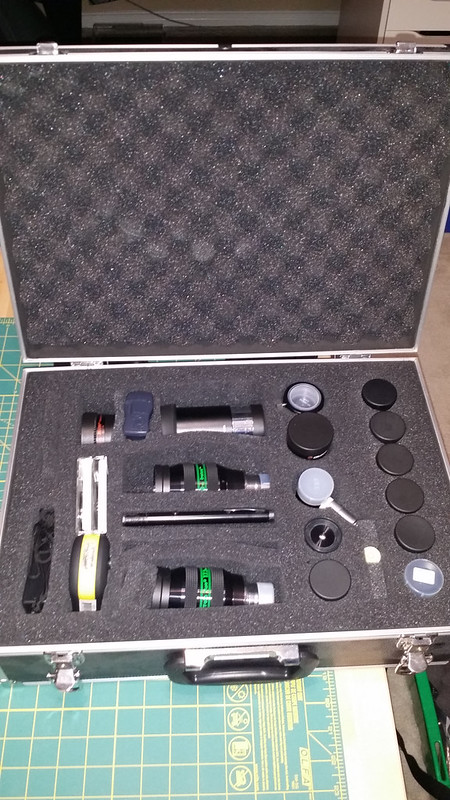
While I was reeling from the loss of my eyepieces, I completely blanked on another small aspect of the loss. They also took my case that the EPs were in. I had ordered it through Amazon, an Orion-branded case, and it came with pluck foam so I could carve out niches for my EPs and keep them safe from physical harm. I put some time and energy into the layout and this was the outcome back in the day:

20180421_005728

A place for everything and everything in its place. I was pretty happy with it. But, as with the EPs themselves, starting over gives me a chance to revisit exactly how I organize my stuff. I have an adapter for my smartphone, filters, a filter wheel, etc., a few other little things that didn’t fit in the above case, and so was separate. What do I do now?

Well, oddly enough, that case wasn’t quite perfect, just good enough. Price was okay, the size was okay, sure, but the locking mechanism always gave me a bit of a nervous edge when carrying it.

However, I was at Canadian Tire a week or so ago, and I found these really awesome cases. And they were on sale. The problem? I don’t know what size I need, and wouldn’t know until I figured out the EP issues above. How much room do Panoptics take? What about the Powermate barlow? How many lenses would I get? How tall are they? What about the other equipment, do I want them in a case?

I cheated. There’s a 90-day return policy, so I bought a small, two mediums and a large case. I figure I’ll likely want two in the end, one for EPs, one for other stuff, I just don’t know which sizes. So this way, I’m covered.  And I’ll just return the ones I don’t need. In the meantime, I’m using a small case with little padding but gets the job done for now.

Viewing

I’d love to say I’ve made huge outings and re-engaged. Instead, the weather has not cooperated. We had to cancel two star party dates in a row (3 if you include International Astronomy Day back at the start of May when we cancelled night-time viewing). I did try to set up one night and the clouds were supposed to improve all night. Instead, it was slightly cloudy at 9:00 when I set up and totally socked-in when I came back at 11:00 to actually view.

I used my solar filter one evening awhile ago and found a small pinhole in that I’ve covered with duct-tape…a bit overkill (you don’t need to probably fix it at all given it is just adding more light to the tube, not directly into your eye), but what the heck. It doesn’t hurt to be overly cautious and affects nothing for performance.

Logging and blogging

Back in 2017, I did up my own customized astronomy log (Draft Astronomy Observing Log). I crowd-sourced some input, pulled some versions off other people’s blogs and various astronomy websites, compiled them all into something that looks great for me, boiled it down to 2 pages, set it up with some other inputs and BAM! I had my own custom astronomy log. Except I hate trying to write in it in the dark. I really wanted something electronic too so that I wouldn’t have to write by hand and then transcribe later. Plus I never did find a good way to hold a red light flashlight while writing. Of course, since I haven’t had much luck with observing, that’s not the biggest issue either.

I have a copy of Sky Safari on my tablet, and it comes with a built-in astronomy log. But even if I customize the heck out of it, there are still some pieces missing for my setup that I would want to record. It’s decent, not awesome. Similarly for several other near tools.

The really GOOD idea is that I could just code an app myself that would have all the bells and whistles I want, customized exactly how I want it. There’s only one problem. I don’t know how to code an app. πŸ™‚

Okay, that seems like a major block, but not an insurmountable one. I’ve always wanted to learn, and I did do coding in high school and university, plus programmed a few small utility apps on my own back in the dark days of DOS. But this is a different kind of beast. Maybe a longer-term solution.

If you step back a second, and look at what I want to do, I basically want to collect data on a tablet with or without a wireless connection, and lots of people have to do this for actual business solutions, right? So I went hunting for solutions. Most of which had monthly subscription fee options, or were good for enterprise solutions, not much decent in the free category.

I shifted sideways and looked for survey and form apps. Same problem.

If I’m completely honest with myself, what I really need is a simple MS Access database (or something very similar). Which would be GREAT if I was just doing it on my desktop, not trying to run it on a tablet in the field (sometimes literally). Google Forms would be AWESOME, except there’s no app version of it that would work without a wireless connection.

But there’s also another “filter” (small pun) at play — I have to be able to use it at night, in the dark, without bright white displays killing my night vision. I found a few tools that were close, but no way to modify the interface, and they often had permanent menus showing, white backgrounds, etc. Not great for an astronomy app. There are apps that will override everything and make it dim, but it’s still not the right colour scheme.

Astronomy apps know this and include a specific type of night mode — black backgrounds, and all lettering is in red font. Hard to replicate in an off-the-shelf app designed mostly for people filling out surveys or forms in malls.

Enter Microsoft

I couldn’t use MS Access as MS doesn’t create an Android version of their database. Nor iOS either. Meh. However, I played with Excel and Word enough to realize that I could colour either the cells all black and change the cell contents to red (in Excel) or change the page background to black and use a red font (Word). In both cases, the app wants to include spaces around the pages, menus, toolbars, etc., all in the wrong colour.

But if I turn off toolbars in Word, eliminate the menus, and set margins to zero all the way around, I end up with a screen that I can say “show page-width” that looks like a black wordprocessor with red lettering. If I minimize the logo line all the way to the minimum and drop the brightness level down to minimum settings, it works. Interesting.

I can do almost the same in Excel, more or less, so what I really wanted to know was what “other” features could I add? Since the dbase option was basically a simple flat-file format, why not do it in Excel, right? Do up some drop-down lists, set a few broad categories, maybe even do short look-ups to allow multiple entries per drop-down (like if I was indicating I was using multiple eyepieces in one viewing session). I could even set some macros that would allow me more sophisticated “profiling” to, for example, allow me to set some pre-defined defaults if I was viewing the moon vs. the sun vs. planets, or if I was using certain filters.

Played with it a bit in Excel and Word, tried doing some simple formatting tricks with macros and VB plugins in the developer menu. I got a couple of things working, mostly just free-designing, not going in with a full-on plan of everything I wanted, just trying some stuff out. I saved the files, kicked them to my tablet, opened them up in the apps, all looked great.

Except for another “small” problem. Most of the functionality didn’t work. The app version, as opposed to the desktop 365 version, doesn’t support macros. Or VB coding. Half the time, it doesn’t even like control inputs (like full drop-downs). Some of it worked, some didn’t. I started playing with checkboxes, thinking “Fine, I’ll just code all the options” and use a checkbox for each of them. Again, some worked perfectly, others didn’t, and I couldn’t modify the data very easily.

Dang it.

Soooo, I went back to basics. A very simple Word document is what I ended up with when I printed the original design two years ago, so why not do the same for the digital note-taker? I ditched tables, most of the checkboxes, left in my instructions for setups, and divided elements between those that are common for the night (i.e. for a session) vs. those that change for each object (i.e. for a target). I then told the computer it was a legal size file and kicked it over to the tablet. After I saved it, removed all the menus and minimized the header area, it actually works. I tried it quickly outside the other night, and visually and tablet-wise, it worked. Now I just need to give it a real-life trial.

Here is the file, if anyone wants to see what I’m using. [ddownload id=”15318″]

In the end

I’ve got my EPs locked and loaded, even if I don’t have the final case setup yet. One more EP in the future, mostly ready to go now. I have cases, just need to decide which ones. I desperately need some clouds to get the heck out of my universe, I feel like I’m hoarding them of late. And I’ve got my astrolog ready to go. I’ve even consolidated some of my astro materials/tools so that I can be down to two small boxes right now. I’m good to go. Imaging is on my list for the future, but not urgent.

In the meantime, I’ll be looking at you, universe!

Posted in Goals | Tagged astronomy, log, observing | Leave a reply

Countdown to Retirement

Days

Hours

Minutes

Seconds

Retirement!

One of my favourite sites

And it's new sister site

My Latest Posts

  • Book clubs 2026-05: May the rigour be with you (it wasn’t with me)May 22, 2026
    Ah, April showers have brought us May books. Wait, that’s not the right saying. I’ll get back to you on that. Remember last month when I said I was going to show rigour? Well, that didn’t happen. With the larger intake base, I have 119 entries for consideration this month. Of which, I only said … Continue reading →
  • Cleaning up book club lists for January to AprilMay 21, 2026
    In my last post, I noted that I’m monitoring 40+ book clubs for “new to me” titles to consider putting on my TBR pile. There is an inherent challenge that I’m saying yes or maybe to between 15-20% of the titles, which is WAY MORE BOOKS THAN I CAN READ. I’ll have to trim those … Continue reading →
  • Book clubs — Missed books in 2025May 21, 2026
    I mentioned earlier that I have a list of 40+ book clubs that I’m monitoring for “new to me” books to consider for my To Be Read (TBR) pile. I went through all of 2025, made a list of ones that interested me, and posted it. But it wasn’t the best of lists. I didn’t … Continue reading →
  • Leveling up: Memes, postcards and flashcardsMay 13, 2026
    So, I have two giant premises working against me here: Yet, every guru on anything web-related has said the same thing for the last fifteen years — that blogs and posts are only successful with eye candy. I’ve played with the formats of posts over the years in certain categories, trying to get them to … Continue reading →
  • Leveling up: Retirement contentMay 6, 2026
    As I mentioned yesterday, I’m doing a “content” review of my websites to see if there are areas I should be expanding or contracting, comparing them to other blogs and posts that are out there. I would like to do more on retirement as I transition out of the public service, but I am always … Continue reading →

Archives

Categories

© 1996-2025 - PolyWogg Privacy Policy
↑