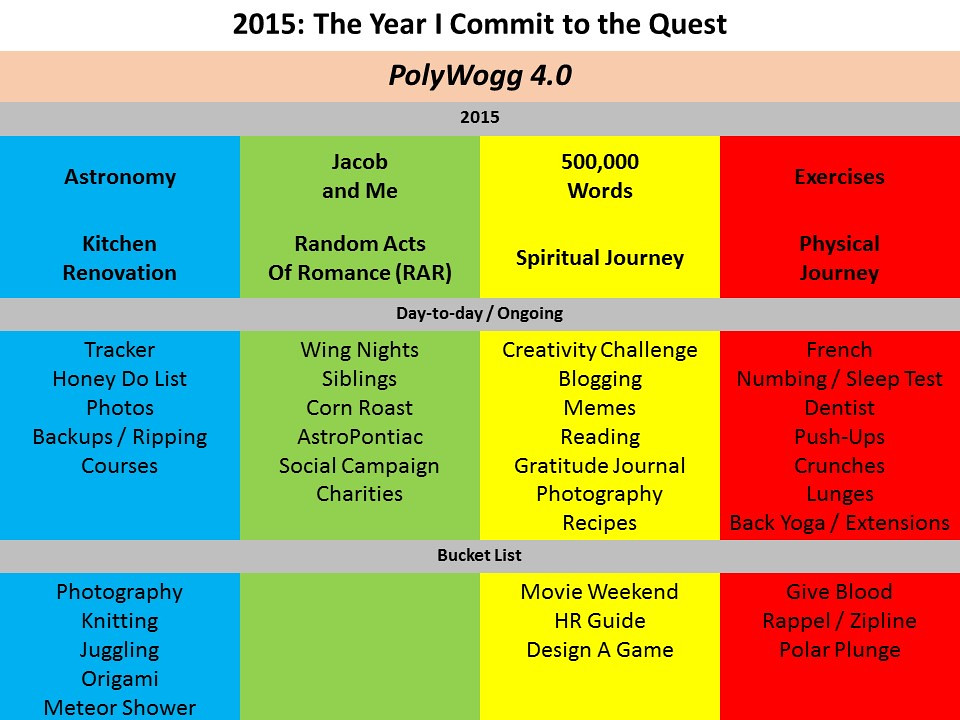
One of the things that is a bit odd about setting goals and doing all this work is that when I’m done, the list isn’t the sort you just memorize. You need to work on it regularly to make progress, and you need a way to remind yourself what the goals are so you don’t skip one. I hesitate to say “see the big picture” as it isn’t exactly about the bigger picture. It’s about seeing the details. So I’ve put them all in a single graphic for myself. Eight overarching goals, 25 ongoing, and 11 bucket list items. I know, 44 sounds like a lot. But PolyWogg 4.0 can handle them. I’m committed to the quest.
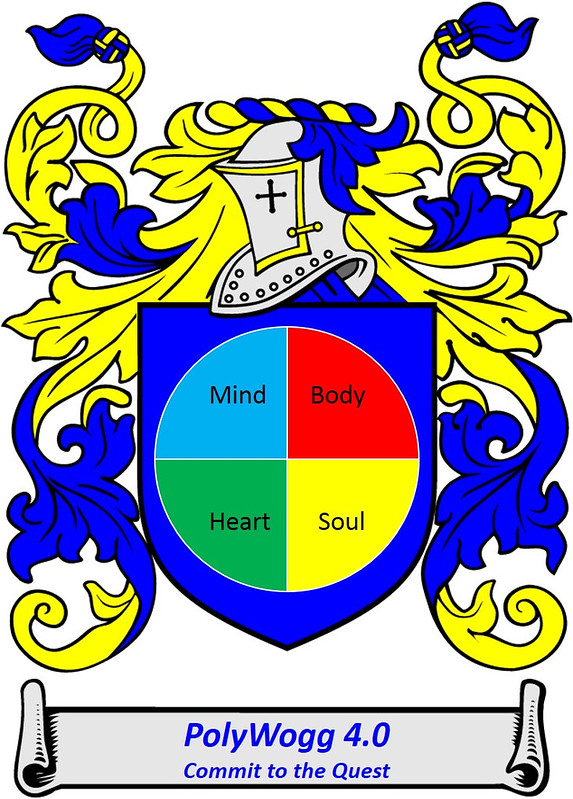
The other thing I want to do is give myself a separate logo for the year. Given that I’m pitching it to myself as a quest, something a little “knight”-like seems in order. So I went back into the archives and found a crest that resembles the Sadleir crest, which is the closest I can find. Add in my 2015 stuff, and I’m good to go.
I’m tempted to put those on a mouse pad or something. Maybe even a T-shirt for the knight logo. I like it a lot. Not that it is amazing artwork, or stellar creative work, but rather that I have something “different” than usual. Something unique to the year that reminds me that it is not business as usual. Whether or not it will help me visualize my goals or not is another story.
I’m still working on my detailed tracker though. I did find a nice planner over at ProductiveFlourishing. They have some of the best planning templates for personal use out there, and they’re all free. They update them every month, just click and download. They’re in editable PDF so they’re pretty good to use right out of the box. Unfortunately, I’ve been at this awhile so out-of-the-box options don’t usually work well for me, but they were enough to give me a good template that I replicated in ExCel and could then move things around, edit, tweak, etc. I’ve done the one for work, just trying to figure out what exactly to do for the blog tracker for the month/year plus my own goal tracker.
In the meantime, I’ve got my logo to keep me focused.
Given my obvious commitment to setting goals, my wife passed along a new tool called “The Year Planning Booklet” from YearCompass. I am going through it page by page, and it’s a pretty good tool. Let me tell you why I like it.
First and foremost, it starts with a review of the past year. You might think that sounds both obvious and counter-intuitive — you’re looking forward, why are you looking back? The reason you look back is the exact way they start the booklet. They have you identify big events and/or meetings of the last year. Which allows you to basically then categorize them into groups to show where you spent your time, what milestones you considered significant. Note that your memory is a really bad source of information — you might have thought, “Hey, I did a great job on meeting with my financial advisor” only to go back through your calendar and realize that you blew them off more than you met with them. Evidence-based analysis is key, and reviewing your last year is pretty good at providing that evidence.
Second, I really like the idea that you write out some simple declarative sentences that summarize various aspects of the year. For example, declaring what your wisest decision / biggest lesson / biggest risk / biggest surprise / biggest service / biggest achievement was during the last year also helps you think in terms of plans vs. reality, static vs. growth. I also like the fact that they go beyond that to nuance the types of “growths” that were possible. Partnerships, influences, best “moments”, what you needed to forgive, etc.
All of which culminates in the decision to close the book on your previous year. It’s done. Let it go (without the cheesy Frozen song). The analysis is a little long for most people, but it’s a decent set of questions to get you thinking before you get to the hard part — setting yourself up for the new year, which is the second part of the booklet.
I like too the idea of dreaming big at the start of the year. It worked for me this year (2015, the year I commit to the quest), but I confess that it won’t work for most people. Very few people know what their goals are, let alone an overarching theme. For many, it’s too big. However, the second page of the new year looks at what you see in family / private life (green energy); work, studies, profession (red energy); belongings (green energy); relaxations, hobbies, creativity (yellow energy); friends, community, service (green energy); health, fitness (red energy); intellectual (blue energy); emotional, spiritual (green or yellow energy); finances (blue or red energy); and a bucket list (any of the four energies). I find it a bit heavy on the green for my taste, but most personal goals approaches do this, reflecting the fact that “home is where the happy is”. It then takes those pieces and has you schedule them throughout the year. Also a good approach. For me, I use the same idea for the Creativity Challenge that I run with friends on Facebook. In it, people commit to certain projects for a single month (one month on, one month off). But it allows you to break larger ideas (Be more creative! Learn to sing!) into more digestible chunks and assign them to individual months.
I’m not as impressed with the next two pages of the booklet that focus on “magical triplets”, as I think in some cases they simply will not apply. Plus I don’t think there is any magic to the power of 3, outside of the Charmed TV series. Plus 12 categories is a bit heavy for most people. Planning shouldn’t tire you out, in my view, it should be short enough that when you’re done you’re energized, not exhausted.
It then concludes with a 30 day challenge, with some suggested items in it. Personally, I’d replace it with the Seinfeld method instead. Lasts longer, and easier to understand. Lots of people miss a day in a 30d challenge and then call it quits, whereas the Seinfeld method keeps trucking along.
I do however really like the ending — a word (or a phrase) for the year ahead. In my case, 2015’s phrase is “Commit to the Quest”. It reminds me what I’m trying to do, how much I’m aiming to do.
A good tool overall. And maybe might inspire me to write my own guide for next year in a similar vein! 🙂