↓
 

The PolyBlog

My view from the lilypads

  • Home
  • Goals
    • Goals (all posts)
    • #50by50 – Status of completion
    • PolyWogg’s Bucket List, updated for 2016
  • Life
    • Family (all posts)
    • Health and Spiritualism (all posts)
    • Learning and Ideas (all posts)
    • Computers (all posts)
    • Experiences (all posts)
    • Humour (all posts)
    • Quotes (all posts)
  • Photo Galleries
    • PandA Gallery
    • PolyWogg AstroPhotography
    • Flickr Account
  • Reviews
    • Lilypad Library (Books)
      • Book Reviews (all posts)
      • Book reviews by…
        • Book Reviews List by Date of Review
        • Book Reviews List by Number
        • Book Reviews List by Title
        • Book Reviews List by Author
        • Book Reviews List by Rating
        • Book Reviews List by Year of Publication
        • Book Reviews List by Series
      • Special collections
        • The Sherlockian Universe
        • The Three Investigators
        • The World of Nancy Drew
      • PolyWogg’s Reading Challenge
        • 2026
        • 2023
        • 2022
        • 2021
        • 2020
        • 2019
        • 2015, 2016, 2017
    • Movies
      • Master Movie Reviews List (by Title)
      • Movie Reviews List (by Date of Review)
      • Movie Reviews (all posts)
    • Music and Podcasts
      • Master Music and Podcast Reviews (by Title)
      • Music Reviews (by Date of Review)
      • Music Reviews (all posts)
      • Podcast Reviews (by Date of Review)
      • Podcast Reviews (all posts)
    • Recipes
      • Master Recipe Reviews List (by Title)
      • Recipe Reviews List (by Date of Review)
      • Recipe Reviews (all posts)
    • Television
      • Master TV Season Reviews List (by Title)
      • TV Season Reviews List (by Date of Review)
      • Television Premieres (by Date of Post)
      • Television (all posts)
  • About Me
    • Subscribe
    • Contact Me
    • Privacy Policy
    • PolySites
      • ThePolyBlog.ca (Home)
      • PolyWogg.ca
      • AstroPontiac.ca
      • About ThePolyBlog.ca
    • WP colour choices
  • Andrea’s Corner

Tag Archives: goals

Post navigation

← Previous Post
Next Post→

Reading Jeffrey Kottler’s “Change”: Chapter 5 – The Benefits of Hitting Bottom

The PolyBlog
August 14 2018

Chapter 5 of Jeffrey Kottler’s “Change” is a challenging chapter in terms of how universally applicable it is. The premise of the chapter, entitled The Benefits of Hitting Bottom, is that some therapists believe that true change will only happen once you hit rock bottom, and you have nowhere to go but up.

It’s a common theme in the narratives of lots of people who turned their lives around and became “success” stories that are shared, repeated for others as inspiration, the “if she/he was down so low and crawled back up, I can do it too”. It is almost de rigeur it seems for addiction stories, and certainly so in pop culture. The arc almost writes itself:

  • Average Joe/Jane goes through life;
  • An EVENT happens and they start taking painkillers;
  • They get addicted;
  • They lose everything, including their spouse and kids;
  • They have an epiphany while lying on the bathroom floor of a dive bar in SoHo;
  • They quit cold turkey and start getting their shit together;
  • They claw their way back into a semblance of normalcy;
  • They`re journey encourages them to help others find their way out too.

The media and the internet loves these kinds of stories, and I confess, I think most of them are complete and utter horseshit. Partly because the narrative is too perfect — “something happened TO them” that started the spiral i.e., there is nothing negative about them, it could happen to anyone. Except often when you poke the surface of the story, you find out that they were a recreational drug user already. But, you know, THAT was under control, no issues. Then, because of the DRUGS, they lost everything, but the story omits the fact that they were already heavily in debt to begin with, and had never held a steady job for more than a couple of months. Or the bathroom floor was just them stopping in while passing by, and they slipped and fell. They weren`t passed out high. But the arc says they bottomed out.

Really? Because there are LOTS of stories out there of people who have bottomed out way lower than that. I`ll come back to that in a moment. But then, by the grace of God (who by the way wasn`t involved in the story up until now apparently), they manage to crawl their way out on their own and are now independent. So, without any training other than they dragged themselves out, they now want to help others, despite the fact that their self-help was partly what gives them their new life, i.e., doing it on their own gave them a boatload of confidence that will now be denied the person they`re helping because they`re not doing the same thing on their own, they`re getting helped. Not that being helped is a bad thing, but if the whole idea is “do what I did”, well, they’re not doing what they did.

Now, separate from my BS detector going off every time I see someone claiming they`ve ascended spiritually or intellectually on their own and now want to become evangelical about the ONE TRUE WAY to change, I am strongly critical of what “bottoming out” even means to them or the universality of approach. As I said above, lots of people bottom out at different places…some might bottom out if there child doesn’t get into their preferred middle school. Others bottom out when they have debt collectors calling. Other bottom out when they’re selling their body for foodstamps and living on the street. Everyone has a different threshold for when the price of whatever they`re doing gets too high for them, and they say, “Okay, I’m out.” They’re fine up until that point, vaguely dissatisfied perhaps or the addiction is too strong, and they hit a point where they say, “here, and no further”. The proverbial and mental line in the sand that once they cross it, they’re suddenly motivated to change.

But I hate the term bottoming out because it suggests someone has nothing left to lose and hence the reason they are willing to change. Except they can always lose something else, even if Dante’s view of hell only had 9 rings.

Part of the reason I don’t like the term is often, as I mentioned above, the therapy community considers bottoming out as a pre-requisite for change. Often in addiction treatments, for example, a tough love view of “they’ll change when they lose everything”. Almost where some people have thought, “Great, I want to change, now I just need to accelerate my bottoming out to get to that point faster.” Not necessarily consciously, but there are those who have told stories of doing exactly that, and partly under a therapist’s care. Including spiritual scammers who convince them material possessions are the devil’s playground and they need to lose it all to experience rebirth, so why not donate it to the scammer’s very helpful associates.

For me, a great question is not only the typical “what is your break-even point where your benefits equal your costs” but rather “how can we change your perception so that the break-even point is higher than you think”. We already have tons of research on positive goal-setting where we are told to chunk large goals into smaller goals and thus you can achieve the smaller ones to start with (assuming they’re realistic) and moving up and on from that early success. But negative goal-setting could work the same way — chunk out a larger fear (i.e. “I never want to weigh more than 300 pounds”) into smaller fears (i.e. “I never want to weigh more than 275, 285, 295”) until the 295 becomes the new 300, or the 275 becomes the new 295. Raising the threshold of what they feel is their break-point before they get to it. Kottler words this as raising the “negative feelings” about the current state of affairs in order to increase motivation/impetus to change, although I’m not sure I like the idea of “feeling worse to get better”, a little too simplistic and too close to hurting yourself to get better.

The chapter struggles with the concept, much in the same way I do, namely that “addiction specialists have a name for the level of desperation it takes to overcome resistance — hitting rock bottom” while researchers call it “someone’s relative degree of impairment”, although I don’t think “bottoming-out” is a prerequisite and what “bottoming-out” means depends on a case-by-base basis. For me, I think the key element is that it isn’t the bottoming-out that matters so much as an open confrontation by a person of what the problem is and what the costs and benefits are that are keeping the situation “as is”. The bottoming-out, so to speak, is just a manifestation that causes the person to confront their costs. Until that happens, the change won’t occur. Kottler talks about how often change won’t happen until there is no alternative, but I am not so certain. As I said, there is always the alternative of death or descending lower to another ring of hell. Instead, they choose to try and rise, a conscious and cognitive-based choice. I do like the recognition however that if the outcome seems uncertain, people will tend to drag their feet on the commitment/implementation until they are more certain their “solution” will work.

Near the end of the chapter, there is a small phrase that jumps out at me, and I’m not sure how I feel about it. While everyone wants to know about preconditions for change, most of the answers are “it depends”. However, Kottler says:

The single best predictor of a successful change effort is the degree of support you receive from others.

I get the theory — you can’t do it alone — but the word that bothers me in that sentence is “degree”. I agree that support is required, but I think it is more about the presence of support, friends or family, or professionals, not the extent of the support as an universal benefit for everyone going through change. I have reflected a great deal on the change I went through between ages 29 and 33. I stripped my psyche down to the component parts, I tweaked and rearranged them, and I put them back together. Did I put them back in the best order possible? I have no idea. But I liked the result. Could I have done it more effectively or efficiently with professional help? Absolutely. Except I wasn’t in the headspace to get professional help at that point, I wouldn’t have accepted it.

Yet I did have support through friends. Three friends in particular, Sebastien, Sara, and Aliza, were privy to my thoughts [perhaps under the hashtag #TMI!], and frequently served as sounding boards as I worked through some of my mental rebuild and tested out my latest theory. And while I don’t want to dismiss some of the EXTREMELY long conversations some of those sessions lasted (Yes, Aliza, I’m talking about you and one particular 12-hour marathon!), there also times where I would sequester myself for 4-6 weeks while I did my homework on myself. So I don’t know if it is about degrees of support so much as (a) having support at all; (b) having support available when needed; and (c) quality of support targeted to the issue being addressed. For example, I knew I had friends. And they were open to conversations about personal things, not just chatting about the weather. But much of what I was trying to figure out what I wanted out of life, and if that life was to be shared with someone else, what I was looking for in a partner.

In retrospect, one of the things I got “right” in my approach is that I did it while single, and remaining so through the process. There is a fair amount of research on addiction treatments and the challenges posed not only for the person in recovery (i.e., anchoring themselves to people who might have enabled their previous behaviour or who harbor resentments for past behaviour) but also for the partner (i.e., the massive changes going on in the other person, often leading to unpredictable behaviour, inconsistent mood management, etc.). I can’t imagine what I would have done to someone else if they were “with” me during that time. Take for instance a serious relationship scenario, where not surprisingly, one of the key questions might be if both people want kids. And during that four years, I didn’t know the answer to that question because I didn’t even know who I was, let alone who else I wanted in my life or what I had to offer. Imagine doing the work while a relationship clock ticks alongside you asking, “So, you got your shit together yet?”.

Massive change over 4 years as I figured out who I was. But my bottoming out, so to speak, didn’t look like most people’s. For me, there was some financial stuff involved, but not life-ending. My father had passed away, and I was in grief. Sure, that was going on, but that’s part of life. But the real “bottoming-out” was simply the end of a relationship where neither of us were “in love” with the other person anymore, but I was still pursuing it. And in my head, I still saw it going towards marriage. Three thoughts were existing in my head simultaneously — a) I wasn’t in love; b) she wasn’t in love with me; and c) we weren’t “right” for each other long-term, and yet I was still bopping along thinking naïvely about the future. And it shocked me. Could I really be so messed up mentally that I would marry someone who was nice and we were friends, rather than holding out for “true love”?

And once I started poking the surface, I realized that I was drifting. Letting the winds of fate blow me wherever life took me, there was no real control in place of asking myself what I wanted, I just let life guide me. Yet that’s not who I wanted to be. I’m more analytical, rational than that…I didn’t think exactly in these terms, but I was more of a planner. A directed life. Yet it wasn’t how I was choosing to live.

Overall, I come down to believing that bottoming-out is the wrong focus — it should be more about figuring out in advance what you think your break-point is, and trying to slow your descent before you hit it, while also potentially raising the threshold through confronting your situation openly and consciously. Bottoming out is just one way to trigger such a confrontation, but my change was triggered not by a flame-out so much as a general malaise with where my life was going and a cognitive confrontation of my need to change to get what I wanted.

Posted in Learning and Ideas | Tagged book review, change, goals, personal development | Leave a reply

Reading Jeffrey Kottler’s “Change”: Chapter 4 – Life-Changing Stories

The PolyBlog
August 13 2018

I read Jeffrey Kottler’s “Change” last year, and was blogging about it, but I got distracted with my “50 things before 50” theme, and kind of forgot about getting back to the book. I wouldn’t say Chapter 4 was particularly compelling for me, or at least most of it wasn’t. It was about how people attempting to change can create narratives to help or hinder themselves. It seems pretty obvious to me, so the various headings of different types of stories didn’t really resonate with me. I did like a couple of quotes, including stories that promote change (as opposed to other stages in the process):

Through the use of metaphors, they have the advantage of operating indirectly and bypassing resistance; they engage in active imagination and require listeners / viewers / readers to personalize the lessons in a meaningful way.

Some helpers (teachers, psychotherapists, health experts, leaders, etc.) often use stories to help instruct or heal:

Contemporary therapists often make frequent use of recommending particular books or films to their clients, even basing their treatments on what has been called bibliotherapy or cinematherapy. One practitioner has compiled a collection of movies that inspire people to overcome their problems, organizing them according to the issues they highlight…

There are some people who read through several self-help books or biographies and nothing resonates. Then they read THE ONE that does resonate with them, and they feel almost like they can model their behaviour after the person’s success. Books help for me, but movies not so much. I do however believe there is a great untapped role for music, but perhaps that is more short-term mood management than inspired change. However, those with specific issues have merged upbeat playlists to help them deal with depression over their love life or their weight or challenges staying motivated to work out. I guess it is similar in many ways to those who listen to sad songs after a break-up to help them process the experience and move them through it towards a healthier mental view of the end of a relationship.

Rarely, however, does a book inspire me so much as an idea or two within a book. I do like the power of stories, just not sure they are as strong when not self-created, so ideas often spark me to take them away, wrestle with them, unpack them, and decide if they work for me or not. But that process is more creative for me than a passive reading of other people’s stories.

Posted in Learning and Ideas | Tagged book review, change, goals, personal development | Leave a reply

Articles I Like: Six Simple Questions That Yield Better Decisions

The PolyBlog
May 14 2018

Over at the Heath Brothers’ site, they have lots of little posts about making better decisions. I signed up for the newsletter at some point and they sent me one entitled “Six Simple Questions That Yield Better Decisions”.

I quite like the list, partly as it is about thinking your way out of a box that you might have put yourself in earlier without realizing it. We all have shortcuts in our thinking processes, and the six questions they suggest are designed to help you avoid “lazy thinking”:

1. Imagine that the option you’re currently leaning toward simply vanished as a feasible alternative. What else could you do? 

2. Imagine that the alternative you are currently considering will actually turn out to be a terrible decision. Where could you go looking for the proof of that right now?

3. How can you dip a toe in the decision without diving in headfirst?

4. [For personal decisions] What would you tell your best friend to do, if he/she was in the same situation?

5. [For professional decisions] If you were replaced tomorrow, what would your successor do about your dilemma?

6. Six months from now, what evidence would make you retreat from this decision? What would make you double-down?

Chip & Dan Heath – NYT bestselling authors of Made to Stick and Switch Heath Brothers

All of them are apparently developed in more detail in their book called Decisive, and I might see if I can pick it up. I certainly liked the list they forwarded.

Posted in Pondside Planner | Tagged decisions, goals, personal | Leave a reply

#50by50 #31 – Expand my volunteering

The PolyBlog
May 6 2018

Let’s start with a confession. I generally don’t like people. 🙂

Okay, that’s not really true, but I am an analytical introvert and extensive social interactions tend to exhaust me, not energize me. So a lot of volunteer options tend to be limited because, you know, they often want you to engage with people. 🙂 Financial books, website stuff though? I can handle that. Especially if I can do it in my track pants and t-shirt while sitting in front of my computer on a Sunday morning. And if I can submit/provide any views on strategic direction, if desired, by email? Count me in!

And I’ve said yes to three volunteer gigs.

AstroPontiac

My friend, Stephan, is organizing an astronomy park in Luskville, Quebec and I agreed to be on the board because (a) he asked and (b) I like the initiative. He is the one who introduced me to astronomy a few years back with a conjunction viewing (Mars and Venus, maybe?) and eventually helped me choose my scope much later. My role is not extensive or taxing. I’m on the Board, agree/propose motions, review proposals, and because he and I work in the same building, can easily sign documents when they’re being submitted to various entities or cheques are being issued. Pretty minimal, but useful to the Initiative. I also attend events when I can (hmm, not sure, I might be the only other Board member with their own scope, not sure).

But my “big” contribution is that I manage the website and handle the domain registration/renewals. It is not a particularly sophisticated website, more a simple page that says where it is and lists the events. When there is an observation night, I also post the “Go / No go” message to the site, once Stephan decides (he tweets it and updates on FB). The only quirk to the site is that it is bilingual. There are a few plugins in WordPress to help with that, but either I’m an idiot, or they’re finicky. I tried the most popular one but couldn’t get it to handle the menus properly. Instead, I’ve manually coded the pages using buttons and bypassed the menu option entirely. I tried bilingual pages, and the layout challenges were just too painful (often French text is longer than the same English text, which causes different lengths to side-by-side paragraphs). Eventually, when the site is bigger and in more regular operation, we’ll likely need a content creator and possibly a re-design, but it meets the needs and I can handle the ops for now.

School support

My wife is on the School Council for my son’s school, and they needed a webmaster-type person to be able to post documents, link things, etc. It is an extremely minimal role. I moved a few docs around when I started, just to put them all together in good order, created an “old page” for previous years and kept the current ones there. I often feel like I should be doing more, tweaking it more, but the load/need is pretty minimal. Most of the people accessing things are the members themselves. And for the other content, i.e. notices of bake sales or book sales or foodstuff, there is a content creator who directly posts all that themselves. I just have to watch the website and tweak it if something goes wonky. Easy peasy, lemon squeezy.

RASC Ottawa

Last year, the Star Party Coordinator was looking for a replacement so he could focus on other activities in the club, and so I took it over. The star parties are monthly free public stargazing events held in the darkened parking lot of the Carp Public Library, next to the Diefenbunker.

For my role, as the interim SPC, I was basically sending out a series of emails a week before to say “Star Party next week”, sending out the same series the day of the event to say “Yes it’s on” or “Postponed to the rain date”, and making sure there were Marshals at the site (to turn the lights off at the start, turn the lights back on at the end, and handle basic safety during the meeting). If I have Marshals attending, I don’t even have to GO to the star party. I do go, but the pressure is off if I want to leave early or arrive late, etc. We can share the on-site duties a bit.

So, with low-intensity involvement, I was happy to fill in as the interim SPC for last year. I also liked the idea of trying it out for a few months to see if I was willing to take it on longer-term. Turns out, I was indeed willing. So I became the SPC for 2018 too.

Now, I’m anal. And a planner. So the first thing I wanted to do was survey the members who go to the Star Parties to see what “else” they were looking for if anything. Not surprisingly, on-site washrooms popped to the head of the list. Second on the list was a light barrier to block car lights at the site, but really, that’s almost a parking issue. Washrooms and parking, the two biggies for any public event. Not surprising. But I asked a bunch of other questions too for interest and got some good results. (Survey results for RASC Star Parties in Ottawa for 2018)

However, I wanted to go a bit further. I wanted to know if other Centres were doing things that we weren’t. There are 26 RASC Centres in Canada, and I reached out to all of them to see if they were interested in a quick survey. A bunch were, some sent me some comments on questions, and about half filled out the overall survey. I found some really interesting results, and it helped build my confidence we were in the right ballpark with our approach. Some key takeaways for me were cross-promotion and pushing for more members-only observing, not just public events.

Did I have to do either survey? No, the process is relatively well-established, so I could have just done the same as last year and been perfectly fine. But it helped with some internal capacity-building.

This year, as full SPC, I also had to arrange a few other things that were already done last year:

  • Propose and confirm dates for the star parties (not as easy as that sounds!);
  • Approval from the library and Diefenbunker to use the space;
  • Insurance certificate from the national organization for our dates;
  • Contract with the city for formal consent to use the space on specified dates;
  • Put all the dates on social media, website, etc.;
  • Find field marshals for the year.

I will also be looking into portable toilet rental, and possibly a large tarp to block light. And, just for fun, I’ll be trying to figure out how to promote other viewing activities across the city and at other locations.

Is it more work? Sure. But I get a lot out of membership, including just maintaining my interest in the hobby for the first five years of alignment problems, attending the Star Parties myself and with my family, and last but not least, actually having members solve the problems with the scope (Solving alignment problems with the Celestron NexStar 8SE).

In the past, I admit I have felt somewhat disconnected from the club. It is surprisingly hard to bond with people when (a) you don’t generally like people hehehe and (b) the events take place in the dark where all you have are voices, no faces to remember for next time or at the monthly meeting.

As the official SPC for 2018 (can you tell I like the acronym SPC? Space / Star Party Coordinator, get it?), I was invited to attend the Council meeting this past month. And I *loved* it. I liked seeing the discussions on the direction of the club, finances, other events going on, etc. I could see myself getting more involved over time. But baby steps. I don’t need to take over the Galactic Senate for many years to come, and I have to develop my evil voice in the meantime anyway.

Adding in some money

Now here’s a bit of a question I don’t have my head wrapped around yet. Back when I was a bit younger with work, I was using the internal donation system to handle any charitable giving. But after doing a bit of investigating on United Way, overhead rates, etc., I realized I wasn’t comfortable with their approach. They have good comms people doing up bullet points to respond to these types of questions, but in the end, I decided the fund-raising costs were unconscionable on the front-end and mildly extortionate on the back-end. As such, I’ve tended to default to two other types of giving.

First, I let Andrea do the bulk of it since she manages most of the finances. Various societies, memberships, associations, etc., almost all funded directly.

Second, if a friend is raising money for x or y, and they need a sponsor, I’m often a soft touch. Even for United Way events at work — I may not want to support them directly, but if other people are putting their time and energy into it, heck, I’m willing to honour that commitment and initiative. Just don’t ask me to run the relay with you. What’s that saying? You need people to stand along the parade route too and clap? That’s me. As long as I don’t actually have to come out and stand there or clap. But, “good on ya”, I say.

So I wonder. I’m putting time and energy into the two astronomy efforts, why don’t I sponsor myself too? Something to think about. I confess I am a bad donor though. I like the idea of paying for specific things where I can think, “Hey, I paid for *that*” and to see what I got for my money rather than doing the proper thing which is to contribute to general revenue and trust the organization to put the money to the highest priority use. None of the ones involved have any salaries to worry about or real overhead, so why target my funds? Hmmm…

But that’s next year’s problem. This year, I just wanted to volunteer a bit more of my time.

Posted in Pondside Planner | Tagged astronomy, clubs, goals, volunteer | Leave a reply

#50by50 #30 – Organize my astronomy gear

The PolyBlog
May 1 2018

I mentioned earlier this week that I had started my astronomy season for the year (Kicking off my 2018 astronomy season with two outings) and in the post, I shared two photos of cases I had set up for my gear (eye pieces and my filters). What I didn’t mention at the time is that this is also related to a #50by50 goal — organize my astronomy gear.

That seems a bit basic, doesn’t it? Why would I put organizing my astronomy gear into a plan for 50 things to do before I’m 50?

Simply put, because it is a bit of a proxy for myself. What I really wanted to say was, “Okay, I’ve committed to this hobby”, and one way to do that was to organize my gear properly. Let me explain.

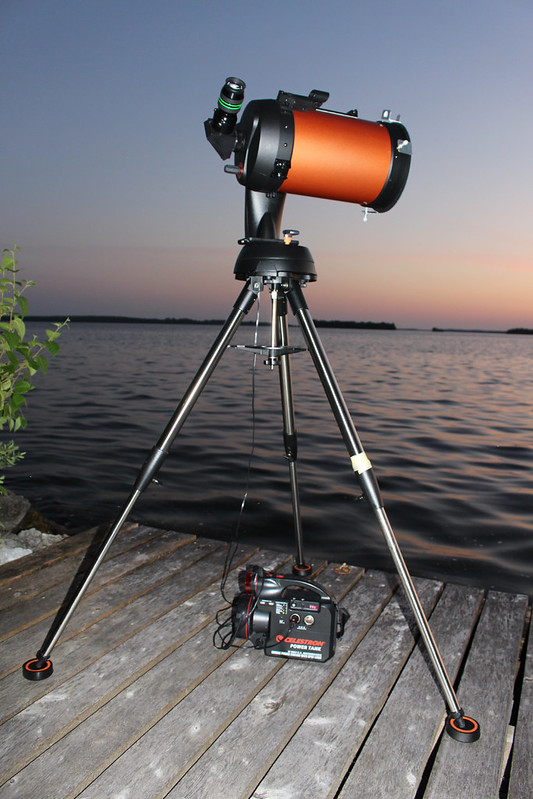
When I bought my scope, this is the setup / gear I got:

Celestron NexStar 8SE

Now, looking at that photo more closely, you can divide some of the sections into separate categories:

  1. The scope itself — the optical tube assembly (OTA) as they say in astro circles, or “the orange part” for the layperson;
  2. The mount — You can’t see it but there is an arm going up the other side of the orange tube, and coming down to just above the top of the tripod, i.e. the “black part” before you get to the legs;
  3. The tripod — The three silver legs; and,
  4. The accessories — everything else.

My organization to date has been relatively done on the cheap. For the mount, I tend to leave it attached to the tripod, and move it all together as one piece. There’s a hand controller that attaches to it, and it regularly falls off and dangles, which is a pain, but other than that, it’s relatively safe to lie on its side, move it around, as long as I don’t drop things on it, drop it itself, or mistake it for a hammer to whack something with.

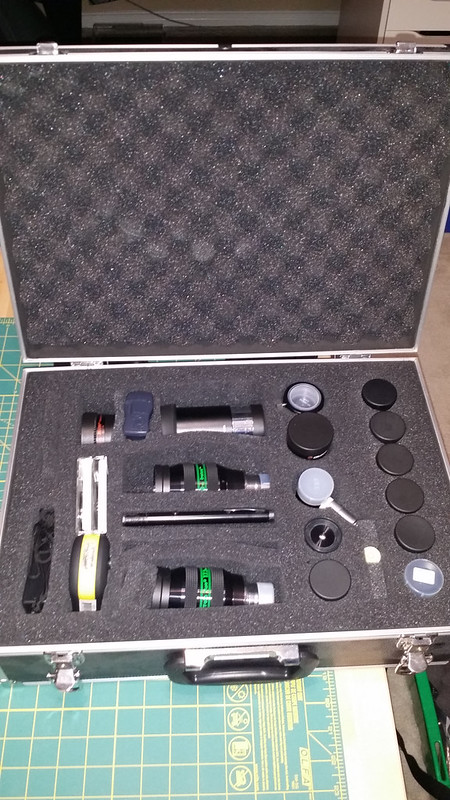
For all the accessories i.e. the eyepieces and filters mainly, I had been keeping them relatively loose in tupperware-type containers partly as it is easy to pop in some gel packs and control for any humidity. Plus, well, the plastic cases are cheap and come in different sizes. Add a bit of foam and they were good to go. But all the EPs together probably cost as much as the scope, and are more easily damaged, so I set up an aluminum case I bought on Amazon plus a plastic case (originally for a handgun) that I bought at Canadian Tire. A bit of pluck foam later, and Bob’s your uncle, I had two cases set up for the main accessories:

20180421_005728
20180501_220911

Which basically left me with one big question and one smaller one (how to transport the little accessories, easily ignored for now). For the big question, I had to figure out how to transport my scope safely. Here’s the challenge. The scope is relatively self-contained, has good framing etc., but it doesn’t handle hard knocks particularly well (you can knock mirrors out of alignment) and it’s kind of big. I have a good place to keep it in its own cupboard in the garage, so that wasn’t a problem, but I’ve been carefully transporting it to and from the car, while relying mainly on a large duffel bag to allow me to keep my hands free while I did it. It sounds a bit risky, but not really. I move everything carefully, I’m not walking around like it’s a gym bag with clothes in it. Plus the “soft” nature of the case let me “wrap” it evenly for support.

But just about everyone I know has a hard case of some sort for their scope to protect it. And if I’m going to be serious about my hobby, and my tools to do that hobby, I’ve been feeling like I needed a proper case too.

Now, Celestron will sell me one, specifically designed to fit my scope, all good. Except it is $300 and a very tight snug fit. If you have any peripherals added, they all have to come off apparently to fit in the case. Hmm. And $300? Pretty expensive.

So there are after market solutions people have done, mainly using Pelican cases. High quality, good reputation, can be ordered online. Even usually comes with pluck foam inside. Great. Except the case I need, or rather in the size I need, runs about $300. Noticing a pattern?

My friend Rennie just did one for his scope, but he had a large case to use, and he wanted his mount to fit inside too. I admire his commitment to set that up on the scope everytime, I’m too lazy to keep doing that. But I wanted a case still for the tube.

I visited Home Depot and found this GREAT tool box, 28″ long. Seemed PERFECT. Brought it home, tried it out, and the scope fit! Except it didn’t, not really. Lengthwise it was fine. But for girth, it was right against the sides of the toolbox, no room for any foam or padding. In other words, any knock on the case would directly transmit to the tube. No dice. I tried another from Canadian Tire, and the girth was a little better, but the length was off by an inch or two. I could take a couple of accessories off, but then everytime I use it — which is mostly in Ottawa by percentage — I would have to put things back together. To give you an analogy, it would be like a camera case where you had to remove the batteries, memory card and lens everytime you put the camera in. So when you went to use it, you would have to reassemble all the pieces. Every time. And for me, the more time I spend on setup, the less time I spend observing and the less frequent I’ll even go. Kind of like the friction test for purchases — more hurdles, less purchases.

So I started looking at larger cases. Almost all of the ones up to $100 or so were too short. Some came close, but when you opened them up, the insides had these extra grooves and dividers that were permanent and meant you didn’t have the full space available. I tried Home Depot, Canadian Tire, Rona and Lowes, plus about 10 stores online (including Amazon). I finally found a couple of options in the $119 range, but they weren’t quite right for size and shape (Dewalt / Stanley versions). Doable, but not sold. I did find one that laid a bit flatter, and had some extra room in it that seemed really interesting, but the only reviews I found online said that it was rather flimsy and the handles and hinges tended to break. For $120? I wouldn’t be using it as heavy (most people use them for tools), but I wouldn’t want to be carrying it and have the handle break off.

Which put me in the $170 range for some really solid Dewalt models (although the Husky and Stanley versions were good too). They came with wheels, and lots of extra space. But that extra space comes at two costs — the extra $$ involved, sure, but also the extra real estate in the car. I originally was hoping for something I could use to take the scope to the cottage too, but I have ways around that I suppose.

One nice feature that I have, and I don’t know how long it will last, is that when the scope arrived, it came in a cardboard box with form-fitting packing form. The cardboard box is rubbish, but I can put the foam in a different box, and then pack my scope in it. In the end, I decided that if I was going to go “big”, I might as well just get myself a simple tub. Total cost? $13. Plus there’s room left over for suppression pads (they go under the tripod legs to reduce vibration), my power cord, my filter case (yay it fits, boo the EP case doesn’t), my light, and wonders of wonders, it will also hold my solar filter in its original packaging as I have no other way to keep it safe). Is it awesome, worthy of emulation? Nope. I’ll also have to decide if it is too heavy with everything in it or not and which objects I will keep in the box. Sigh. 

It’s functional and can do the job perfectly fine, and at a tenth the cost. The tube sits underneath in the white foam, with parts and accessories down the side, and the regular filter case plus solar filter on top.

Works for me. I’m committed to the hobby, I’ve got cases to protect my gear!

Posted in Pondside Planner | Tagged accessories, astronomy, cases, gear, goals | Leave a reply

Post navigation

← Previous Post
Next Post→

Countdown to Retirement

Days

Hours

Minutes

Seconds

Retirement!

One of my favourite sites

And it's new sister site

My Latest Posts

  • Frog writing book review entries into a journal
    Book clubs 2026-06: A birthday buffet too rich to finishJune 10, 2026
    Ah, the fresh scent of June and my birthday month. There are lots of interesting books for me to consider reading on my birthday. First, though, there are some gifts from last month that weren’t posted in time for my roll-up, even though I said no to all of them! I’ve also been wondering about … Continue reading →
  • A red-eyed tree frog wearing a panda apron is stirring food in the Lilypad Kitchen.
    Leveling up – Three kitchens, one frogMay 28, 2026
    Let me start with a confession. I only have 12 recipes on the website. Not much of a start, right? But this is part of my anal-retentive side. I like to curate recipes, find some good ones, and then put them on my blog. Except that I have hated the design of my recipes for … Continue reading →
  • Leveling up – From Goals to Pondside PlannerMay 27, 2026
    I write a lot about goals. Goals for the day, goals for life, goals for the week. Goals before retirement. Setting goals, monitoring goals, achieving goals, dropping goals. Different types of goals, different types of methods for managing goals. Having goals as a goal in and of itself. Sometimes it veers into performance measurement. Yet, … Continue reading →
  • Leveling up – Movie reviewsMay 27, 2026
    Similar to the work on the Lilypad Library (my book reviews), I’ve upgraded my movie reviews, too. First and foremost, I’ve changed the name to Lilypad Cinema. Notice the theme? Yes, I’m leaning fully into the frog motif. Second, I’ve upgraded my featured image. Previously, I used the couch potato-style image below, with the man … Continue reading →
  • Frog writing book review entries into a journal
    Leveling up – Book reviewsMay 26, 2026
    Soooo…I have said a few times over the last few years, “NEVER AGAIN WILL I EVER CHANGE MY BOOK REVIEWS FORMAT.” Why? Because I am generally anal-retentive, and with 300 completed reviews, there is a niggly part of me where, if I change something, I want to go back and change all of them to … Continue reading →

Archives

Categories

© 1996-2026 - Paul Sadler aka PolyWogg Privacy Policy
↑