This is the annual observer’s guide published by the Royal Astronomical Society of Canada.
What I Liked
Each year, the Observer’s Guide is produced and sold to amateur and professional astronomers across North America, and those astronomers vary considerably in their capacity and interests. It’s hard to serve any “one group”, but as I am at the intro stage to the hobby, I’ll review from that perspective. Some highlights include:
List of observatories, star parties, planetaria (pp 11-14);
Observable satellites of the planets (pp 25-26);
Observing artificial satellites (p 38);
Overview of filters (pp 64-67);
Deep-sky observing hints by Alan Dyer (pp 85-87);
Lunar observing (pp 158-161);
The brightest stars (pp 274-283, 285); and,
The deep sky (pp 307-337).
Of course, it also has the key reference materials:
The Moon (pp 148-157);
The Sun (pp 184-193);
Dwarf and minor planets (pp 241-251); and,
Double and multiple stars (pp 291-294, 296-297).
And it has specific highlights for the year:
The Sky month-by-month (pp 94-121);
Times of sunrise and sunset for 2019 (pp 205-207);
2019 transit of Mercury (pp 139-143);
The planets in 2019 (pp 211-229); and,
Comets in 2019 (p 264).
I’m happy too that some of the errors in URLs published last year have been corrected.
What I Didn’t Like
I still find the pages on telescope exit pupils (pp 50-53) to be incredibly dense. I keep meaning to find a more basic set of explanations online of it, but I never seem to get around to it. I would add the next section on magnification and contrast in deep sky observing (pp 54-57) as equally confusing. I have to believe that dense text can somehow be explained more easily to the newbie with some basic guidelines for common scopes and ages of users. Equally, I’m not thrilled with the astrophotography section (pp 91-93) which still lists the “big cameras” as best, in the same way that many photography websites ten years ago suggested that professionals would never go digital. There is an emerging market for people sharing prime shots they take with their smartphones — souvenir quality shots, not NASA shots — and it is almost completely ignored by the section (grudgingly it says “even cell phones”). I also find that the economic bias of last year towards higher-end binoculars and scopes continues. But those issues are mostly me just being picky — they aren’t enough to reduce the overall rating.
Disclosure
I received a copy of the guide as part of my annual membership in RASC.
Let’s start with a confession. I generally don’t like people. 🙂
Okay, that’s not really true, but I am an analytical introvert and extensive social interactions tend to exhaust me, not energize me. So a lot of volunteer options tend to be limited because, you know, they often want you to engage with people. 🙂 Financial books, website stuff though? I can handle that. Especially if I can do it in my track pants and t-shirt while sitting in front of my computer on a Sunday morning. And if I can submit/provide any views on strategic direction, if desired, by email? Count me in!
And I’ve said yes to three volunteer gigs.
AstroPontiac
My friend, Stephan, is organizing an astronomy park in Luskville, Quebec and I agreed to be on the board because (a) he asked and (b) I like the initiative. He is the one who introduced me to astronomy a few years back with a conjunction viewing (Mars and Venus, maybe?) and eventually helped me choose my scope much later. My role is not extensive or taxing. I’m on the Board, agree/propose motions, review proposals, and because he and I work in the same building, can easily sign documents when they’re being submitted to various entities or cheques are being issued. Pretty minimal, but useful to the Initiative. I also attend events when I can (hmm, not sure, I might be the only other Board member with their own scope, not sure).
But my “big” contribution is that I manage the website and handle the domain registration/renewals. It is not a particularly sophisticated website, more a simple page that says where it is and lists the events. When there is an observation night, I also post the “Go / No go” message to the site, once Stephan decides (he tweets it and updates on FB). The only quirk to the site is that it is bilingual. There are a few plugins in WordPress to help with that, but either I’m an idiot, or they’re finicky. I tried the most popular one but couldn’t get it to handle the menus properly. Instead, I’ve manually coded the pages using buttons and bypassed the menu option entirely. I tried bilingual pages, and the layout challenges were just too painful (often French text is longer than the same English text, which causes different lengths to side-by-side paragraphs). Eventually, when the site is bigger and in more regular operation, we’ll likely need a content creator and possibly a re-design, but it meets the needs and I can handle the ops for now.
School support
My wife is on the School Council for my son’s school, and they needed a webmaster-type person to be able to post documents, link things, etc. It is an extremely minimal role. I moved a few docs around when I started, just to put them all together in good order, created an “old page” for previous years and kept the current ones there. I often feel like I should be doing more, tweaking it more, but the load/need is pretty minimal. Most of the people accessing things are the members themselves. And for the other content, i.e. notices of bake sales or book sales or foodstuff, there is a content creator who directly posts all that themselves. I just have to watch the website and tweak it if something goes wonky. Easy peasy, lemon squeezy.
RASC Ottawa
Last year, the Star Party Coordinator was looking for a replacement so he could focus on other activities in the club, and so I took it over. The star parties are monthly free public stargazing events held in the darkened parking lot of the Carp Public Library, next to the Diefenbunker.
For my role, as the interim SPC, I was basically sending out a series of emails a week before to say “Star Party next week”, sending out the same series the day of the event to say “Yes it’s on” or “Postponed to the rain date”, and making sure there were Marshals at the site (to turn the lights off at the start, turn the lights back on at the end, and handle basic safety during the meeting). If I have Marshals attending, I don’t even have to GO to the star party. I do go, but the pressure is off if I want to leave early or arrive late, etc. We can share the on-site duties a bit.
So, with low-intensity involvement, I was happy to fill in as the interim SPC for last year. I also liked the idea of trying it out for a few months to see if I was willing to take it on longer-term. Turns out, I was indeed willing. So I became the SPC for 2018 too.
Now, I’m anal. And a planner. So the first thing I wanted to do was survey the members who go to the Star Parties to see what “else” they were looking for if anything. Not surprisingly, on-site washrooms popped to the head of the list. Second on the list was a light barrier to block car lights at the site, but really, that’s almost a parking issue. Washrooms and parking, the two biggies for any public event. Not surprising. But I asked a bunch of other questions too for interest and got some good results. (Survey results for RASC Star Parties in Ottawa for 2018)
However, I wanted to go a bit further. I wanted to know if other Centres were doing things that we weren’t. There are 26 RASC Centres in Canada, and I reached out to all of them to see if they were interested in a quick survey. A bunch were, some sent me some comments on questions, and about half filled out the overall survey. I found some really interesting results, and it helped build my confidence we were in the right ballpark with our approach. Some key takeaways for me were cross-promotion and pushing for more members-only observing, not just public events.
Did I have to do either survey? No, the process is relatively well-established, so I could have just done the same as last year and been perfectly fine. But it helped with some internal capacity-building.
This year, as full SPC, I also had to arrange a few other things that were already done last year:
Propose and confirm dates for the star parties (not as easy as that sounds!);
Approval from the library and Diefenbunker to use the space;
Insurance certificate from the national organization for our dates;
Contract with the city for formal consent to use the space on specified dates;
Put all the dates on social media, website, etc.;
Find field marshals for the year.
I will also be looking into portable toilet rental, and possibly a large tarp to block light. And, just for fun, I’ll be trying to figure out how to promote other viewing activities across the city and at other locations.
Is it more work? Sure. But I get a lot out of membership, including just maintaining my interest in the hobby for the first five years of alignment problems, attending the Star Parties myself and with my family, and last but not least, actually having members solve the problems with the scope (Solving alignment problems with the Celestron NexStar 8SE).
In the past, I admit I have felt somewhat disconnected from the club. It is surprisingly hard to bond with people when (a) you don’t generally like people hehehe and (b) the events take place in the dark where all you have are voices, no faces to remember for next time or at the monthly meeting.
As the official SPC for 2018 (can you tell I like the acronym SPC? Space / Star Party Coordinator, get it?), I was invited to attend the Council meeting this past month. And I *loved* it. I liked seeing the discussions on the direction of the club, finances, other events going on, etc. I could see myself getting more involved over time. But baby steps. I don’t need to take over the Galactic Senate for many years to come, and I have to develop my evil voice in the meantime anyway.
Adding in some money
Now here’s a bit of a question I don’t have my head wrapped around yet. Back when I was a bit younger with work, I was using the internal donation system to handle any charitable giving. But after doing a bit of investigating on United Way, overhead rates, etc., I realized I wasn’t comfortable with their approach. They have good comms people doing up bullet points to respond to these types of questions, but in the end, I decided the fund-raising costs were unconscionable on the front-end and mildly extortionate on the back-end. As such, I’ve tended to default to two other types of giving.
First, I let Andrea do the bulk of it since she manages most of the finances. Various societies, memberships, associations, etc., almost all funded directly.
Second, if a friend is raising money for x or y, and they need a sponsor, I’m often a soft touch. Even for United Way events at work — I may not want to support them directly, but if other people are putting their time and energy into it, heck, I’m willing to honour that commitment and initiative. Just don’t ask me to run the relay with you. What’s that saying? You need people to stand along the parade route too and clap? That’s me. As long as I don’t actually have to come out and stand there or clap. But, “good on ya”, I say.
So I wonder. I’m putting time and energy into the two astronomy efforts, why don’t I sponsor myself too? Something to think about. I confess I am a bad donor though. I like the idea of paying for specific things where I can think, “Hey, I paid for *that*” and to see what I got for my money rather than doing the proper thing which is to contribute to general revenue and trust the organization to put the money to the highest priority use. None of the ones involved have any salaries to worry about or real overhead, so why target my funds? Hmmm…
But that’s next year’s problem. This year, I just wanted to volunteer a bit more of my time.
I mentioned earlier this week that I had started my astronomy season for the year (Kicking off my 2018 astronomy season with two outings) and in the post, I shared two photos of cases I had set up for my gear (eye pieces and my filters). What I didn’t mention at the time is that this is also related to a #50by50 goal — organize my astronomy gear.
That seems a bit basic, doesn’t it? Why would I put organizing my astronomy gear into a plan for 50 things to do before I’m 50?
Simply put, because it is a bit of a proxy for myself. What I really wanted to say was, “Okay, I’ve committed to this hobby”, and one way to do that was to organize my gear properly. Let me explain.
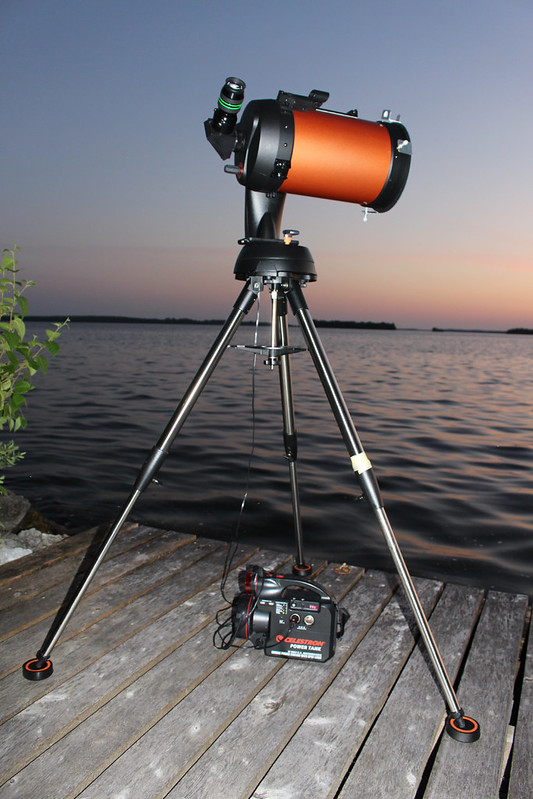
When I bought my scope, this is the setup / gear I got:
Now, looking at that photo more closely, you can divide some of the sections into separate categories:
The scope itself — the optical tube assembly (OTA) as they say in astro circles, or “the orange part” for the layperson;
The mount — You can’t see it but there is an arm going up the other side of the orange tube, and coming down to just above the top of the tripod, i.e. the “black part” before you get to the legs;
The tripod — The three silver legs; and,
The accessories — everything else.
My organization to date has been relatively done on the cheap. For the mount, I tend to leave it attached to the tripod, and move it all together as one piece. There’s a hand controller that attaches to it, and it regularly falls off and dangles, which is a pain, but other than that, it’s relatively safe to lie on its side, move it around, as long as I don’t drop things on it, drop it itself, or mistake it for a hammer to whack something with.
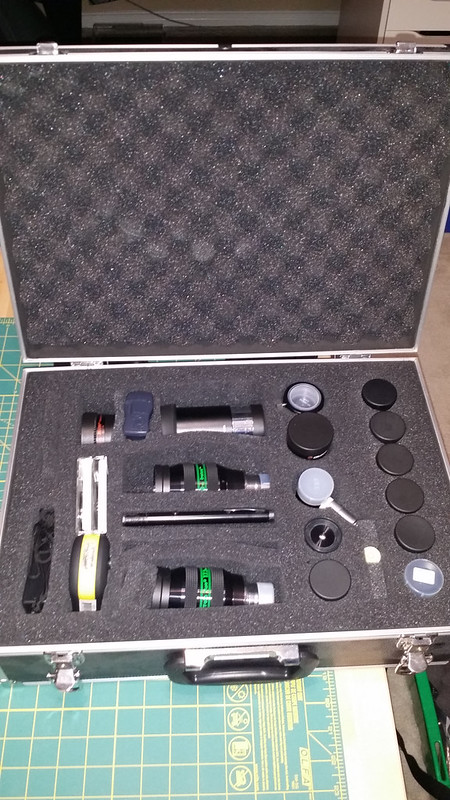
For all the accessories i.e. the eyepieces and filters mainly, I had been keeping them relatively loose in tupperware-type containers partly as it is easy to pop in some gel packs and control for any humidity. Plus, well, the plastic cases are cheap and come in different sizes. Add a bit of foam and they were good to go. But all the EPs together probably cost as much as the scope, and are more easily damaged, so I set up an aluminum case I bought on Amazon plus a plastic case (originally for a handgun) that I bought at Canadian Tire. A bit of pluck foam later, and Bob’s your uncle, I had two cases set up for the main accessories:
Which basically left me with one big question and one smaller one (how to transport the little accessories, easily ignored for now). For the big question, I had to figure out how to transport my scope safely. Here’s the challenge. The scope is relatively self-contained, has good framing etc., but it doesn’t handle hard knocks particularly well (you can knock mirrors out of alignment) and it’s kind of big. I have a good place to keep it in its own cupboard in the garage, so that wasn’t a problem, but I’ve been carefully transporting it to and from the car, while relying mainly on a large duffel bag to allow me to keep my hands free while I did it. It sounds a bit risky, but not really. I move everything carefully, I’m not walking around like it’s a gym bag with clothes in it. Plus the “soft” nature of the case let me “wrap” it evenly for support.
But just about everyone I know has a hard case of some sort for their scope to protect it. And if I’m going to be serious about my hobby, and my tools to do that hobby, I’ve been feeling like I needed a proper case too.
Now, Celestron will sell me one, specifically designed to fit my scope, all good. Except it is $300 and a very tight snug fit. If you have any peripherals added, they all have to come off apparently to fit in the case. Hmm. And $300? Pretty expensive.
So there are after market solutions people have done, mainly using Pelican cases. High quality, good reputation, can be ordered online. Even usually comes with pluck foam inside. Great. Except the case I need, or rather in the size I need, runs about $300. Noticing a pattern?
My friend Rennie just did one for his scope, but he had a large case to use, and he wanted his mount to fit inside too. I admire his commitment to set that up on the scope everytime, I’m too lazy to keep doing that. But I wanted a case still for the tube.
I visited Home Depot and found this GREAT tool box, 28″ long. Seemed PERFECT. Brought it home, tried it out, and the scope fit! Except it didn’t, not really. Lengthwise it was fine. But for girth, it was right against the sides of the toolbox, no room for any foam or padding. In other words, any knock on the case would directly transmit to the tube. No dice. I tried another from Canadian Tire, and the girth was a little better, but the length was off by an inch or two. I could take a couple of accessories off, but then everytime I use it — which is mostly in Ottawa by percentage — I would have to put things back together. To give you an analogy, it would be like a camera case where you had to remove the batteries, memory card and lens everytime you put the camera in. So when you went to use it, you would have to reassemble all the pieces. Every time. And for me, the more time I spend on setup, the less time I spend observing and the less frequent I’ll even go. Kind of like the friction test for purchases — more hurdles, less purchases.
So I started looking at larger cases. Almost all of the ones up to $100 or so were too short. Some came close, but when you opened them up, the insides had these extra grooves and dividers that were permanent and meant you didn’t have the full space available. I tried Home Depot, Canadian Tire, Rona and Lowes, plus about 10 stores online (including Amazon). I finally found a couple of options in the $119 range, but they weren’t quite right for size and shape (Dewalt / Stanley versions). Doable, but not sold. I did find one that laid a bit flatter, and had some extra room in it that seemed really interesting, but the only reviews I found online said that it was rather flimsy and the handles and hinges tended to break. For $120? I wouldn’t be using it as heavy (most people use them for tools), but I wouldn’t want to be carrying it and have the handle break off.
Which put me in the $170 range for some really solid Dewalt models (although the Husky and Stanley versions were good too). They came with wheels, and lots of extra space. But that extra space comes at two costs — the extra $$ involved, sure, but also the extra real estate in the car. I originally was hoping for something I could use to take the scope to the cottage too, but I have ways around that I suppose.
One nice feature that I have, and I don’t know how long it will last, is that when the scope arrived, it came in a cardboard box with form-fitting packing form. The cardboard box is rubbish, but I can put the foam in a different box, and then pack my scope in it. In the end, I decided that if I was going to go “big”, I might as well just get myself a simple tub. Total cost? $13. Plus there’s room left over for suppression pads (they go under the tripod legs to reduce vibration), my power cord, my filter case (yay it fits, boo the EP case doesn’t), my light, and wonders of wonders, it will also hold my solar filter in its original packaging as I have no other way to keep it safe). Is it awesome, worthy of emulation? Nope. I’ll also have to decide if it is too heavy with everything in it or not and which objects I will keep in the box. Sigh.
It’s functional and can do the job perfectly fine, and at a tenth the cost. The tube sits underneath in the white foam, with parts and accessories down the side, and the regular filter case plus solar filter on top.
Works for me. I’m committed to the hobby, I’ve got cases to protect my gear!
This is the annual observer’s guide published by the Royal Astronomical Society of Canada.
What I Liked
One of the most obvious challenges for an Observer’s Guide of this kind is balancing the needs of newbies and moderate amateurs with the needs of advanced astronomers, photographers, and outright astrophysicists. However, I’m on the newer end of the spectrum, and I found the typical wealth of information such as using the handbook for teaching purposes and resources (p 17); observable satellites (p 25); filters (p 64); deep-sky observing hints (p 85); the sky month by month; and overviews on planets, dwarf planets, satellites, the sun, and various star options before getting to the deep-sky lists (which could benefit from better presentation). However, I think my favourite section was on the Moon. The entire handbook is “made” just having the info from Bruce McCurdy on lunar observing starting on page 158 as it is perfect for me. Relative shifts per day (p 158), Canadian content (p 160), the Hadley Rille (p 161), and the lunar certificate (p 161) are all great elements for me to try to see in the coming year.
What I Didn’t Like
I was surprised to see a number of errors in included URLs. While it is hard to stay evergreen, these were links that had not changed from last year and when I went back to the RASC website, the links worked just fine. Somehow they got edited in publication and never tested. Even links to the actual RASC website were wrong. There are also some highly technical pages on magnification, telescope parameters, night myopia, and exit pupils, and while correct, they are presented so densely that re-reading them left me more confused than informed. Finally, there is a strong economic bias that creeps into the texts in a few places — on binoculars, the only ones they mention as being good cost around $1500, and when talking about using Schmidt-Cassegrain scopes (often bought as they are quite portable), recommends just putting it in your backyard observatory, assuming, of course, that you have the money to have a house with a backyard with room and resources to build an observatory. In addition, there are numerous editing choices made throughout the text such as lists sorted by one variable instead of by one that might aid organization. I’ve already found myself copying lists from previous years online into spreadsheets so I can resort them into a more usable format.
Disclosure
I received a copy of the guide as part of my annual membership in RASC.
The Bottom Line
Solid guide but some editorial and tone issues throughout.
Despite the fact that I bought my telescope five years ago, I consider myself relatively new to astronomy. Mainly because of the myriad of alignment challenges that I’ve had over the last five years, I feel like I’m starting fresh, albeit with more knowledge than most enter the hobby. I’ve done some basic starhopping, attended numerous RASC meetings, gone to star parties, done some outreach. You know, got my feet wet.
As a RASC member, I also get the annual RASC Observers Handbook. Yet for the last five years, it’s been hit or miss with me whether it was useful. In 2015, I dove deep, and did a review (A newbie’s guide to the RASC Observer’s Handbook 2015) based on being a complete noob and how I found the contents. 2016 was okay, flipped through. In 2017, I didn’t even open the plastic wrap around it until a few weeks back when I got the alignment issues solved.
This year, I wanted to go hard core on the guide as part of my 50by50 challenge. The 2018 edition arrived two weeks ago, and my basic intent was to read it cover to cover. I know, I know, it’s part field guide, it’s not meant to be read cover to cover. Yet I wanted to know what was in it so that I could go back and dive into sections when I needed them. Here’s what I found…
Introduction
One of the biggest and most obvious challenges for an Observer’s Guide of this range is trying to hit a target audience of RASC members that combines newbies, solid amateurs, semi-professional astronomers and photographers, and outright astro-physicists. That is a huge spectrum of potential users, and there is virtually no way to write a single text that will fit all four stops on the spectrum. Yet, for me, a newbie alumni potentially, I found some quirks that bothered me.
One thing that bothers me is a number of website errors in URLs. Don’t get me wrong, the web changes every day, and trying to keep up to date on a series of links is a no-win battle. That’s true of almost any publication that is linking to publicly available information. Sites change their structure, move some files, and voila, a dead link. And I have this site which deals with dead links all the time.
But that’s not this type of error. Most of the links haven’t changed, and they are already up to date on the RASC main site. Just somehow they got edited before they went to print, and they no longer work. On page 10, there are some recommended readings, atlases and software links, and there is a link to an article by Andrew Franknoi. Except the link takes you to a generic entry portal for the magazine that the article is in, and it was only by other google searching that I luckily chose the right issue. However, later I was on the RASC national site for the 2017 guide, and the link was there. So I clicked it again, and it worked, took me right to the article. So between last year and this year, someone edited the URL for no apparent benefit. In the same section, there is a reference to Sky Safari being available on the desktop which was news to me. So I surfed and couldn’t find it. Until I realized that yes it was available on desktop, but only Mac. Would have been good to know before wasting time looking for something that doesn’t exist. Later on page 15, there are a list of selected internet resources. Some good ones in there, a standard list that appears every year. Which URL is wrong? The one for the Observer’s Handbook. On the site, it is rasc.ca/handbook; on the list, they called it rasc.ca/observers-handbook. Which doesn’t take you to the handbook, it just throws an error. Really? They got their OWN url wrong?
Page 16 starts with an article about using the handbook for teaching purposes, and I really like the resources they have for the Night Sky (page 17) around constellations, when they’re visible, and even just a list of them.
Basic Data
Page 25 has “observable satellites of the planets” and I’m very excited by the list. I’m sure some variant was in previous handbooks, but I’m adding it to my observing target list for 2018. Equally, page 38 has information on observing artificial satellites too.
Optics and Observing
Pages 49-59 are all about magnification, telescope parameters, night myopia and exit pupils. I read the articles twice and I was more confused than when I started. At the end of page 53, there are some examples, and it probably should have aimed to get there a lot faster. Ideally, and I may be missing some huge variables, they would take some basic types of scopes and give ranges…like for the Schmidt-Cassegrains that range in aperture from 4″ to 8″, or maybe even 11″, they could use basic eye piece sizes (32mm, 25mm, 20mm, 15mm, 10mm, 8mm, 4mm), show the magnification that goes with that, and add the exit pupil. Then use shading in the table to show the different ranges that are good combos. Then do the same for refractors, reflectors, dobs, etc. Heck, if they want, they could add in seeing quality to eliminate most of the “high magnification” values that are more theoretical than practical, unless you have near-perfect skies. I’m going to look for better explanations online. It is clear they know their stuff, it just doesn’t come across as very user-friendly to understand.
After the challenge of the first ten pages of the section, I was excited to see the updated article on binoculars that is included in some form annually. And so it has the great info on page 60 about what you can see, i.e. without needing a telescope, you can see a lot. Unfortunately, when it comes to practical information, the only pair it recommends is the Canon 10x42L with image stabilization. Sure, I agree it is a superb instrument. And for the almost $1500 it costs, I would expect that. I’m not sure why that pair is relevant as the majority of people buying are people who didn’t have $1000 for a scope or even $700. The reason there’s a market way less than that is because that is what people can afford. Much more useful would be some indication of the entry-level astro models with 2-3 examples, and then maybe a small jump up before going all the way to the wallet breaker.
By contrast, no pun intended, the filters article on page 64 is awesome. Great combo of basic info about all the different types of filters. Having recently experienced for the first time the benefits of the Ultra Block and an Oxygen III in viewing the Veil and Orion Nebulae, I was inspired to branch out more with this article.
Skipping over a few articles of limited resonance for me, I came to the one on Weather Resources. I think this article has appeared before, but I was struck on page 76 that it is incredibly outdated. It talks about the effects of fires in B.C. in 2002 and 2003 having implications for viewing far away, but so did the ones in 2015 and again this year. This year could be forgiven for being excluded due to time constraints in publishing, but we have much more recent examples than 2002. But where I just about lost my sh** was on page 77 when I read:
The popular Schmidt-Cassegrain telescopes do not come with cooling fans and they are known to suffer from internal turbulence, especially at large apertures. Only a few advanced amateur astronomers will have the courage to add fans to those telescopes. Any telescope, and particularly the Schmidt-Cassegrains type, should always be brought outside to cool it down at least two hours before the observing session. Better yet is to keep a telescope permanently outside in a backyard observatory.
The bold and italics are added by me. I don’t have a problem with the cooling info for SCTs. I do however have a huge problem with such a strong economic bias creeping into a field guide for observers. Just like with the previous article on binos, albeit written by a different author.
First of all, not everyone lives in a house to even have the chance to have a backyard. Lots of people live in apartments and condos. Second, separate from that, many wouldn’t have the money to build a whole separate observatory in their backyard or the space to do it, or even the lines of sight to make it useful, even if the skies were dark enough where they live. Third, this is in a paragraph about SCTs. Why are SCTs so popular? Because up to 8″, they’re highly portable. But sure, the best object is to go out and buy a house so you can have a backyard to put a SCT in your personal observatory. There’s a reason a lot of the people doing that are retired…they have retirement and savings, and have the time and resources to do that. Most Canadians don’t. I’m extremely fortunate to have a good job, and above average disposable income, and I don’t have the extra money to move to darker skies and build a personal observatory. I wouldn’t expect an article in a field guide to actually piss me off, but this one did.
Moving on, we come to light abatement, and there is a great chart on page 84 about star parks and dark sky preserves in Canada. Except for some reason, the chart is organized by reverse chronological order of when they were created — not by GPS coordinates, not by province, not by closest city, just by reverse chron. I suppose it shows history, but most people would want to know where they are in Canada…so why not put a map with a date next to it? I don’t get it.
I’m all the way to page 85 before I start hitting the mother lode. Alan Dyer’s deep-sky observing hints. Which starts with planning. Page 86 has Paul Markov on the observing logbook, and while I didn’t use the RASC default one (side note — the URL for this was wrong too, again one of RASC’s own links (!), although I did find it eventually on the national site), I found enough in the Markov article and elsewhere to design my own. I’m not quite finished with a couple last minute additions and tweaks, and adding a bunch of static info up front, but I’ll print and bind it in coil when I’m done so I’ll have a nice half-sheet size notebook.
Kathleen Houston has another inspiring article on sketching, and I confess I was a bit underwhelmed. Even though I have no ability whatsoever for drawing anything, I love the premise. Enough so that my logbook has a space for each observing to draw in, if I so choose. I figure if I put it in, I have the option; if I don’t, I’ll never do it. So it’s in for now. But I think what would make this article “sing” more is some actual practical examples. Like a few pictures with a corresponding simple sketch beside each one. To actually show people what we’re talking about, rather than pages of prose. After all, the whole point is that a picture/sketch is worth at least a couple hundred words, isn’t it?
I was a bit disappointed with the astrophotography primer, and maybe that isn’t fair to the author. It’s an almost impossible task to describe at any level of detail that will make the masses happy. But for me, the part that bothered me was around the afocal imaging and a rather basic / negative treatment of it. If anyone has doubts about the quality of imaging with a smartphone, check out Andrew Symes on Twitter. Based in Stittsville, he has some amazing planetary shots. All with his iPhone and Nexstar 8SE with Alt-Az mount. None of the equipment that people are supposed to use to do AP. And he’s getting amazing results.
The Sky Month by Month
Okay, I confess. My eyes glazed over reading this section, which admittedly is the meat of the book. Many people might buy it just for these chapters. A great overview of each month, all condensed down to 26 pages. Yet, I can’t help but feel there is something missing. Like Letterman doing a top 10 list for each month. Or maybe even just the top 3. Three things that are UNIQUE to that month. The best time all year to see Saturn. Or a fantastic view of some DSO that will be high in the sky with little distorting atmosphere between us and them. Or a meteor shower. January for example has 42 events listed for the month. Even if you go with the bold ones, there are 17. Sure, I can guess which ones are better. Hello, lunar eclipse! But it would be great for people to have almost a “basic” option, a “medium” option, and a “challenge” option for each month.
Eclipses
Page 122-146 has a lot of information, and while some of the lunar stuff is interesting, I confess I feel like the entire chapter is a year too late. I don’t remember if 2017 had such a chapter, as I said I just opened it(!), but there was a reason to have it this year. Without the solar eclipse in N.A. driving interest, I feel like the whole chapter is overkill. Even with a lunar one this year to aim for…
The Moon
I love this section. Maybe in part because I want to do the Lunar certificate for RASC sometime, and I think the moon is undervalued as an accessible target for people.
For me, the entire handbook is “made” just having the info from Bruce McCurdy on lunar observing starting on page 158 as it is perfect for me. Relative shifts per day (p. 158), Canadian content (p.160), the Hadley Rille (p.161), and the lunar certificate (p. 161) are all great elements for the coming year.
The Sun
Like the previous chapter, I am interested in this one as I have a solar filter. I don’t however have a solar scope. Which means what I can do is kind of basic. But it’s a start. And I can do it during the day. Kim Hay’s article on page 186 on solar observing is a bit more basic than I would like, would have been good to have a bit more detail like the moon article. Oddly enough, I found Roy Bishop’s article on Sky Brightness at midnight the most, ahem, illuminating. While fairly basic, I hadn’t thought of the night wind-down in terms of times and horizons, partly as I’m more constrained by sky glow of suburbs that don’t start to taper off until after 10:00 and often 11:00 or 12:00 anyway.
Planets and Satellites
Pages 211-240 cover the seven planets and is probably the most useful section in the short-term. Like the Month-by-Month section, I wish it was a bit clearer as to when the best viewing was, as some of the descriptions are kind of “on the one hand, this is good, but on the other, this is not so good”. Give me a date or a month, people! Break it down! I have what I *think* it means, but honestly, I have no guarantees I’m reading it right. But I took a LOT of notes in the margins.
Dwarf and Minor Planets // Meteors, Comets and Dust
I was going to skim read these two sections, I confess, as I’m usually in the city glow, not a dark sky, and I have an 8″ SCT. Which means my chances of picking these ones out are quite low in the beginning. Maybe later when I know what I’m doing, and I’m at a dark site, I might have a chance. But I’m willing to pick the best night of the year to try for it, and if I can time that for a dark sky viewing, I’ll go for it. I’m optimistic that some day I might get to it, but maybe not 2018.
Stars
The star section, pages 270-306, should be the simplest in my view, and yet I find the various lists confusing. First we have named stars, that seems simple enough, 85 stars whose names I have seen. Then there’s a list of the brightest stars. Equally simple, I thought. It even says there are 286 of them. Great. Except it organizes by the technical name, not the known name, so Mirach is Andromeda B. Umm, okay. Fine. I guess that makes sense. And then we have the 50 brightest stars by magnitude. WTF? Why wouldn’t you just combine this with the list of 286? Presumably they’re on the list. Couldn’t that REALLY detailed table have a column to identify it’s rank out of 286? Then there’s a list of nearby stars. Okay that makes sense too. Wait, a separate list of “easily observable” nearby stars. Okay, colour me confused. No wait, I haven’t got that far yet — I still have double stars, multiple stars, and carbon stars, before I get to coloured double stars. Not to mention variable stars and expired stars. I see lots of LONG lists, and not much of a guide to filtering them other than to do the 50 brightest or the easily observable nearby ones. It would be great if they were organized by season though. Not sure how I’m going to use much of the lists unless I can download the e-version.
The Deep Sky
Unlike the stars section, the deep sky section is just richness personified. I love all the lists and I want to do them all:
Deep Sky Selection – From Near to Far;
Open Clusters
Globular Clusters
Messier – by season
Finest NGC Objects – by season
Dark Nebulae
Deep Sky Challenge Objects
Deep Sky Gems – by season
Wide Field Wonders
40 Optically Brightest Shapley-Ames Galaxies
The Nearest Galaxies
Galaxies with Proper Names
Conclusion
The RASC Observers Handbook 2018 has a huge amount of material that is useful to multiple users across the spectrum. And for me personally, there are a lot of things that I will try and turn into useful target lists for various nights. But there are some editorial and tone issues in a few places that made it a less than positive initial engagement with the guide.