I love Danielle LaPorte’s “white hot truth” approach to life, goal-setting, etc. It is a bit more aggressive than most you see — unreservedly full throttle, and it’s refreshing to see the passion of her approach so strongly reflected in her life-affirming posts. As most of you know, I am far more “low-key” but I am passionate about goals, so her latest post was so inspiring, weirdly so given the fact that 80% of the text is about failing, that I just had to try turning it into one of those inspirational posters for my wall. You can find her original prose here.
There are lots of gurus out there who offer tips on “how to be happy”, with most of them stressing the importance of finding your “one true passion”, or if you prefer the model espoused by Jack Palance in “City Slickers” to Billy Crystal, looking for your “one thing”. However, there are other gurus who suggest aiming not for the moon, but for the little incremental steps you can take each day as you go about your daily routine. An article on Success Magazine’s site follows this latter technique, and looks at different ways to try and improve your state of mind in the short-term. My reaction is below, but first, let’s start with some excerpts.
Gregg Steinberg, author of the best-selling self-help book Full Throttle says, “Happiness in everyday life is all about mastering our emotions. You can be miserable even when you are successful, and you can be happy even if you are not successful. Your emotional mastery is key to your happiness.” … Melanie Greenberg, a licensed clinical and health psychologist who has a Psychology Today blog called “The Mindful Self-Express,” believes that writing a gratitude diary is one of the “ingredients of a healthy, balanced life.”…Close your eyes and focus on the feelings of gratitude that these things bring you. Really breathe and absorb the feeling of being helped and supported. … Gretchen Rubin had an epiphany one day on a cross-town bus when she found herself asking, “What do I want from life, anyway?” The result is both a top-selling memoir and a popular blog titled The Happiness Project, where she writes about the tools and techniques necessary to achieve the ideal state of bliss. For one thing, she has started compiling a list of the “bare minimum” things we should do on a daily basis in order to be happy and healthy.
You can read the full set of tips via Boost Your Mood: 23 Ways to Up Your Love of Life | SUCCESS Magazine (link expired).
I’m a bit agnostic about the wording of the first excerpt about mastering your emotions. I think it is more about mastering your thinking process, more in line with traditional behaviour therapy techniques. In other words, finding alternate ways to interpret things and thus having that guide your emotions rather than trying to “master your emotions”. If, for example, your reaction to being “cheated on” is to get really angry, that’s not necessarily an emotion you need to master. It’s actually appropriate if your line of thinking was that it is the most personal of injuries from a trusted intimate partner. On the other hand, if you get really angry if someone gives you flowers, that’s an emotion that needs to be mastered cuz there’s an inappropriate reaction going on. In the first instance, though, most behaviour therapists would look at why the cheating is making you “so” angry that you can’t function or that you want to hurt the person in return. Is it because you have other buttons that are being pushed? Is it a violation of your core principles? Are you angry at yourself for feeling “duped”? Only by understanding those logic chains of thought will you be able to change the way your body interprets them and reacts to them.
The second excerpt, the gratitude journal, is an interesting way to do something that most spiritual advisors would simply list as “count your blessings”. It is something that has been on my mind of late, as I attempt my spiritual journey this year. I am not a great believer in the power of “prayer” per se, but I like the idea of saying “grace” before meals more. Probably in a completely non-denominational way, and not as a blessing of the food, but of an opportunity to just take a moment to reflect on your, well, for lack of a better word, blessings. Is “gratitudes” a proper word, i.e. things you are grateful for? 🙂
The final excerpt, on day-to-day increments, resonates pretty strongly with me as it is in many ways a key part of my goal-setting overall. Living a conscious life, mindful of our daily choices, and daily habits. And recognizing that little steps on some things you feel are important is just as empowering as achieving big huge goals too. I’ll have to check out her other offerings on the web.
Dorie Clark over at the Harvard Business Review site posted an interesting article on when to give up on a goal without feeling like a quitter. My reaction after the excerpt:
Goal setting can be powerful. It’s important to periodically look at your priorities and ensure you’re doing the things that matter, whether it’s seeing friends, getting healthy, or making more sales calls. But it’s equally important to re-evaluate those goals to ensure they’re still appropriate:
When your goals have adverse consequences When your goals impede other objectives When your goals are no longer appropriate.
I like the article as it raises an important question for me — if I have lots of goals, when do I give up on a goal? But my reaction is a bit different.
At first blush, I thought the article was missing a couple of nuances for me. First, most importantly, all goals should be constantly evaluated, broken down into sub-components objectives, and the resulting tasks become priorities. So, you review your priorities daily or weekly, your objectives perhaps quarterly, and your goals annually. But for me, life is about the journey too, so if I miss a priority or an objective or even a goal, I’m not upset about it (usually). After all, the first goal is to have goals/objectives/priorities and to make progress on some of them — which I do. So if my first goal is met, how would I feel like a quitter?
Second, when I review my goals, I see how I did against past goals, but I focus on what I’m going to do for the coming year. And not all my goals can make it. So quitting on a goal isn’t a problem because it is all about priority-setting. If a goal has dropped in priority for me, such as because it’s producing adverse consequences, impeding other goals, or just not as appropriate, it automatically drops in priority. Eventually, it will drop off the list entirely.
My two best examples of that were law school and a job in a Deputy Minister’s Office. When I neared graduation from my undergrad, I didn’t completely know what I wanted to do — something public administration-related, probably municipal government, was my main thought. But I thought I would do a joint degree with law and have this great law degree to further my public administration ambitions. I thought about just doing law by itself, but I was more interested in public admin. The joint degree allowed me to do both.
Except when I went to law school, I really hated it. At the time, I didn’t really know why, but I was just not enjoying it. And that isn’t just a reflection of the work. I mean I couldn’t care two rat’s asses worth of anything about certain legal areas — torts and property law being the biggest. Anything to do with government, I was interested and actively doing my readings. Anything to do with business entities, snooze-a-rama. About six months in, we read a case that crystallized part of the problem with the cases for me. The short version is that after a particularly disheartening discussion by my fellow classmates, the professor asked me afterwards if I had as much trouble with the case as she suspected. When I confessed that the other students’ view of the case really really bothered me, she pointed out that part of the reason for that was that I was still seeing the people in the case. While my peers had indoctrinated themselves in the mystique of law school where you tease out the various abstract legal principles, I was still feeling an injustice of an 80-year-old British property case. The windmills that I wanted to tilt at were long gone, dead and buried even, and here I was arguing about them. But in most of the government-related cases, the “entities” were still alive — the government institutions. And the cases were as much about law as they were about how governments work, organize themselves, and exercise their power.
Fast-forward another eight months, and in the intervening time, I had spent six months working for a government department doing legal summaries and research (and loving it) and started my public administration courses (and loving ALL of them). I got a co-op job a few months later, started taking “stop-out” time from the law school…two years later, I dropped law school from my life altogether.
My second example was a job in the DM’s office of a government Ministry. I had worked for about 8 years for government at this point, and I was a level three program officer when an advertisement came out looking for a level five or six officer to work in the DM’s office in the same department. It seemed like my dream job — high-level policy stuff, good overview work, cabinet relations duties, a chance to have my finger on the pulse of government, however obliquely. But I was too junior and didn’t apply. In other departments, those jobs are hot competitions; in my department, nobody wanted it. So they advertised again, and I said, “Well, I would be interested but the language profile is too high and the level is too high…”. They interviewed me and ended up offering me the job.
But the cost of taking it would have been too high — no more career development, no more rotation, and I’d have to burn a bridge with my current boss on short notice. A mentor pointed out that nobody in the department wants those types of jobs, so if I waited until later, the jobs would always be available for someone with my background, and leaving my current post then would really burn my current boss. And so I turned it down. I couldn’t believe it…I even said at the time, “If you had told me even three years ago that I would not only get offered this job but also would turn it down, I would have said you were crazy”. But it wasn’t the right fit right then.
Fast-forward another five years, and I took a similar job in the same office at a much higher level, with more responsibilities, more flexibility, more work in the areas I like. My seeming dream job. And I hated it.
Like with law school, it was a goal of mine to work there. But goals are often set with ideals in mind, and the reality may be quite different. For me, law school was not what I expected — not in a naive way, but rather the experience of law school was trying to train me to look at the world in a way that I didn’t want. I couldn’t eat just part of the fruit of knowledge, it was all-consuming. But it wasn’t me then or who I am now, and I bailed. And for a long time I did feel like I had failed myself. Yet, years later, I read an assignment I had written for an undergrad law class where the intro resonated me in ways I couldn’t have predicted previously…I wrote, “I know the assignment was to go and watch a legal case unfold, like a traffic stop or DUI. Then to summarize the bare legal essentials in the case, with facts and legal issues identified. But that wasn’t what interested me in my research — I want instead to talk about the people and how they interacted together to reach a resolution.” That’s the reason I left law school, written two years before I even went to law school. I wasn’t “quitting” law school, I was being true to myself.
Similarly with the DM’s office job. There was nothing wrong with the job, it just wasn’t what I had hoped for when I pursued it. I had hoped for a lot more high-level understanding of policy discussions, value-added to the unit as the first senior policy analyst. Yet much of the work at that level is surprisingly administrative, superficial even. It was high-level, I learned a lot, but eight months later when I won another competition at a newly created department, the opportunity to manage a team and create an international framework for them almost from scratch was too irresistible to pass up. It even ended up being a good timeline for moving on. Others have done the job after me, and loved it. As I said, there’s nothing wrong with the job…but the reality was different from the ideal. So even though that was a goal I “accomplished”, it was not a success.
One goal missed, but still success; one goal accomplished, but not a success.
In the end, I think the real question about the goals is whether they are still actually your goals? Or are they simply leftover “scripts” that you are following? And do you really know what that goal means or is it just an ideal you’re pursuing?
For those who have read my blog before, or know me personally, you know that I have a strong routine for goal-setting and tracking. It is a bit more anal this year than in past years as I find myself less and less able to track the goals in my head as easily as I used to, and so I am keeping track on the blog with monthly updates — partly it serves to help me see my progress and partly it just serves to remind me of what my goals actually are for this year. This year, I promised myself that I would “review” my spiritual beliefs, and come up with 12 questions (i.e. one per month) that would help me define my beliefs. To know “why” I am asking myself these questions, it is a bit hard to explain without a bit of background and context.
Over the last ten years, my belief system has greyed a bit when it comes to religion. Lots of things I grew up believing are not necessarily in line with my day-to-day experiences and expectations of life. To be truthful, and without getting too far into the individual details that will come out as part of Questions 2 through 12, I’m not sure what I believe anymore. I’m also pretty sure that some of the things that I “think” I believe are thoughts I accepted in my youth without question and without really understanding them. Plus, while I’ve modified some of them over time, I’m sure they are not all entirely coherent and internally consistent.
Which unsettles me. Not that I don’t know the answers, or that it may not be knowable, but that I haven’t really asked the questions of myself. Despite fifteen years of solid goal-setting and knowing what I want out of life, I’ve never really pushed myself to ask, “What do you believe about the nature of our existence?”
I’d also be incredibly remiss if this looked like an entirely internally-driven process. I have had lots of external events that have challenged my beliefs over the years — the death of my father, an absence from organized religion, getting married, seeing certain behaviours in people, dealing with day to day stuff that we all see plus some stuff that most people don’t get to see, seeing various faiths espousing views that are downright offensive to me, trying to understand the nature of the universe from a scientific perspective, etc. Mostly standard stuff that you can put under the general heading of “life”.
But what probably triggers my desire to push myself now is that I have a child. He’s only 2, and while I know that someday he’s going to be asking big questions, etc., in the meantime I have questions myself. Do I get him baptized? If I do, in what faith? What does it mean? Why would I do that if I’m not sure what I believe? I’ve been fine to drift along knowing what I generally have as my core set of beliefs (faith, spiritualism, value system, etc.), but how do I give expression to that faith? If I drift along in my “expression of that faith”, is it really something I hold as a firm principle, or am I just paying lip-service to my own beliefs? And if so, what am I teaching my son?
Obviously, these are not idle questions. Some of them are incredibly mundane but profound — do we take him to church? Some of them are profound, but often silent in many families — do I instill in him a belief in God, Christianity, Gaia, creationism? Send him on a vision quest in the woods to find his animal spirit?
Put somewhat more bluntly, I am asking myself these questions this year for two reasons:
I want to know myself better (internal drive); and,
How can I tell my son him what I believe (while leaving him open to developing his own beliefs in time), if I don’t even really know what I believe? (external drive).
As I begin my year-long quest, or more accurately, as I begin this next phase of a lifelong journey, I am starting this phase by looking at where I have been up until now.
My early religious experiences
I was raised Catholic, the son of a Catholic mother who was submissive in religious matters and a Protestant father who was well-versed in the contents of the Bible but did not go to church. Generally speaking, religion wasn’t an active topic in our household — my parents got married in the rectory of the Catholic Church (Protestants couldn’t marry Catholics in the full cathedral in that time) and my parents made a deal — she would choose the elementary school that the kids would attend and he would choose the high school.
Growing up, I had somewhat typical experiences of a Catholic elementary school, plus weekly trips to church with my mom, etc. But I never really understood everything that was going on. Some of it was a lack of interest, some of it was the very large, impersonal cathedral we attended, some of it was just youthful rebellion, some of it was that we weren’t inundated with religious discussion — it was part of our lives, presented as obvious, not a choice.
As most people might expect, my Catholic elementary school was no more open to healthy debate of religion by their youngsters than any elementary school would be welcoming of debate in interpretations of geography, for example. It will sound somewhat offensive to those who think religious education can do no wrong, but it wasn’t unlike Star Trek: The Next Generation’s big villains, The Borg: Resistance was futile, I would be assimilated.
In my case, my rebellion started at Grade 5 when we were supposed to engage in the sacrament of Confirmation. For those not well-versed in the sacraments of the Catholic church, there are seven:
Baptism — usually within a few weeks/months of your birth, it is the ritual washing away of the original sin of your creation and the pledging your soul to the tenets of Christian values, etc.;
Communion — the short version is that trans-substantiation transforms the bread into the metaphorical (or literal) “body of Christ” so that you can accept him into your heart and community;
Reconciliation — this is the new term for “confession+penance” where you confess your sins and atone for them through penance;
Confirmation — essentially the same as baptism except that, for baptism, your parents/guardians/godparents spoke for you and now you get to speak for yourself, a recommitment ceremony to the tenets of Catholicism;
Marriage — solemnizing your marriage vows before God, Christ, and the community;
Holy Orders — for those who didn’t do the marriage one (!), this is basically for those males who want to become priests; and,
Anointing of the Sick — normally thought of by most people as “Last Rites” before death, it is now focused on healing physical, mental, emotional, and spiritual ailments.
Regardless of your views of the above, the important part here is that I breezed through Baptism. I might have cried, but according to official records (my mom), there was no rotation of my head or spewing of vomit like in The Exorcist.
I did fine with my first Communion of course. It was Grade 2 — who has spiritual objections at Grade 2?
I was a little uncomfortable with Confession (now called Reconciliation) as I felt more like I was almost lying sometimes, trying to think of things to say. “I fought with my brother” was a frequent option.
Of COURSE, I fought with my brother — do you have a brother? That’s what BROTHERS do! Kids in general, for that matter, but definitely brothers who spend a lot of time together. After all, we’re KIDS. We don’t have the maturity to process complex emotions. So we fought. And I would confess it, even if I wasn’t entirely sure it had been an actual sin worthy of confession. Apparently it was, though, because the priest would nod, bless me, tell me to try harder to avoid fighting with my brother, and then I give me an extra “Our Father” as part of my penance.
What I found really interesting though was that a couple of a year afterwards, they changed our Confession rite. Remember this is a SACRAMENT, laid down in stone from the dawn of the church. And what they changed was the part that you always see in movies and TV shows — you go to confession, you go into the little closet, pull aside your screen, the priest when he is ready will pull aside their screen, and you will semi-anonymously confess through a grill in the dark. Quietly, you don’t speak loudly in there. Whispers. Shhh. God can hear you, no need to shout. (A secret revealed — how does the priest know you’re there? In some confessionals, he can hear you move your screen to “open”; in others, when you kneel down, a little red light goes on to tell him his next customer is waiting to be served — there’s also a light often above the curtain on the outside so you don’t interrupt.)
But they changed it — we could choose to sit in a CHAIR across from the priest, with NO SCREEN. Kind of like normal people having a conversation. For me, this was incredibly appealing, but at the time, I had no inclination for why. I know now that in part it’s because I’m not afraid of Confession. For me, it is primarily about the same issues that drive my goal-setting — holding myself accountable for my actions. This is not something that should be celebrated when you “fail”, so to speak, but the act of accountability is also not something to be ashamed of, hidden away in a closet. Openly recognizing your failure is what helps drive you to try to succeed the next time, rather than hiding it away or ignoring it.
So, all in all, Confession didn’t present great challenges for me, although I sometimes felt like there should be deeper truths being discussed than whether I fought with my brother or if I ate meat on Friday.
But I was rebellious when it came to Confirmation, yet not in any way you might expect. I was fine with the re-commitment, no outstanding issues with God or Christ. I wasn’t very “discerning” in my spiritual beliefs at that point. I was okay too with the ritual aspects — make a stole (banner/scarf you wear over your shoulders), get splashed with water, say some prayers, take some pictures, okey-dokey. Nope, I only had one problem. Choosing the name of a saint to add to your name. This is where things got a bit, umm, wonky for me.
You are baptized with your first name and middle name. So, for me, I became Paul Gregory (our teachers were a bit fuzzy on the catechism — ME: “Is Paul my “given name” and Gregory my “Christian name”, the name by which God and Jesus would greet me after death? I’m going to have to spend eternity answering to “Gregory”? THEM: “Don’t ask questions, keep moving, grab your wafer, don’t chew in front of the priest, keep moving, no talking during the sacrament”). But then when you get confirmed, you choose an “extra” name. A name that is supposed to have meaning for you and again will be a name that God will call you.
Most Catholic kids, including my classmates, pick a common Saint name and move on. No real consideration.
John? Great name, strong choice for a commitment ceremony as he symbolizes the baptismal rite. Except it was my father’s name and my brother’s middle name, so that seemed a bit overused.
Peter? Founder of the church, another strong choice. But Paul Gregory Peter? I might as well have started my own folk band.
Paul? Hello? Already in my name.
So, quite frankly, I wasn’t really into the whole “here’s a list, pick a random saint” thing. I focused instead on the second half of the instruction — a name that would have meaning for ME.
At that young age (10 or 11?), there was one thing that made me relatively unique amongst my peers — no, not my amazing penmanship, but that I was an uncle. I thought that was pretty dang cool. Unusual, unique. My nephew’s name was Brian, so that is the name I chose. That’s when the meetings started.
I had to meet with my teacher who didn’t like my logic. St. Brian? Who the heck is St. Brian? If I had Google back then, I would have had at least a partial answer (for the record, there is not really a St. Brian — there was a St. Edmund whose birth name was Brian and a martyr named Brian who hid priests, but nobody in my school knew anything about either one of them, or if they did, they weren’t sharing). So no St. Brian. And the rules/instructions say “pick a saint’. I balked.
Then the teacher met with my mom, and I think even my dad expressed a view (most likely along the lines of telling them I was an A student, a good kid, and if I chose Brian, they should suck it up, buttercup). Then I had to have a conversation with the priest, who I think I had met twice before in the form of “Class, say hi to Father So-and-so; hello Father So-and-so!!”. Never one on one.
He grilled me lightly. I don’t think he really cared. Because, and I only know this now, there aren’t hard and fast rules. There are catechism guidelines, but they cared more about the commitment than which specific name I chose. He pushed me slightly, but not egregiously, and he caved and told me he thought Brian was a fine choice. My mother was probably embarrassed; my teacher was definitely mortified. But Brian was on my stole, Brian was the name I spoke, Brian was the name the priest called me by, and Brian was my confirmation name.
Apparently I never got the memo that most Catholics then go home and promptly forget the entire “choose a name” thing. I didn’t forget. My name was now Paul Gregory Brian, and dammit, that’s what I was going to write on forms. Including high school registration, university, etc. If I had to put a middle name, I put both. I have Catholic friends who vaguely remember their confirmation, vaguely remembering choosing a name, and have no idea what it was. Not me. It’s right there on my passport. It’s not on my driver’s license, I just checked, but I’m sure I wrote it down there too. 🙂
Oh, I was destined to be a problem Catholic.
My middle years
Elementary school ended, and with it, most of my formal religious experience as I trundled off to a public high school. I had already started drifting away from the weekly trips with my mom, viewing it as more of a burden than as something I embraced. As noted above, some of that was rebellion, but some of it was also my mom’s approach to church. My mother likes to be anonymous at church, often sitting in the back or in the “wings” — most, if not all (?), Catholic churches are shaped like crosses, and the left and right parts of the cross often house small seating areas for special functions like baptisms, confessions, or funeral services. Bottom line? I couldn’t see anything. I had no idea what was going on. I never used the bulletins; heck I don’t even remember knowing that an order of service existed — we usually grabbed bulletins on the way OUT, not in. So I just blindly sat there. Bored. Fidgety. Unengaged. Bored. Did I mention that already?
I also didn’t know then, it wasn’t until my late high school and early university days that I found out, I am a bit cantankerous when someone says, “Here, swallow this info and don’t ask questions.” Plus I’m not a good oral learner. I want to read things, digest them, ask questions, wrestle with the concepts. Lots of people will tell you that is exactly what religion is all about…yet none of those people were in MY church, as far as I could tell. Did we have a Sunday school? Youth Group? Probably. No clue. Those activities were for whackjob religious freaks, not normal people.
So I drifted away from regular attendance. I liked going at Christmas and Easter, or just “occasional” trips with my mom. In the winter, she always wore this nice coat with a fur collar. Sometimes lipstick. Always chewing fresh gum, often with a bit of mint flavour (spearmint, if I recall correctly). A definite olfactory memory that can be triggered easily. No bad memories there, just simple nice ones. But they are memories of time with my mother, not the church itself. Too big, too impersonal. Boring. I think I said that already.
Rediscovering the institution without the institution
In late high school, I started dating a girl whose parents were wardens of the big Anglican church in the city. I remember thinking, “RUH ROH, church types. Great.” But they seemed so normal. Funny even. He was a teacher, she had been a nurse. I was invited to come to service with them, but I demurred. Partly as the church was boring, partly as it was not MY church. I realized too that I knew very little about different denominations — I’m not even sure how old I was before I found out that protestants were not atheists and that Catholicism was not the only Christian faith, but much older than I should have been. Some of that was lack of interest, much of it was that my elementary school didn’t exactly offer “comparative religion”. Most of it was of the form of “Catholicism good, everybody else will rot in hell”. Not quite that strong, but definitely an undercurrent. I knew two Jewish kids in our high school, and only because they took the Jewish holidays off. I knew nothing about their faith.
After about a year of my GF and I dating, the Minister at her church asked when she was going to bring that young man of hers to meet them. Bear in mind that the parents were churchwardens, saw the minister several times a week, etc. and I had never physically appeared. When my GF said that I was Catholic and was probably a bit apprehensive, his response was illuminating for me — he said, “Tell him that Anglicans are just Catholics who failed Latin.”
Why is that illuminating? Not for the historical description of the conflicts between royalty and popes, but rather because I am pretty sure that this was only the second time in my life where I thought of a religious representative (minister, priest, deacon, whatever) as human. Normal. The first had been Deacon Heffernan during Grade 6 or 7 at elementary school — he was YOUNG and he played the GUITAR with us. Not like the old fuddy-duddies who were bishops and priests. Yet here was an older minister summing up his entire faith, comparing two religions, and turning it into a humorous line. A FUNNY priest? Whoever heard of such a thing?
Eventually, I caved out of curiosity and went to a service. Not surprisingly, I found myself very much “at home” with the trappings of an Anglican church. Certain things were different, but the major tenets were close enough. Another minister I met liked to describe it as “Catholicism lite”. This same Minister, Christopher “call me Kit”, was an intriguing fellow. Educated, relaxed, MARRIED WITH KIDS. Okay, so some things are VERY different.
But coming from a family where I was the youngest of six, and the first to go to university, here was someone that actually seemed like a role model. I don’t think I thought of it that way at the time, just that I admired him greatly. I even started going to lunch with him and two other Anglican priests who came out to the university campus as part of outreach. The first time I went, I was thinking, “Oh Gawd, this is going to be so baaaaaaad, I’ll go once, show that I support him, and then I’ll be busy every other time.” Except there was no discussion of religion (well, they said a short grace privately before they noshed), and one of the other priests, Fallon, was hilarious. Brutally funny impressions of JFK and Nixon. So I started attending a bit more regularly than I expected. Not every week, but at least half the time for a while. I wasn’t attending service regularly, but I was hanging out with the priests.
Fast forward through the next 10 years or so with no major church involvement, and then I met the woman that would become my wife. Her parents are very similar to my former GF’s parents in that they too are active in the local church. United, but close enough. And a former Minister at their church performed our marriage ceremony. So I have drifted along, kind of as I said at the beginning, but mostly in Christian faiths.
Where am I now — why I am asking?
I basically have a core value that overwhelms everything else. Maybe it is partly spiritual. Maybe it is past indoctrination, similar to the sacrament of confession/reconciliation.
But my core value reflects two sides of a coin:
An unexamined life is not worth living;
You must to thine own self be true.
In a spiritual sense, that includes being accountable to yourself for your own actions, your own behaviour, your own sense of self-improvement. Maybe working towards a higher purpose, maybe focusing on the day-to-day interactions with others. But something that is a yardstick that says, “Yes, I’m on the right track to being the best me I can be” without devolving into philosophical relativism or rampant narcissism.
Yet while I am huge on setting goals, measuring my progress, holding myself accountable to myself, I find myself “lacking” coherence in the spiritual realm. I am not sure what I believe, what my doubts mean, or how I can assemble the pieces together into any sort of picture that I would recognize or even embrace.
It is a bit odd — I feel like I am on solid ground for the “MIND” / intellect category of my state of well-being. Similarly so for “HEART” / emotions. For “BODY” / physical, I know what I have to do even if my progress is limited.
But then I come to my “SOUL” / spiritual-social-community aspect, and while a couple of those elements are defined, or I at least know what they look like, still there is a big giant vortex sitting in the middle of that category that I think of as religion.
A friend helped me play a bit with my definition of terms as I embark on my journey, and I think they were useful divisions. Spirituality to me is mostly about faith (and my relationship with and role within the universe) while religion is more about the expression of that faith.
I’m hoping my thoughts over the coming 11 questions will help me give a bit more form to those two elements (faith and religion). I may not come up with answers, but I’m hoping the journey gives me more insights into myself and my role in the universe. Regardless of the outcome, I’m betting it won’t be dull! 🙂
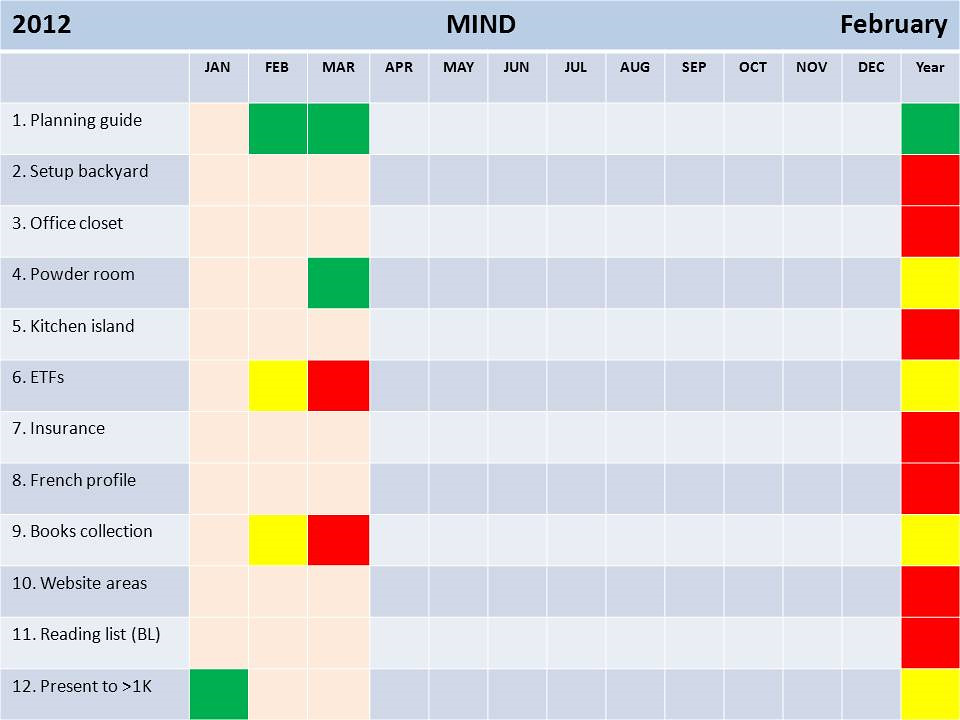
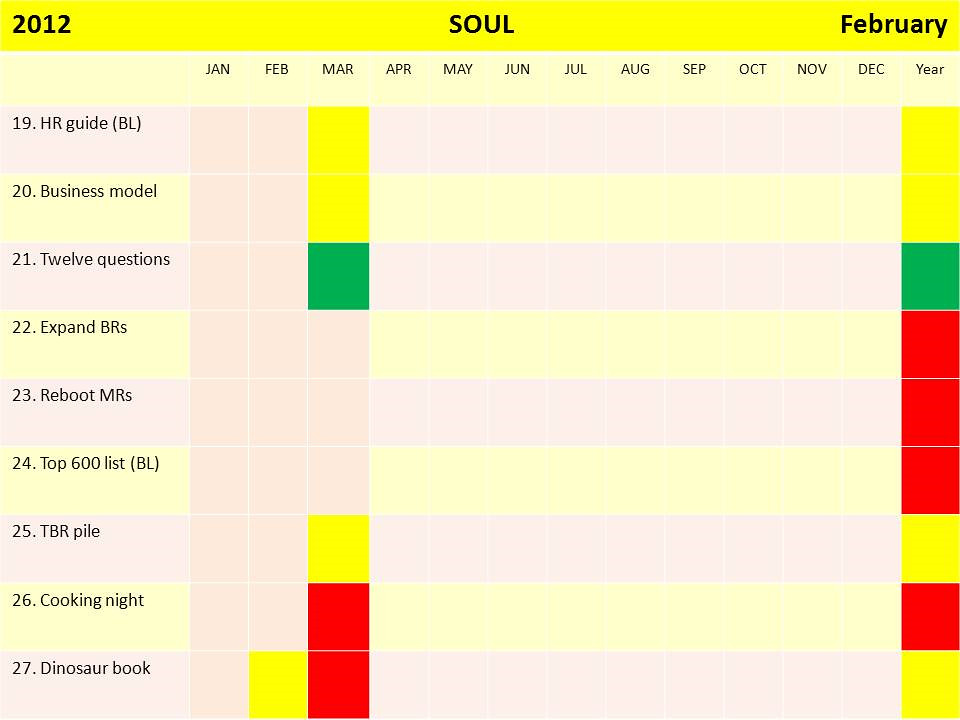
I’m still tracking progress on each goal by month, trying out the new tracking mechanism for the year. And it is helping me visualize my goals better this year…only time will tell if it improves performance though. March should have been a good month for me, as work quieted down a bit and my goals were firmly established, and I did make progress — active on more items in total, upped my “green” rating overall. Mostly though, I’m happy about initial progress on a HUGE “soul” element…see why below!
Progress on Mind: My planning guide is done, printed, and I’ve got my trackers up and running, definitely “green” and I expect it will hover around green for the year (might dip to yellow occasionally). We did get most of our powder room done, although that is more a gift from Andrea’s parents than my own effort. A few things left to do to tick the box. I had hoped to have the ETFs done by now, along with taxes, and more done on sorting books, but didn’t do much on those this month.
Progress on Heart: I continued my support to Andrea on her M.Ed., although that is mostly just making sure she has her night free for her class. I should be doing more somehow, but not sure what that is yet…we usually divide up our chores, and there are certain jobs that are “blue” jobs, like shoveling snow and cutting grass, and some that are “pink” jobs like washing dishes, because I hate washing … and then others that are up for grabs, like laundry. And while I have been trying to do the dishes a bit more (since Andrea has been doing more laundry, a blu-ish job), I don’t think “dishes” counts as career support. I helped out a bit more at the start of the month on Jacob’s nighttime routine, but not so much near the end of the month when a cold and some blood pressure spikes just wiped me out. Equally, I fell off the wagon near the end of the month for making my lunch rather than buying it every day. And I’m annoyed that I haven’t finished the Pontiac website yet. No progress yet on a Remembrance Day party, but then again, it’s MARCH! hehehe I did kick in some cash for one of my universities as a charitable donation, and successfully earmarked it for a specific program to support.
Progress on Soul: My big “success” this month was on a specific goal. I’ve got a mixed history for spiritualism and religion, and to be honest, I’m not entirely sure what I believe anymore. Or, from another perspective, my beliefs are not entirely coherent. So I came up with a unique idea — defining my core beliefs by coming up with 12 questions and asking myself them throughout the year. I’ve started work on coming up with the 12 questions first, which in and of itself is no easy matter. And while this might take awhile, I’ve also enlisted the aid of an expert — my friend Hope is a Catholic military chaplain, and I’m going to grill her like a fish about better questions. Heck, she’s got professional training in this, I might as well bribe her with food and cut my learning curve. As I said when I asked her, I’m not looking for her to give me answers, just help me come up with some better questions. I’m pretty happy with my approach so far, and I’ve got the first few questions starting to shape up pretty well. Look for more blogs on this when I go to answer them. I’ve even recruited friends on FB to help me come up with better questions.
Separate from that, I’ve done a little more work on my business model for writing, and organized myself a bit better for my HR guide (including for the actual cover), but not much tangible to show for it yet. Most of the rest are “reds” as I haven’t done anything on them yet, but I also gave myself a “red” for having a regular “new recipe” cooking night as Andrea and I have defaulted a LOT in recent weeks to not planning our dinners, just mostly doing responsive “day of” cooking that is really unexciting. Need to get back into a better groove for that, as well as ensuring the “new recipe” nights.
Progress on Body: As with January and February, most of March was a washout. And I had a bad experience with my blood pressure spiking near the end of the month — cold and flu remedies can elevate blood pressure, but Tylenol-based ones tend to cause less impact. So, I bopped along taking my Tylenol Cold/Flu stuff for three days and started to feel better, only to have my blood pressure spike and give me really really bad headaches at night. Not fun, and a little scary until I realized what was causing it. In the end, not super problematic, easy to adjust (stop taking the damn cold pills!), but the rest of the first quarter is a wash. Definitely need to be more active, and happy that the warmer weather is starting to appear.
Overall Results
January: 32 inactive; 0 RED; 0 YELLOW; 2 GREEN = 5.8% for month, 5.8% for year
February: 25 inactive; 0 RED; 6 YELLOW; 3 GREEN = 8.8% for month, 8.8% for year
March: 17 inactive; 7 RED; 6 YELLOW; 4 GREEN = 11.8% for month, 8.8 % for year