
↓
 

The PolyBlog

My view from the lilypads

  • Home
  • Goals
    • Goals (all posts)
    • #50by50 – Status of completion
    • PolyWogg’s Bucket List, updated for 2016
  • Life
    • Family (all posts)
    • Health and Spiritualism (all posts)
    • Learning and Ideas (all posts)
    • Computers (all posts)
    • Experiences (all posts)
    • Humour (all posts)
    • Quotes (all posts)
  • Photo Galleries
    • PandA Gallery
    • PolyWogg AstroPhotography
    • Flickr Account
  • Reviews
    • Lilypad Library (Books)
      • Book Reviews (all posts)
      • Book reviews by…
        • Book Reviews List by Date of Review
        • Book Reviews List by Number
        • Book Reviews List by Title
        • Book Reviews List by Author
        • Book Reviews List by Rating
        • Book Reviews List by Year of Publication
        • Book Reviews List by Series
      • Special collections
        • The Sherlockian Universe
        • The Three Investigators
        • The World of Nancy Drew
      • PolyWogg’s Reading Challenge
        • 2026
        • 2023
        • 2022
        • 2021
        • 2020
        • 2019
        • 2015, 2016, 2017
    • Movies
      • Master Movie Reviews List (by Title)
      • Movie Reviews List (by Date of Review)
      • Movie Reviews (all posts)
    • Music and Podcasts
      • Master Music and Podcast Reviews (by Title)
      • Music Reviews (by Date of Review)
      • Music Reviews (all posts)
      • Podcast Reviews (by Date of Review)
      • Podcast Reviews (all posts)
    • Recipes
      • Master Recipe Reviews List (by Title)
      • Recipe Reviews List (by Date of Review)
      • Recipe Reviews (all posts)
    • Television
      • Master TV Season Reviews List (by Title)
      • TV Season Reviews List (by Date of Review)
      • Television Premieres (by Date of Post)
      • Television (all posts)
  • About Me
    • Subscribe
    • Contact Me
    • Privacy Policy
    • PolySites
      • ThePolyBlog.ca (Home)
      • PolyWogg.ca
      • AstroPontiac.ca
      • About ThePolyBlog.ca
    • WP colour choices
  • Andrea’s Corner

Category Archives: Pondside Planner

Purpose, priorities, and progress.
Goals, grit, and growth.
Fundamentals, focus, and frameworks.

Post navigation

← Previous Post
Next Post→

FtU #03 – My astronomy hobby – Here’s looking at you, universe!

The PolyBlog
June 6 2019

So my current depressive episode was finally triggered by an astronomy setback when a bunch of my eyepieces were stolen. And there are two ways to look at that event if I was searching for meaning. First, I could wallow, and take it as the latest in a string of negative experiences the universe had thrown my way to discourage me from sticking with the hobby (which I did for a while). Or, second, do a more micro examination for a time that it happened just after my best seeing ever (AstroLog 2019.002.1 Best. Viewing. Night. Ever.) and therefore I had a huge “high” just before to help me get through the low. Neither are particularly insightful views of the events — frequently shit just happens — but it did put astronomy in my cross-hairs for review during my depression. I have already outlined some of that history previously, so I won’t repeat it here. I’ve moved on. Instead, I chose hope, with some inspiration from an internet friend named Loren who is doing amazing things with his iPhone and small scope.

Soooo, as part of my FtU approach for June, I made some proactive decisions and steps on my hobby.

Solving my eyepiece problem

I discovered somewhat happily that I didn’t, in fact, lose all of my eyepieces. I had forgotten that I had added one awhile ago to my collection, a Baader Planetarium Hyperion-Aspheric 36mm eyepiece that is supposedly well-suited to use with my phone to take pics at the scope. It’s a bit on the large size to have as my only eyepiece i.e. it only has a magnification factor in my scope of about 56x, which is about the same as basic intro-level astro binoculars. It shows a HUGE chunk of sky, but not much detail. Certainly not very good for planets. And about half the power of my usual “go-to” eyepiece of a Delos 17.3mm. But the point is that it didn’t fit in my case with all the other EPs, so I didn’t lose it when they were stolen. I still have an EP to use.

There is also a small ironic/dark “silver lining” in the clouds…for the sake of explaining, let’s assume there are five levels of eyepieces with fives being top of the line and ones being cheap but usable glass. When I bought my scope, I was using inheritance money and so I splurged a bit on a couple of really good eyepieces. They’re a series called Delos made by Televue. A pretty good field of view, adjustable eye relief and rotations for dioptrics, with eight strengths in the series from 17.3mm (about 117x magnification in my scope) all the way down to the high-powered ones of 3.5mm (a magnification factor of 580x for my scope, but nothing I could ever actually achieve). I bought the 17.3 and the 10, yet I rarely go below 17.3mm for the conditions I’m observing in for Ottawa, and I had given thought to selling my 10mm. The two lenses together cost about the same as all the other lenses combined, and I would rate them at the 4/5 level for quality.

I had a couple more that were 3/5 for average quality — a nice 2″ 42mm widefield that I bought used, even the 25mm that came with the scope was probably in the same quality. And another 15mm Plossl, maybe something in the sub-8mm range (an X-Cel eyepiece). And then a small number of 2/5 level quality. Mostly I used them to help me focus when jumping from a big size to a smaller more powerful size, not actively viewing through them. I’ve never been to a truly dark sky site, so anything below 10mm was always quick “what if” viewing, and I would usually back out of it pretty fast.

So the silver lining, albeit a bit dark humour as I said, is that I’m now replacing my EPs knowing already exactly how I use my scope, what powers I am interested in, and what features are most important, so I can choose a smaller number of lenses of higher quality, which is always a good idea in astronomy anyway. The fact that I’m starting over just makes it easier.

Although it looked a bit at first like I was going down a small rabbit-hole. One of the guys at the local astronomy store, Nathan, is very particular about his eyepieces, and I lucked out that he was working the day I went in to pick their brains. I spent about an hour with him going over what I liked and then trying out a few high-end lenses. And I was really surprised. A few of the truly high-end ones that are 5/5 on the quality scale were ones I didn’t like at all in the sub-25mm range. Not enough eye-relief for me, particularly as I like the flexibility of being able to use the EPs with and without my glasses (both for me and others at star parties). I also had figured out at my good viewing night that my exit pupil is somewhere in the 4-5mm range, which means I don’t want anything much higher in size / lower in power than a 42mm lens. So, where does that leave me?

At the top level, I was a bit surprised to find out I really liked the feel of the Panoptics. They look so different from the Delos that I love, I wasn’t expecting to like them so much. But, don’t get me wrong, the EPs are awesome and depending on who you ask, they would be either 4s or 5s for quality, so lots of people DO love them. They are also 2″ eyepieces, and the 41mm (about 50x magnification) shows a huge chunk of sky. Great for wide-field views. Plus, I still have a couple of nice filters that also weren’t in the stolen box that fit a 2″ EP. Sweet. Since that is the top-end for my exit pupils (the size my eyes dilate to for my present age), I figured that was a good upper cap. I don’t need it immediately, and at $700 new, I’ll look for a used one over the next year and see if I get lucky.

Under that gets a bit tricky. They have five more in that style — 41, 35, 27, 24, 19mm. The top 3 sizes are all 2″, but the bottom two are 1.5″ and when they get to that size, I don’t like the eye-relief as much, so the 24mm and 19mm are out. So I won’t buy only Panoptics. The 41 is chosen above, which leaves 35 or 27. Honestly, I’d love them both, but I already have a Hyperion 36mm 2″ option, so the focus is on 27mm. I found one online used, saved about $140 that way, and it is in transit. Fingers crossed.

Continuing downward for size and upward for power, my scope is designed originally for centring and alignment using a 25mm lens (i.e., at about an 80x magnification) so I replaced the default Plossl with another one, picking it up used. Call it a 3/5 for quality. It is a quick option when I don’t want to break out the big 27mm Panoptic. Plus it should work well enough with my smartphone.

The Delos 17.3mm was my favourite EP previously, and it was a no-brainer to get another one for 180x power. I bought it new, even though the price has gone up by $100 since I bought it 7 years ago. Call it a 4/5 for quality. and I fully expect it will remain my go-to EP of choice. I just love it.

A guy in the local astronomy group heard about my EP problem, and as he is selling off some astro equipment (including a couple of nice scopes, sigh), I got a decent deal on a 15mm Plossl that I can also use with my smartphone.

And, one of the benefits of seeing the expert at the astronomy store, I learned about Televue Powermate. You can buy these small things called barlows that serve as small tubes that add a magnification factor to your existing eyepieces. So, for example, if I had a 40mm eyepiece, that would give me about 80x magnification. If I put the EP in a 2x barlow, it is like I turn my 40mm EP into a 20mm EP, and I get 160x magnification. In effect, if you have a barlow, you virtually double the number of EPs you have to choose from. Sounds perfect, right? Except barlows add some distortion to the viewing.

However, as I said, my viewing conditions are far from optimal, so if I get much above 250x magnification, I get a lot of movement in the image from distortion in the atmosphere anyway. Therefore I didn’t want anything that ADDED distortion. I had a 2x barlow previously, but since I had lots of small increment EPs in a series (even of lower quality), I frequently just swapped those in and out rather than using the barlow. For example, I could have used the 25mm Plossl with the 2x to get to 12.5mm power (160x) or just use a 12mm Plossl. Or the 10mm Delos that I didn’t enjoy as much as the 17.3 Delos.

So I was thinking no barlow. There are lots of models out there — 2x, 3x, 5x, adjustable 2-5x, etc. And I assumed they all caused the same distortions. Except apparently Powermates don’t. A lot bulkier, different design, but they minimize the distortion factor. But whereas a barlow can run you anywhere from $50 to $200, Powermates are $400+ new. Yikes. But I lucked out, I found one online used for $140 off, similar to the Panoptic I found (different sellers). In the end, this means I will have six lenses (although 2 mainly for smartphone attachments) plus a Powermate that will give me 12 different magnifications.

EyepiecePairedMagnificationEyepiece size
Quality
Pan-optic 41mm—50x2″4-5 / 5
Hyperion 36mm—56x2″ / 1.25″3-4 / 5
Pan-optic 27mm—75x2″4-5 / 5
Plossl 25mm—80x1.25″3 / 5
Virtual 20.5mmPanoptic 41mm + Powermate 2x100x2″4 / 5
Virtual 18mmHyperion 36mm + Powermate 2x113x2″ / 1.25″3 / 5
Delos 17.3mm—117x1.25″4 / 5
Plossl 15mm—135x1.25″3 / 5
Virtual 13.5mmPanoptic 27 + Powermate 2x150x2″4 / 5
Virtual 12.5mmPlossl 25 + Powermate 2x160x1.25″2 / 5
Virtual 8.65mmDelos 17.3mm + Powermate 2x235x1.25″3 / 5
Virtual 7.5mmPlossl 15mm + Powermate 2x270x1.25″2 / 5

So my main EPs will give me 50x to 117x, and the Powermate will fill in gaps between 80x and 117x and give me options above 135x (i.e. 150x-270x). But I don’t have the 41mm yet, hopefully sometime in the next year. Just have to be patient. 🙂

Cases

While I was reeling from the loss of my eyepieces, I completely blanked on another small aspect of the loss. They also took my case that the EPs were in. I had ordered it through Amazon, an Orion-branded case, and it came with pluck foam so I could carve out niches for my EPs and keep them safe from physical harm. I put some time and energy into the layout and this was the outcome back in the day:
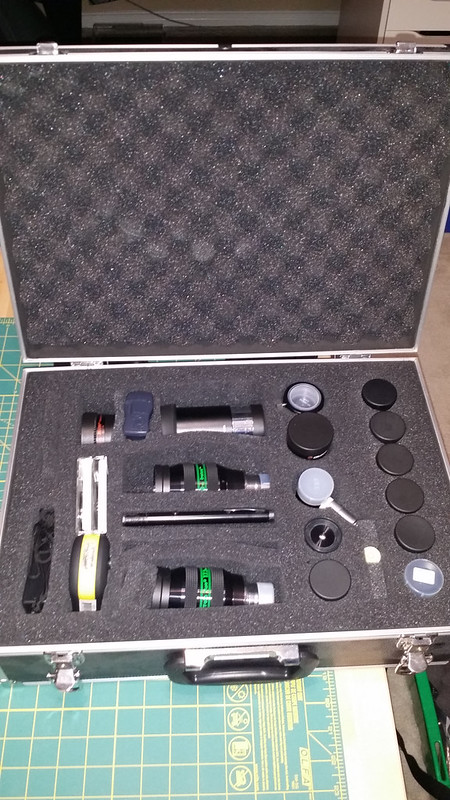
20180421_005728

A place for everything and everything in its place. I was pretty happy with it. But, as with the EPs themselves, starting over gives me a chance to revisit exactly how I organize my stuff. I have an adapter for my smartphone, filters, a filter wheel, etc., a few other little things that didn’t fit in the above case, and so was separate. What do I do now?

Well, oddly enough, that case wasn’t quite perfect, just good enough. Price was okay, the size was okay, sure, but the locking mechanism always gave me a bit of a nervous edge when carrying it.

However, I was at Canadian Tire a week or so ago, and I found these really awesome cases. And they were on sale. The problem? I don’t know what size I need, and wouldn’t know until I figured out the EP issues above. How much room do Panoptics take? What about the Powermate barlow? How many lenses would I get? How tall are they? What about the other equipment, do I want them in a case?

I cheated. There’s a 90-day return policy, so I bought a small, two mediums and a large case. I figure I’ll likely want two in the end, one for EPs, one for other stuff, I just don’t know which sizes. So this way, I’m covered.  And I’ll just return the ones I don’t need. In the meantime, I’m using a small case with little padding but gets the job done for now.

Viewing

I’d love to say I’ve made huge outings and re-engaged. Instead, the weather has not cooperated. We had to cancel two star party dates in a row (3 if you include International Astronomy Day back at the start of May when we cancelled night-time viewing). I did try to set up one night and the clouds were supposed to improve all night. Instead, it was slightly cloudy at 9:00 when I set up and totally socked-in when I came back at 11:00 to actually view.

I used my solar filter one evening awhile ago and found a small pinhole in that I’ve covered with duct-tape…a bit overkill (you don’t need to probably fix it at all given it is just adding more light to the tube, not directly into your eye), but what the heck. It doesn’t hurt to be overly cautious and affects nothing for performance.

Logging and blogging

Back in 2017, I did up my own customized astronomy log (Draft Astronomy Observing Log). I crowd-sourced some input, pulled some versions off other people’s blogs and various astronomy websites, compiled them all into something that looks great for me, boiled it down to 2 pages, set it up with some other inputs and BAM! I had my own custom astronomy log. Except I hate trying to write in it in the dark. I really wanted something electronic too so that I wouldn’t have to write by hand and then transcribe later. Plus I never did find a good way to hold a red light flashlight while writing. Of course, since I haven’t had much luck with observing, that’s not the biggest issue either.

I have a copy of Sky Safari on my tablet, and it comes with a built-in astronomy log. But even if I customize the heck out of it, there are still some pieces missing for my setup that I would want to record. It’s decent, not awesome. Similarly for several other near tools.

The really GOOD idea is that I could just code an app myself that would have all the bells and whistles I want, customized exactly how I want it. There’s only one problem. I don’t know how to code an app. 🙂

Okay, that seems like a major block, but not an insurmountable one. I’ve always wanted to learn, and I did do coding in high school and university, plus programmed a few small utility apps on my own back in the dark days of DOS. But this is a different kind of beast. Maybe a longer-term solution.

If you step back a second, and look at what I want to do, I basically want to collect data on a tablet with or without a wireless connection, and lots of people have to do this for actual business solutions, right? So I went hunting for solutions. Most of which had monthly subscription fee options, or were good for enterprise solutions, not much decent in the free category.

I shifted sideways and looked for survey and form apps. Same problem.

If I’m completely honest with myself, what I really need is a simple MS Access database (or something very similar). Which would be GREAT if I was just doing it on my desktop, not trying to run it on a tablet in the field (sometimes literally). Google Forms would be AWESOME, except there’s no app version of it that would work without a wireless connection.

But there’s also another “filter” (small pun) at play — I have to be able to use it at night, in the dark, without bright white displays killing my night vision. I found a few tools that were close, but no way to modify the interface, and they often had permanent menus showing, white backgrounds, etc. Not great for an astronomy app. There are apps that will override everything and make it dim, but it’s still not the right colour scheme.

Astronomy apps know this and include a specific type of night mode — black backgrounds, and all lettering is in red font. Hard to replicate in an off-the-shelf app designed mostly for people filling out surveys or forms in malls.

Enter Microsoft

I couldn’t use MS Access as MS doesn’t create an Android version of their database. Nor iOS either. Meh. However, I played with Excel and Word enough to realize that I could colour either the cells all black and change the cell contents to red (in Excel) or change the page background to black and use a red font (Word). In both cases, the app wants to include spaces around the pages, menus, toolbars, etc., all in the wrong colour.

But if I turn off toolbars in Word, eliminate the menus, and set margins to zero all the way around, I end up with a screen that I can say “show page-width” that looks like a black wordprocessor with red lettering. If I minimize the logo line all the way to the minimum and drop the brightness level down to minimum settings, it works. Interesting.

I can do almost the same in Excel, more or less, so what I really wanted to know was what “other” features could I add? Since the dbase option was basically a simple flat-file format, why not do it in Excel, right? Do up some drop-down lists, set a few broad categories, maybe even do short look-ups to allow multiple entries per drop-down (like if I was indicating I was using multiple eyepieces in one viewing session). I could even set some macros that would allow me more sophisticated “profiling” to, for example, allow me to set some pre-defined defaults if I was viewing the moon vs. the sun vs. planets, or if I was using certain filters.

Played with it a bit in Excel and Word, tried doing some simple formatting tricks with macros and VB plugins in the developer menu. I got a couple of things working, mostly just free-designing, not going in with a full-on plan of everything I wanted, just trying some stuff out. I saved the files, kicked them to my tablet, opened them up in the apps, all looked great.

Except for another “small” problem. Most of the functionality didn’t work. The app version, as opposed to the desktop 365 version, doesn’t support macros. Or VB coding. Half the time, it doesn’t even like control inputs (like full drop-downs). Some of it worked, some didn’t. I started playing with checkboxes, thinking “Fine, I’ll just code all the options” and use a checkbox for each of them. Again, some worked perfectly, others didn’t, and I couldn’t modify the data very easily.

Dang it.

Soooo, I went back to basics. A very simple Word document is what I ended up with when I printed the original design two years ago, so why not do the same for the digital note-taker? I ditched tables, most of the checkboxes, left in my instructions for setups, and divided elements between those that are common for the night (i.e. for a session) vs. those that change for each object (i.e. for a target). I then told the computer it was a legal size file and kicked it over to the tablet. After I saved it, removed all the menus and minimized the header area, it actually works. I tried it quickly outside the other night, and visually and tablet-wise, it worked. Now I just need to give it a real-life trial.

Here is the file, if anyone wants to see what I’m using. [ddownload id=”15318″]

In the end

I’ve got my EPs locked and loaded, even if I don’t have the final case setup yet. One more EP in the future, mostly ready to go now. I have cases, just need to decide which ones. I desperately need some clouds to get the heck out of my universe, I feel like I’m hoarding them of late. And I’ve got my astrolog ready to go. I’ve even consolidated some of my astro materials/tools so that I can be down to two small boxes right now. I’m good to go. Imaging is on my list for the future, but not urgent.

In the meantime, I’ll be looking at you, universe!

Posted in Pondside Planner | Tagged astronomy, log, observing | Leave a reply

Deciding on my way forward

The PolyBlog
May 23 2019

I’ve been working my way through what I call Functional Depression for a couple of weeks now. Some high days, some low days, nothing new. And mostly it was a delaying tactic from moving into my standard “hide and heal” approach. But there was also a small niggling part of me that was wondering about trying something new. What I was calling “F*** the universe”. Ratcheting up my energy, pedal to the metal, no retreat, no surrender, get ‘er done, just do it, no quit, whatever other metaphor/slogan a sports team can come up with, blah blah blah.

Except the first part of that is the challenge. Finding the energy to do it. Most likely by tapping into my inner core of reserve plus some anger at the universe. Getting “mad” to augment my fire. Yet also worried that I would tap out at some point and have nothing left.

Clarifying the options

A couple of people sent me messages and emails asking about some of the sub-elements I put in the previous post (Choosing between three depressions).

One question in different forms was if my standards were too high. I understand the concern, but it’s a bit misleading. I was noting that I feel like I not only have to do the right thing, it has to be for the right reasons. And if I’m not sure it is the right reason, I don’t do it. The reason for that is that often it is easy to think something is the “right thing”, because of some hidden urge within me. But if I’m not clear on the reasons, it usually means I’m lying to myself about what the right thing is (rationalizing my choice). I can remember two incidents in particular from my past, but they aren’t entirely my story to tell, so I’ll be a bit vague. In both instances, I thought the right thing to do was “X”. And I could, at the time, wrap both of the things in a noble flag as to why I was doing them. In one case, I tried and it blew up; in the other, I was suspicious of my reasoning, and held off, and it could have been really bad. In both cases, I realized afterwards, I was telling myself it was the right thing to do, but I couldn’t see the reasoning as clearly. Because I was hiding it from myself; it was more selfish than noble.

So while it seems like a high standard, it isn’t so much about the standard as it is clarity of my thinking. If I can’t see how the right means are leading to the right end, and that both are justified, I’m likely better off standing down. It usually means that I know one of the two isn’t right, but I just can’t see what my psyche is hiding from myself. Which is not to say I don’t have high standards, I do, but they are not impossibly high. I’m just more aware of how the “why I do things” relates to the “outcomes I’m achieving”.

In terms of my anger management, I was also a bit misleading. I don’t “deny” it in the sense of it not being felt or expressed, I just mean that I try very hard (if I can help it) to not direct it at someone else. For me, it is quite simple. Whatever someone else does around me may push a button. Maybe intentionally. Maybe maliciously. Maybe uncaringly.

But what happens afterwards is up to me. They didn’t install the buttons, they didn’t install the software that responds when the hardware button is pushed. I am responsible for both my reaction and the strength of my reaction.

If it is mild irritation, sure, I’ll go with the flow, express it, no big deal.

If is more moderate irritation, bordering on true anger, as long as it is just about me, I can probably redirect it into less negative forms of expression than just tearing a strip off someone. Not the reaction I want to be doing, nor the strength I want to express. I find it easier with Jacob to control, harder with Andrea — partly as I figure she’s an adult, she can handle if I’m being a bit jerky. But I do think about how I respond, and particularly with Jacob, I’ll talk with him about how I responded and why I was feeling that way, plus whether it was appropriate or not, how I could have handled it better. And apologize so he knows it wasn’t about him nor did he deserve it. I’m big on taking responsibility and saying the words; Andrea prefers to just have the tiff and move on, no blood, no foul.

What I am calling true anger is more like a temper bordering on rage. A response that is out of proportion to the underlying actions. Three things will cause that to flare faster than normal.

First, if we are out somewhere, and I see someone basically being a bully in a traditional sense or trying to push someone around with their personality by being a jerk or really aggressive, I start to get irritated. Maybe because of experiences as a kid, maybe I’m just sensitive to power imbalances, but I find it really hard not to react when someone is either being outright aggressive or more passively condescending and insulting to suggest someone else is the problem, particularly when it is clear they are counting on the other person to back down. Making it uncomfortable for them, being awkward, because they’re expecting the other person will try to smooth things over and avoid a scene. To me, that is flat out abusive. And I am perfectly happy to go the opposite way and be completely blunt about how they’re the ones actually causing the problem instead of back-pedaling to make nice. That isn’t a problem that happens within the family, although it was a problem with previous family members that I have cut out of my life. They hoped that they could be assholes and I wouldn’t call them on it. For the first 30 years of my life, that was the case; after that, no dice. I won’t eat a shit sandwich no matter who is trying to feed it to me. But still, in external circumstances, I try to walk away unless it is directly tied to me or my family, or I feel the person is in actual danger.

The second is frustration or fatigue. And that is no one’s fault but my own. For example, I suck at home repairs/maintenance. And if I’ve pushed past my limitations and reservations anyway, and something goes wrong, my frustration can redirect very quickly. But that isn’t about anyone, it’s just me fighting me. And no one else really needs to be part of that. So I will TRY to walk away if I can. Sometimes I’ll grunt at the universe first (Argghhhh!).

The third area that triggers in me is if I am feeling trapped. When I was growing up, we were a bit dysfunctional. And if emotions were brewing, I didn’t want to be part of it, I just wanted to leave. But I couldn’t because I was too young to drive. Walking would only get me so far. If I’m in an emotionally-charged situation now that I’m an adult, and I can’t leave for whatever reason, my reaction is not simple irritation, I am in a fight/flight/freeze mode with no option for flight, too hyper for freeze, and so I go hard for fight. Again, that isn’t about them, it’s a fear response. The simplest response is to always have an exit plan wherever I go or if I’m in a more sensitive mood, don’t go at all.

For the ones where I don’t feel it is appropriate, nor proportional, I do try to walk away quickly. To remove myself from the triggering situation before I say something I don’t mean. I have a brutal tongue. There’s a pop song, can’t think of the tune right now, but it has a line about what kind of words come out when you fight. I am WAY harsher than I intend to be. The problem is that my filter disappears. I don’t want to “discuss things” at that point, I just want to drop a bomb that will end the conversation immediately. Perhaps it’s easiest to understand with exes.

I know lots of people who rant and rave, hate their ex, blah blah blah. I don’t. Which isn’t to say some of my exes haven’t done some stuff I could be angry about, and while I might actually be angry about the activities, I’m not angry with them. I am not in contact with a couple of them, yet I don’t have any ill will towards them. I don’t want to slam them in person or indirectly. I don’t want to be that person, simply put, a hater.

The challenge in current relationships with anyone (romantic or otherwise) is that when I’m in “control”, so to speak, I can make that choice; even if I’m irritated or mildly angry, I can still make that choice. But if I go past that point, if I lose my temper, I lose control of what I choose to say. I say hurtful things. Yet as much as I don’t want to be a hater, I also don’t want to be the person who says hateful things to hurt someone, particularly not someone I care about. It’s not who I want or choose to be. That doesn’t make me Gandhi, more that I am aware of reasons and outcomes for my behaviour.

But I still have to let that energy out somehow. Sometimes I’ll go for a drive, put on some music, and sing REALLY loudly while I’m driving around. Letting out both the anger and the energy. I wish I was more prone to directing it to physically working out, some people find that great. I’m good at handling it when it is semi-caused/directed/about other people. I’m not as good when it is anger at myself / frustration / fatigue / feeling trapped. Other times I have to withdraw for a day or two mentally. Put up my defences a bit more so that further “irritation” doesn’t make it worse, just because I might be hyper-sensitive. (Yes, it can look like being grumpy or moping!).

For me, in the end, it is quite simple. It is okay to feel whatever I feel; it is not however okay for me to take it out on someone else just because I feel like being a jerk today. Doesn’t make me Gandhi or Mr. Freaking Sunshine though,nor am I denying the feelings. I just choose how I am going to express it.

Last but not least, a couple of people wondered about my astronomy. Their thinking was a bit varied…why stop doing something I loved? Why be so draconian about the duration vs. short-term? The short version is that at times, there are aspects of the hobby that has felt self-abusive.

First, I took it on when I was in the middle of grief, and it is not a low-threshold learning curve. It takes energy, which was in short supply. Second, I fought with it for four years trying to figure it out mostly myself, before finally saying “Okay, either someone helps me figure this out or I have to chuck it.” Third, since then, I can’t say I have been getting a lot of enjoyment out of it. And so, I’ve been wondering why I stick with it. If I accept, somewhat unproven, that continuing is the “right thing to do”, what are the reasons for doing so that I’m following?

I certainly haven’t been having a lot of “fun” with it, so enjoyment is low on the probable reasons.

Is it because I just want to prove that I can do it, to not give up? Not a compelling reason if I’m not enjoying it. There are lots of other things I could do instead.

Is it that I want to show off to other people in an area that few people do? A bit esoteric, and people ooh and aah with it, am I doing it to please others? I do enjoy, so to speak, the reactions of others at star parties when they see something for the first time. I like answering questions and pretending to be semi-knowledgeable. But I am far from lighting up the astro world with my stardom.

Is it just a learning goal? If it was only that, I could just read books, or watch videos, I don’t have to have a scope to do it.

Is it community involvement? I tend to skip the monthly meetings as I tend to dislike the social interaction, but by contrast, I am the Star Party Coordinator. A visible and controlled role. There is a component I find satisfying, surprisingly given my analytical introvert side. Hell, I wrote a 70-page report for the Council where a 2-page email was likely the standard. So there is an itch being scratched there, but I could find other scratching posts.

Is it somehow tied to my mother? I used inheritance money to buy the scope and some eyepieces (the ones that were just stolen). I could be refusing to give up because I feel like it is a last piece she gave me, even if she never knew. Maybe, but it’s a reach. We never did it “together”, so there is not much emotional resonance there.

Is it that the frustration feeds something darker in me? Perhaps the constant battle reinforces some self-flagellation tendency in myself. If that was the case though, there are other easier ways to fail at bigger things. Home repair, for instance.

Is it the “dark night” activity? No one knows you’re a dog on the internet, but no one knows what you look like at star parties either. There is a degree of anonymity in the experience. And I am a night owl. But it’s also a lot of work to set up, drive out to the dark areas, etc.

So, I can run through another 10 to 20 “reasons”, and none of them explain why I am continuing to flog a dead horse. One that the universe just told me in no uncertain terms, from one perspective, to stop doing by taking away my tools to do it. The final trigger that started the spiral in the first place.

So what do I decide?

Functional depression is short-term only, so that’s out.

Hide and heal is always there, but it’s insufficient.

Fuck the universe takes too much energy, at least in the long-term.

Which means I need a lower-intensity FtU solution, for the short-term to get me past a hump. So I’m doing a 30-day FtU push for the month of June. Not full-scale, not hide and heal. Somewhere in the middle.

A decision which has allowed me to see through the haze and figure out why I want to continue with astronomy, and it is the only reason that matters. While all of the other stuff can look a lot like a relationship with an addict, i.e., at some point you have to quit and move on, the truth can be found in something I did when I was “cutting out” the astronomical noise from my email, Twitter and Facebook. I left one person in my FB feed. His name is Loren, and he does a lot of images of asteroids with his iPhone and a simple setup. I considered snoozing him or deleting him, severing the connection, but I didn’t.

Because his images and posts inspire me. In a dark and dreary world, his posts look a lot like something that is in short supply at times, and the same reason that I bought a new eyepiece today so I could keep doing astronomy.

Even when the universe is screaming, I follow Loren and I do astronomy because it represents hope.

Posted in Pondside Planner | Tagged depression, goals, signs, universe | Leave a reply

Choosing between three depressions

The PolyBlog
May 17 2019

A weird idea, isn’t it? That there are different types of depression and that I could choose between them? It’s not exactly true, but it works for me as a metaphor for today, so I’m going with it.

A. Functional depression

Perhaps because I am talking about my current feelings of depression so openly, some friends are more worried than usual. I appreciate the concern, but I don’t feel like I’m in an unusually dangerous crisis. While some days I might get overwhelmed and need to shut down, generally speaking I’m in a holding pattern. It’s what I consider “functional depression”…yes, I am struggling to keep up my full daily routine, but generally speaking, most of the balls are still in the air. Work, family obligations, etc. I can drive my wife and child to events, I just can’t handle the social side of things. It’s easier to think about take-out right now then expend the mental energy to figure out home dinners. Six days out of seven, that will probably work. On the seventh day, I have to rest. 🙂 Last week, I had to take a mental health day. This week, all three of us were sick on the same day.

I’m vertical, for the most part, and functioning. I do notice my judgement and reasoning are slower than normal. I am less comfortable in social situations. I am stressed more easily by distractive noises at work. You know, the usual.

And having been here before, I could choose to just continue this way for an extended period of time. The problem is that faking full functionality is not particularly sustainable. Partial functionality is likely the result, and if I do it long enough, I’ll need more and more days to re-energize. Right now, I’m choosing this as the working option while I figure out which of the other two I want to try.

B. Hide and Heal

In my previous post (My seven ways to respond to depression), I mentioned a bunch of things I know how to do in order to respond to my bouts of depression. Some of them even work in pre-depression phases to ward off some parts, but they are mainly part of my toolkit when in depression, and I can mix and match as needed. 

In the past, my main approach has been to “hide and heal”. There is much more positive wording to describe my technique, but the term “h&h” is not pejorative to me. It is just descriptive. It involves, for the most part, my withdrawing from some aspects of my life, reducing the simple daily burdens of living, focusing on the knitting so to speak. For me, this involves:

  • Accepting / embracing the depression…while this seems counter-intuitive, it is about accepting that all of life is a phase, and perhaps best characterized by the current Buddhist mantra, Right now, it’s like this. Sometimes, if I’m in  a mental hurry, I’ll go with “It is what it is, for now”, but the Buddhists have a better set of nuances in there;
  • Dumping goals…mostly I am talking about dropping a huge swath of goals and only focusing on what truly needs to get done, focusing on maintenance rather than progress;
  • Self-care…while the whole act of hiding and healing is a form of self-care, I also focus on sleep, rest, stress management, stronger social boundaries, time alone, journaling, quiet hobbies, organizing physical spaces, splurging on some fun things or food, learning, and work boundaries. In effect, most of it looks like becoming uber-introvert with a set routine to do the activities that re-energize me;
  • Cognitive therapy…I often talk things through with a therapist, although it depends on the level of discomfort and the issue too. Right now, what I’m feeling is not unusual and I know the issues, so I`m not feeling the need to talk through it at the moment;
  • Behavioural therapy…in a sense, ALL of this is behavioural — I’ve set the problem as depression and my problem-solving is to hide and heal until my energy levels are back up.

The benefit of this approach is that it is “tried and true”, as the phrasing goes. I’ve used it before, it’s well-grounded in psychology, it will work.

The cost is that it also means shutting down almost everything else. I literally need to withdraw from things, mostly to make sure I’m not simply doing functional depression and pretending I’m healing. And it means if everything is shut down, there is zero progress on any front. So at the end, the best I can hope for is a mental and emotional reboot. I can’t move forward, and to be blunt, even some areas are going to backslide if less unattended.

Since my astronomy problems and the theft of my eyepieces was the final trigger for my latest spiral, I’ll use it as the example. If I shut down, I will block out astronomy as a hobby. I have to, it’s the only way that method works to heal. Kill the triggers. If I’m truly aggressive, as I was starting to be a week or so ago, it could literally mean never doing astronomy again. Accepting that this hobby is just not the right one for me, the level of frustration is just too high. It isn’t simply saying “stop for now”, it is shutting off the desire to do it at all; a bit of reaction-formation, in psych terms, to push it away. If I hadn’t had a really good night just before the trigger, I would have already decided this. I would just say, “I’m out” and move on. Too much investment, too little reward. In the last week, I’ve even debated whether I would just get rid of my telescope or save it for Jacob; would I keep doing my volunteer work for RASC or dump it for the year; would I even go to a party where other people were setting up, or would that be too much “keeping the hope alive” that some day I might get back into it. And it’s complicated by the fact that Jacob is interested, something we could theoretically do together in the future, and if I’m out, what does that mean for his interest? If I was fully out, I wouldn’t be actively encouraging him anymore or being willing to help much. He’d be pretty much on his own. A pedantic wall that I would not break.

That may seem harsh, maybe even unproductive, but it’s the way the Hide and Heal works. I need to shut down not just the activity but the desire / hope too. Managing expectations sounds good until it looks more like eliminating the expectation entirely because it takes too much energy even to keep hoping or to even leave on my mental to do list.

Which is why I haven’t just gone for this “hide and heal” solution. Given my current level of depression, I know that the hide portion will come with some costs that I’m not entirely sure I am willing to pay. In an extreme world, it could mean deleting my blog. Cutting off Facebook and Twitter. Focusing on reading, mainly. I don’t know in advance what I’ll need to do, but I know the price will be high. I’ve been here before.

Yet the alternative could be really risky.

C. Fuck the universe

Pardon my french, so to speak, but the other option is one I’m calling fuck the universe (FtU). Given that I’m saying the universe is shouting at me, the metaphor is that I could do something I don’t normally do. Shout back.

I can tell the universe to take a flying fuck on a rolling doughnut, a phrase I loved so much when I first read it at age 14 that I had a hat made that said, “Take a flyer”. It’s more in line with a previous persona, not PolyWogg but Shiva. The destroyer of worlds. I’ve relied on it before…I used part of it during my tadpole years when I needed to shove some stuff aside mentally and just push through. Occasionally I use the same language now. The only way out is through, although that applies equally to the other two options above too.

Just over a week ago, when I was thinking about my responses as I spiralled, this one occurred to me, as it has before. It’s always there as an option, but I never choose it. It’s risky, for four reasons.

First, it is REALLY hard to sustain. It requires a lot of energy to keep fighting harder and harder, an onslaught against literally the forces of ennui in the universe. 

Second, that energy is hard to muster if part of the problem in the first place is low-energy, and there is only one source left for me to tap into. My anger. To literally get bad at the universe to tell it to take a flyer. While the metaphor is a bit slippery, it’s kind of like the classic Star Wars trope of giving into the dark side. It’s powerful, it provides energy, but it is dark energy, and it is hard to ensure you’re siphoning it off and converting it to light energy before it is used. I don’t mean that it will turn me into the constantly “angry man”, an asshole whose anger is directed at the world, but I do worry about it affecting my judgement to know what are the right things to do for the right reasons in the right way. My dark energy likes to take shortcuts and doesn’t care much about side costs.

Third, if I do this, and it fails, the fall will be huge. A hide-and-heal now could take me 3-6 months to recover. If I fail with the FtU approach, and then have to hide-and-heal, I suspect it would be more like 12-18 months with active professional help and meds. I don’t mean that to sound so dire. I just mean mostly that the core energy I have, part of which is light and a lot of which is dark, is what sustains me in harsh times. If I use that energy to blast through the current barriers, I’ll have little left when that energy wears off.

Fourth, and not the least, I have no idea if it will work. I’d like to think it will. I’m more interested in it now than I ever have been before. Some of that is just a reaction to my struggling with my weight, and my brain being interested for two reasons, like a little devil and angel whispering in my ear…”Do it,” says the angel, believing I flare into a star; “Do it,” says the devil, believing I will fail catastrophically and thus end my battle against my weight. Two voices, whispering encouragement in my ears, even though I know the approach is neither extensively tried nor excessively true.

A decision to make

For the last ten days, I’ve danced on the head of the functional depression pin:

Hide and heal

or

Fuck the universe

Do I take the safe route or risk grabbing the universe by the throat? I am going to think about it this weekend and try to decide by Monday.

Posted in Pondside Planner | Tagged goals, signs, universe | Leave a reply

My seven ways to respond to depression

The PolyBlog
May 15 2019

My previous post about my impending depression, and a possible spiral (Sometimes the universe shouts, I just don’t know what it’s saying), garnered a lot of positive supportive messages,and I’m grateful for them. Lots of people asked if there was anything they could do to help, and mostly the answer is “no” beyond the offers themselves. It’s an internal problem for me, not an external one, and I’ve been here before, so I already know most of my options.

The post itself probably identifies the strength of the depression, at least as it was that day. Feeling lost or hopeless against the universe’s fortunes. I have been losing interest in certain hobbies, although the astronomy one was not so much losing interest as losing hope I would overcome the setbacks. My sleeping is screwed up, and both before and afterwards, feeling exhausted. Restlessness. Difficulty making decisions. Even some physical manifestations. Check, check, double check, check check check. Lots of symptoms in there.

I also know that my focus on weightloss is making me especially susceptible to mood swings and depression since my energy levels have been depleted while I’ve been focusing on that, without much success at the moment.  I also know that HOW I respond will determine a lot of HOW MUCH I am affected, a key tenet of trauma therapy (and heavily noted in Jeffrey Kottler’s book “Change” (Change: What Really Leads to Lasting Personal Transformation by Jeffrey A. Kottler (BR00118)).

The illusion and reality of choice

There’s a bit of a dangerous nuance in the idea that depression is a choice. Most of the time, it isn’t. The chemical effects of the brain, a limited set of economic and social situations, the lack of a suitable support network can all limit not only the likelihood of a healthy response but also drive the initial condition in the first place. I know that most people don’t “choose” to be depressed, although sometimes people need to or want to embrace it as a response. And it is one of the choices available to me now that I’ve entered the realm. But, fortunately, my thinking is still clear enough to know that I have other choices. A total of 7, in fact, that I’ve used and experienced before.

1. Embracing the depression

That sounds ridiculous, I know. But sometimes it feels like a great way to move through it faster. Almost like, “Okay, world, kick my ass, give me an excuse for a month, and then I’ll be all good.” A often-false belief in it being a simple on/off switch that allows you to wallow for a set duration of time. To me, grief is a good example of that, and the most common delusion. The idea that if you try to force yourself through the stages of grief, you can somehow manage your grief “better” or “faster”. It doesn’t work that way, but the illusion of control is appealing — that depression isn’t happening TO you, but rather something you control. Not an option.

2. Setting goals

This has been my most heavily-used technique over the years. It gives me momentum, and some illusion of control over my life. Not necessarily over depression itself, but rather preventing some of the triggers of possible depression. The idea that a well-planned life that is constantly moving forward on one front or several fronts will keep depression at bay.

And it works, most of the time anyway. The feeling of accomplishment is more a reality check against feeling that things are out of control, to maintain perspective. The feeling that “Okay, THAT area of my life is sucking right now” but not letting it define you or trick you into thinking all of your life is going that way. In a way, it’s not about the goals themselves so much as just conscious comprehensive mindfulness of all the different aspects of your life.

It’s also a seductive mistress of deception. “Oh, look, my life doesn’t suck because I am doing really well in area X”. Except you never stop to ask yourself about weighting of areas…If “X” is organizing your sock drawer, that may not matter much if your relationship with your parents sucks the big one.

And, as someone asked in response to my last post, does having multiple goals make me happy? The short answer is no, but it isn’t really meant to. That’s a bit hard to nuance, though I’ll try. I guess the simplest explanation is that overall, I feel like developing multiple areas of life gives me a better chance at a well-rounded life, that I’m not “missing” something I’ll regret later. I hate the term work/life balance, but it is a good example of people who have focused all their energies on work and later felt like they missed out on life. I responded, somewhat flippantly perhaps, that I’m not sure happy is in the cards for me, and that’s a pretty big #TruthBomb to drop that is reflective of my depression. The truth is that I feel more like my mental makeup takes me more towards “contentment” or “satisfaction” than towards saying “I’m happy”. There’s too much in my makeup of “what’s next” rather than taking victory laps or enjoying a moment. Yet, to the extent that I can say what makes me happy, I feel like there are moments in all of the areas where I am setting goals and moving ahead where I feel like I’m not just “content” or “satisfied” but have transcended that into a small feeling of euphoria. Maybe it’s what others simply call happiness, but for me it is more mindfulness — that in that moment, I am not thinking about anything else. I’m just “enjoying” what is in that moment.

About ten days ago, I had that experience with my astronomy. AstroLog 2019.002.1 Best. Viewing. Night. Ever. was my summary of that night, where for once, all of my challenges with astronomy virtually went away. And I was just “living” in the moment. Obviously, it’s not like the joy of holding a child or getting married, it’s more cerebral rather than pure emotion, but it’s still pretty powerful.

I feel it sometimes in writing too. The perfect phrase that sums up a feeling exactly as I am feeling it at that moment. Or trying to dance about architecture — you know the phrase? Talking about love is like dancing about architecture? Sometimes, I’m trying to use words to describe something I’ve seen or experienced and I know I’m going to fail. The moment in a show like Almost Famous where Kate Hudson turns to ask, “What kind of beer?” after hearing devastating news. Or a scene in a TV show like Republic of Doyle where he’s kissing his new love interest for the first time, her phone rings, and she says she should get it, it’s HER HUSBAND! A small twist, a small scene, but so beautifully done that it sparkles in my mind. A feeling like I’ve momentarily seen writing genius on display in the midst of otherwise ordinary fare. And yet describing it in words is like dancing about architecture.

In the end, setting goals is comforting to me. I feel like it keeps a wide array of activities open to me that I might otherwise ignore and risk missing out on such sparkles. Alternatively, I could say it is a way of ensuring that I have the broadest possible foundation upon which to find and build happiness, rather than the goals themselves or the process itself making me happy.

The approach resonates with me and helps me keep a broad perspective. As a tool to mitigate depression, it has worked pretty well for me over the years compared to earlier times when I didn’t do it.

3. Focusing on one single thing

By contrast, lots of people respond like they were watching City Slickers and have found their “one thing” that makes them happy (perhaps picture Jack Palance holding up his one finger to Billy Crystal and you might get the reference better).

I sort of did that when I dropped all my other goals to focus on weight loss, but that’s not really the same thing. The “one thing” approach is about finding your passion — writing, singing, playing music, painting, yoga, working out, cooking, whatever that “one thing” is that makes you happy.

Kind of an emotional Marie Kondo technique to eliminating everything else that doesn’t give you as much joy as that one true thing.

The short problem with that is you have to KNOW what that one thing is. Writing comes closest for me, but I’m not going to drop everything else in my life to do that 100% of the time. Part of that is financial, part of that is risk adversity, sure. But the main reason is that writing is NOT my one true thing. It is close. Maybe the closest. But photography, astronomy, web stuff, it all comes close too. As does reading, although most people don’t think of that as a viable option. Yet I could easily read for extended periods of days for weeks on end if given the chance. But that is more distraction from reality than reality to me.

Maybe I haven’t found my one true thing; maybe it doesn’t exist; maybe the concept is an illusion. But it’s not a viable solution for me. I think I just get bored too easily. For me, it is more about doing multiple things I enjoy, rather than one thing.

4. Self-care

A friend posted an image on FB last week as a reminder for all of us of options for self-care. I found a copy of it over on http://www.blessingmanifesting.com and while I can’t speak to the aim or content of the site, the graphic is decent.

The benefit of the list is that many of the items are not only preventative, they can also be healing. Exercise, forgiveness, social supports, knowing yourself, organized space, money management, and work boundaries are frequently the ones that people turn to as almost cure-alls. Why? Because the reverse of them is often flagged as triggers — being unhealthy, self-criticisms, isolation, emotional dissonance, chaos, financial problems, or poor work/life balance. Treat the trigger, save the patient.

I’m not dismissing them, they are important techniques. But they are, to me at least, more preventative than cure-alls. They should be / need to be part of whatever treatment or coping plan you come up with, but there are two in there that are at a different level so I’m separating those out.

5. Time alone / social connection

While it is perhaps odd to put those together since they are polar opposites, I feel it is more the flip sides of the same coin. I also don’t have any empirical evidence to justify my conclusion towards them, but I feel intuitively that they are more suited to specific types of people — introverts and extroverts.

An introvert tends to be stressed and drained by social activities. A bit simplistic, or perhaps over-simplification, but time alone re-energizes them. It does me. And so taking time out to be by myself, to turn inward, to meditate, to journal, to think…it all helps me heal. And gives me the energy to carry on, even perhaps to pull myself out of the funk I’m in. Some of that is just stress reduction … the isolation removes demands on me, I’m not dealing with anxiety, or other people’s expectations, or reactions to what other people say or do. It’s a controlled environment. A way to hunker down, stick to the knitting, do what I need to do and nothing more, and just be me.

Often this also goes along with a focus on routine. Pundits and pop psych articles often describe routine as a coping mechanism to prevent slippage, the idea that if you make positive change part of your routine, it will make it part of your life. That’s true, but that isn’t the way routine works when dealing with depression. It isn’t to prevent slippage, it is to pre-decide certain decisions so your brain doesn’t have to think about them. If, for example, you have trouble making decisions when you first wake up, perhaps because you’re formally depressed or just because you’re exhausted all the time, ready-made breakfasts that you decide at the start of the week can take the planning and decision-making out of the equation. On Sunday night, for example, you decide what your breakfasts are for the week. You have everything organized, efficiently in one process, and it’s gone from your week. If you’ve never fully experienced depression, you don’t know how tiring it can be making decisions. Let alone group decision-making, if you have to do things with others. Routine and time alone simply takes the pressure off.

When I was at law school, and having a depression outbreak one summer, I was coming home late to a lonely apartment and I had zero interest in spending time deciding on or making dinner. So I would often stop at the same restaurant. Sit in the same section, preferably at the same table where there was low cross-traffic. Order the same dinner (chicken fingers and fries) that I knew they couldn’t screw up and was fuel more than flavour. And I would read. Occasionally I would chat with the waitresses, but even then, I gravitated towards sitting in the one waitress’ section who was the least interactive, the least burdensome to my experience. I didn’t have to do much other than say hello, tell her the usual order, eat my food, pay, and leave. Few social requirements, low stress, almost time alone, and predecision about all of it before I even got off the bus near the restaurant on the way home, one stop earlier than I would normally. Even now, if I’ve had a long day, don’t feel like dealing with anyone, I can stop at some place like Swiss Chalet, I don’t need a menu, I know what I’m ordering before I even walk in the door. Fuel, time alone. Not to the extent of becoming a hermit, you still need a social connection somewhere, of course.

An extrovert that I know is the complete opposite. For her, spending time with others pulls her out of herself and stops the potential for wallowing. It’s a distraction, of sorts, a break from her own thoughts, and the interactions literally act as battery surges to re-energize her. The comparative chaos of spontaneity and random decisions, new things to try give her a mental boost. Staying connected to friends, family, pets, helping others, all of them help immensely.

Both approaches can take you to your comfort zone, whichever that comfort zone is, and allow you to be you.

6. Cognitive behavioural therapy

I confess that I am going to diverge a bit from the classic CBT definitions, partly as I am not a psychologist and partly as I just think it is easier to understand them separately. For me, both are about finding ways to challenge negative thoughts or alter negative thinking that is causing your depression.

For the first part, i.e. the “cognitive”, generally most of the techniques fall into reframing the conversation. Some people describe it as having a more balanced perspective, giving it a reality check, blah blah blah. For me, it is more about simply changing the story you’re telling yourself. And for me, there are three ways to do that.

  1. Education — learning about the way your self-diagnosis and self-conversation works, and how the way you speak to yourself determines some of the outcomes you experience. Equally, it could involve talk therapy, or simply just reading a lot about emotional intelligence, getting to know yourself, etc.;
  2. Counting your blessings — sure, it’s a pedestrian phrase, but it ties in well with my goal-setting, by reinforcing that one area of your life might be sucking right now, but other areas are doing well. Some techniques involve keeping a gratitude journal, so that when you do have lows, you can read it and remember some of the highs too; or,
  3. Expressing yourself — for many, this is about journaling (or talking to a therapist or friends) to “get it out”, to talk through it, to give voice to your feelings rather than hiding it inside.

Some view it as just combating pessimism, but obviously it is way more than that. For example, the real target is the myriad of different negative ways of thinking that frame conversations often into “rock and a hard place” dichotomies that guarantee whichever way you go, you’ll fail, because you set up the parameters wrong. For example, here are some common unrealistic ways of thinking:

Black and white categories — most of the world’s problems are spectrums of gray in between the polar extremes, but depression’s triggers and depression’s behaviour often frames things as the all or nothing outcomes (total success or complete failure), just as people hold themselves to impossible standards like “shoulds” vs. “should nots”, and therefore categorizing yourself as terrible if you do something that wasn’t the “should” choice…I do this for personal standards. I believe very strongly in not only doing the right things but for the right reasons, and sometimes I will avoid doing anything, even what I think is right, if I think I’m doing it for the wrong reason. I’ve even passed on good opportunities for myself if I thought it was badly motivated on my part, or even if I just couldn’t be sure it was properly motivated. Similarly for labeling — if you label everything as “winner” or “loser”, and you didn’t “win”, there’s only one other category to choose.

Hyper focus — if you ignore positive outcomes, and only focus on the negative ones, or pick one event as endemic of your whole life’s experiences, not surprisingly, you’re going to see things in an unrealistic light…my previous post feels a lot like it could be in that category, and I admit there is some element of that. Mostly because I didn’t include the things where I am making progress. Which isn’t to say I don’t know them, or really think that the universe is conspiring against me, just that I’m struggling to maintain momentum right now as I see a number of areas where I am hitting walls, and finding it hard to find ways to stay motivated or dodge the walls.

Assuming the worst — often it feels “safe” and “protective” to just assume things won’t work out with something, partly as it excuses you from having to try and manages your expectations…why cling to hope, which takes energy, if you expect to fail…yep, it’s in there. My wife thinks it is pessimism; most pessimists view it as realism and that optimists are merely naive. I don’t feel I’m doing that, in part because I’ve seen it when my brother and mother used to do it. One thing wrong and assuming that someone is out to screw you. But, if you consistently have your hopes dashed, it is very hard to remain blindly optimistic. Hope hurts if it feels like it is never realized. For my big post, it may even read like I’m assuming the worst. That’s not entirely accurate. I would nuance it differently at least … that I’m not optimistic that my current approaches are going to work out for me. I need to do something different. And I’m not entirely optimistic that I know how to “fix” my approaches to get the outcomes I desire in the timelines I want. Yep, a lot of caveats in there. What it comes down to is a feeling that I am not invincible anymore, nor do I have infinite energy resources. I’m tired, which hurts the reasoning process.

Effect and cause reasoning — people often assume causes based on effects. For example, if you feel unworthy, you assume / reason that the reason you feel that way is because you ARE unworthy, simply because the logic works the other way i.e. if you were unworthy, you might feel unworthy. But if you assume the reverse, it’s the same faulty logical reasoning they teach you in practical philosophy…An apple is a fruit, but if you have a fruit, it doesn’t mean you can assume it’s an apple…there are lots of other types of fruit besides apples, just as there are lots of other reasons why you might feel unworthy (bad advice from dysfunctional or abusive people, faulty reasoning due to the depression, brain chemistry, etc.);

The second part, i.e. the “behavioural”, the goal is more around combating your current situation or inertia through some form of resolution or movement. In short, it’s the “let’s solve a problem” approach to fixing your depression. While it also includes talk therapy, some of it simply breaking down a problem into several component bits, and then developing a step-by-step process to resolve it.

If you are depressed because of your finances, what is a detailed step-by-step process to fix your finances?

If you are having trouble motivating yourself to do something, what sort of step-by-step process could you use, such as routines / goal monitoring / rewards, to help spur you to doing it in smaller chunks?

If you are having trouble with a relationship, including a past one or grieving a loss, what steps can you do or think about to help fix your triggers that are making you think the way you are? If, for example, you frequently get into fights with your family at Xmas with everyone in the same house for several days, can you stay at a hotel or only go for a short visit so that those triggers aren’t as likely to occur in shorter durations? If alcohol is involved, can you leave it out of that year’s equation or time your visit for the morning when they’re likely not to be drinking yet? If everyone fights at Xmas dinner, can you go for an afternoon visit and avoid the slugfest?

For me, this area isn’t that useful in a therapeutic sense. I don’t need help figuring out steps to reduce trigger occurence or even to find ways to solve problems. I can break large problems into small problems, small problems into action items, action items into activities, blah blah blah.

But I do have problems staying motivated on long lists of dominoes. If there are too many dominoes, it’s hard to overcome the first stage. Which is odd. Because the whole point of the behavioural is not really about the action plan or even the implementation, but simply to give you back an illusion of control. You often feel helpless to solve the problem, it’s too big, too out of your control, to solve. Yet, the behavioural part, helps you get there, feel like you are capable of some control, and thus reduce the symptoms.

Except the trick doesn’t work on me. I can’t “fake” belief in an action plan to give me control over a huge problem. It gives me a way to cope, it doesn’t give me a way to really solve it. Or rather, it doesn’t give me a NEW way, just ways I already knew. And when I see too many large dominoes, getting started on the first one seems like a waste of time if it isn’t related. Kind of like deciding that the problem is that you don’t have a house and living in an apt doesn’t work for you. So you decide you need to find a house. But first you need to have a better job to pay for a house. And fix your finances in other ways. And go to school to finish your degree. And stop wasting money on alcohol. Five GIANT things to do before you get to the house you want. Might not be the best domino example, but if you have a bunch like that, breaking all the big pieces into smaller chunks still feels overwhelming because the first four are really not about what you WANT to be fixing, and thus your true motivation is unrelated.

7. Aggressive medical intervention

Sure, I know that there are options out there like electro-convulsive therapy. Would I consider it? Well, let me see…hook some electrodes to my brain and see if lighting me up like a Xmas tree will help my mood. Hmm…that’s a tough one. I’m going to go with no. Maybe there is sound medical research on its efficacy for certain types of disorders. But it isn’t one I could ever see myself opting for. Pass.

Medications are often painted in extreme categories…extremely bad on one end leading to dependencies, psychotic breaks or feeling dead inside vs. extremely good on the other end to take you out of a haze, clear your thinking, stop the spirals before they get too bad, and keep you on an even keel.

Some meds help with extreme anxiety disorders for example. In pop culture, if anyone has watched The Big Bang Theory in the early days, you saw a relatively unhealthy version of this…Raj couldn’t talk to women, too nervous, unless he was drunk. So, he would have a drink before going on a date so he could talk to them. It was played for humour, of course, but it wasn’t that far off the mark from some therapeutic approaches. Usually they use prescription meds, but similar effect in some cases. There are even some therapists who experimented with alcohol, weed, and other relaxants.

Anyway, I’m digressing a bit. What I’m merely referencing is that all meds are neutral by themselves…the only real thing is how they work for you. A few years ago, a brother was on meds and it worked rather well for him. Normally a negative thinker, he was commenting on a situation and he said words that would seem common place for most people but unheard of for him…”…but there’s nothing I can really do about that right now, so I’m working on what I can control.” Wow. What a difference the meds made. Yet he had tried other meds and they just made him sleep all the time, dead inside. Finding the right dose and med was huge.

And I don’t feel any stigma towards them. I’m on other meds for lots of other health things, so that doesn’t stop me from taking them.

But for me, it gets a bit sticky. I have very high standards for myself (as noted above). I also have pretty good self-awareness (as evidenced by lots of my posts)…I can still delude myself, but I am well-versed in the lingo and decently talented at self-analysis for day-to-day problems (grief was a new area for me and needed more help). And I like to do things for the right reasons. Yet the single greatest challenge is my own arrogance.

I can certainly admit that I have a problem. I can even ask for help. That’s not the problem. It’s that when I self-assess my strengths and weaknesses, my single greatest strength, the part of me that makes me me, is my mind. Not my heart, not my soul, not my body, not my social network. I live in my mind. My mind is me.

And anything that messes with my mind artificially scares the fuck out of me. People think I don’t drink or do drugs because it is more moralistic. There’s probably an element of that for drugs, but for alcohol it is more levels and effect than a yes/no world. Happy go lucky drinkers (i.e. not my family experience) who drink in moderation and aren’t addicted don’t pose any problems for me, and generally I don’t care if someone drinks, so long as they don’t turn into assholes and want to hang out with me when they are drunk. Not my issue, not my problem.

I don’t generally drink though because I don’t trust myself to remain me. To do not only the right things but to keep doing them for the right reasons. When I drink, both of those standards get watered down. Not enough that I’m doing shocking disgusting things, just that I’m not entirely happy with myself afterwards. Drinking makes me less vigilant about my behaviour. And my fear of many meds is the same.

I haven’t tried many, and my pharmacist sister-in-law could help identify ones that are more benign than others if I was seeing a psychiatrist with a prescription pad. But my experience in the past has not been promising. One made me almost manic, another made me almost explosive.

And one thing that scares me is my temper. I have it, it’s there, I just never let it out of its box. It gives me strength, like leeching from a distant battery, but I’m always afraid that if my “control” is weakened by a medication, then my temper is more likely to be released. Yet if there is one thing that would destroy me, one thing that would push me over the edge for mental illness and into free fall, it is losing my temper. I get snippy, surly, irritable, sure. But my temper stays in its box. If I’m in a situation where my temper is likely to be triggered, I run away. It’s my safe space.

So I am terrified of playing with meds. I am afraid that I will “gain perspective”, get on an even keel, but without realizing it, also weaken the bonds that hold my temper in check.

I don’t disagree that it is the right REASONS to take it — I just am not sure it is the right THING too. For me, at least.

I simply don’t trust myself if I’m not me. Even depressive me holds my temper in check.

And if I have to choose depressed, untreated, unhappy, yet no-temper me vs. happy, medicated, possibly temper me, I will choose the first one everytime.

Yet to be clear, I am not doing this as some “martyr” complex that I’m afraid of being angry with someone and hurting them verbally or physically. For me, it is an act of self-creation — I don’t ever want to be that person, the one who says the really hurtful thing to someone. I choose not to be that person, whenever I can. At almost any cost.

Medications represent too high of a risk for me and my (possibly delusional) view of my mind and self. I just won’t risk it.

So where does that leave me now?

Most of the time, I am using a bunch of the above techniques as preventative. Now that I’m in more healing and recovery mode, the choices become more acute. And that would normally result in me choosing a “withdraw and heal” approach.

The approach is relatively risk-free, has a decent efficacy rate, and is moderately effective at getting me back to the starting point. Not too high, not too low, even-Stephen.

Yet I don’t want even-Stephen. I want to break through the walls and smash the crap out of them as I go. Which means I have another option. It is high-risk. Zero efficacy or effectiveness ratings since I’ve never fully tried it. And if I fail? I’ll take a REALLY long time to recover, if at all. But part of me wants to try it. To hope, to live, to sleep, perchance even to dream.

I know these crossroads, I have been here before. And each time, I have followed conventional psychological wisdom and chosen the safe path.

I just have to decide if I will make the same decision again.

Posted in Pondside Planner | Tagged goals, signs, universe | Leave a reply

#50by50ish #50 – Rebooting my weightloss efforts (2.01)

The PolyBlog
April 3 2019

When last we saw our intrepid hero (i.e. me), he was facing a cliff-hanger of epic proportions (literally). He had plateaued, become relatively inert, started to despair, and wallowed in frustration. I needed a break. So I took one.

My “goal” for my break was to take my mental energy off my weight and health, and while I wasn’t planning to abandon all my new practices, I didn’t want to be tracking everything every day, only to see no progress. I stopped in early February, and planned to go to the end of March. That was this past Sunday.

So what did I do over the previous seven weeks?

On the positive side, I didn’t go completely crazy. I didn’t throw away my plans to eat breakfast more regularly, although I didn’t try to fight that hard to make it at home either. For snacks, I gave myself a break from preparing them by taking a financial hit, and so I bought my veggies at work more often than pre-chopping them at home. Lunches weren’t bad, but not great. A bit too much pizza thrown in as a treat rather than sticking to other healthier choices, but again, I didn’t go nuts either. I did better on drinking water through-out the day. And dinners stayed relatively the same. We tried out the Hello Fresh delivery service, and while the food was interesting, it also included more prep time than normal, and more prep time than say SupperWorks. We’ll stick with it a bit more, building up some extra recipes perhaps (the yakitori was great, also a couple of others), and then likely try some more SupperWorks. Finally, on the positive side, if I rely on measurement as my progress, my overall weight stayed relatively the same. Up and down a pound or two, but nothing much different than when I was plateaued. The real benefit is that I didn’t expend a lot of mental energy on it in the last seven weeks. That’s at least an indicator that some of the habits are part of my “new normal”.

On the negative side, I had a health scare in there for my heart, which turned out to be (likely) more reflux-related as my body gets used to my new meds. Speaking of which, I started taking a baby aspirin a day for my heart stuff, although my GP removed that from the regime now that my heart issues are “resolved” (i.e. no signs of a problem). I went up to five meds (2 BP, 1 diabetes, 1 reflux, 1 aspirin) and then down to three (dropped 1 BP and 1 aspirin), and then back up to four (added a cholesterol med). Long-term, maybe I can get rid of them all, but for now, we work with what we have.

Continuing on the negative side, I’ve been eating ice cream a little too regularly in the last seven weeks. Not excessively, but since it’s my Kryptonite, I was using Ross’ philosophy from Friends (“I was on a break!”) to allow myself to do it…DQ, Frosties, Laura Secord. It’s a slippery slope.

I’ve also been a giant house slug with the snow challenges. I’ve been hibernating way too much. Sigh.

CTRL-ALT-DELETE

But Monday marked my overall reboot, and the beginning of round 2 / attempt 2 to start the next 25 pound goal. It’s 10 weeks to my birthday, which is probably too short a time to get all 25 pounds lost, but I have smaller goals in there to get things done (like getting my basement done so I can work out in it — or as my new advisor, the Kinesiologist, suggests, I should picture the goal of getting the physical set-up in the right layout as the first exercise / workout). We had a great first appointment, and I suspect we’ll have 2-3 more before I’m fully on track for the future.

After restarting Monday, I can feel the challenge for the week…yesterday was my first day back at work with full menu control. Today I sacrificed a bit at lunch to have pizza with a friend, but I’ll adjust for it in my other items for the day. And I’m planning to BBQ on Saturday night. How wrong can the week go when it ends with BBQ?

Posted in Pondside Planner | Tagged 50by50, goals, health, restart, weight | Leave a reply

Post navigation

← Previous Post
Next Post→

Countdown to Retirement

Days

Hours

Minutes

Seconds

Retirement!

One of my favourite sites

And its new sister site

My Latest Posts

  • A red-eyed tree frog wearing a panda apron is stirring food in the Lilypad Kitchen.
    English Muffin Pizza in Four FlavoursJune 18, 2026
  • A red-eyed tree frog wearing a panda apron is stirring food in the Lilypad Kitchen.
    Cowboy Beef Dip with Salsa and Nacho CheeseJune 17, 2026
  • A red-eyed tree frog wearing a panda apron is stirring food in the Lilypad Kitchen.
    Rotisserie-Seasoned Chicken Thighs in the Instant PotJune 17, 2026
  • A red-eyed tree frog wearing a panda apron is stirring food in the Lilypad Kitchen.
    Sweet Chicken Curry Slow-Cooked with Mango ChutneyJune 16, 2026
    Sweet Chicken Curry: This was an adaptation from a diet recipe book for slow cookers, and was a pretty easy recipe (particularly using the slow cooker, but also just the limited number of items to chop / dice / slice). And the mango chutney is really the key to the sweet taste. I wasn't a big fan of chutney before, but it is awesome here.
  • A red-eyed tree frog rolling out dough wearing an apron with a panda image on it.
    Chocolate Chip Caramel Rolls baked in Brown Sugar and CinnamonJune 15, 2026
    Chocolate Chip Caramel Rolls: I snagged the base for this recipe from a "Taste of Home Fall Baking - Fresh from the Oven" cookbook. My first real attempt at a baking recipe, part of a new goal for myself.

Archives

Categories

© 1996-2026 - Paul Sadler aka PolyWogg Privacy Policy
↑