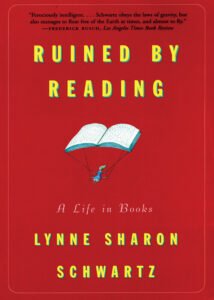
A mixed-tone argument that you can be “addicted” to reading and owning books, with some examples of book hoarders from years-gone-by.
What I Liked
There are some really good “humour” lists, kind of like a Letterman top ten list for:
Moving when you have a lot of books;
A Biblioholic’s test (how big is your problem);
The snobbish Discovery Index (I knew the author when..);
Reading in restaurants;
Latin explanations of literary taste: “De gustibus non est disputandum” — Everyone to their own non-disputable tastes; and,
Ten Commandments for the Book Handler.
What I Didn’t Like
The author can’t seem to decide what the book is — a light-hearted, tongue-in-cheek ode to book hoarders everywhere or a serious tome about an actual mental illness. The book starts out with a light-hearted look at those who feel an overwhelming urge to buy books i.e., “biblioholics”. By the end, however, he treats it like a real mental illness that requires awareness and treatment. Either approach could work, but bouncing between one and the other wears out really fast. Perhaps this would have been better as a collection of small articles for a small newspaper, and even then, in dire need of an editor to give it better focus and less repetition. But even in a series of newspaper articles, I suspect the reader would tire of the subject matter very quickly — the metaphor is dragged out far past its prime.
Schwarz starts with a commentary by a Chinese scholar that some people are handicapped by reading too much, and not thinking enough about what they read. From there, she looks at the books she has read in her life and the role they have played. It is not a heavy analytical tone throughout, but rather a personal commentary on the books that have been important to her in her life, and the elements of her life that took place in and around books.
What I Liked
There are a number of sections that are quite well done, such as:
Emptying your mind for meditation vs. filling it up during a life spent reading (pg. 14);
On the un-importance of the authors vs. the impact of the words themselves (pg. 17);
A life spent reading (pg. 96);
Choices of reading material (pg. 107);
Ruined by reading (pg. 114); and,
On self (pg. 119).
What I Didn’t Like
Some of the sections could have benefited from a bit more analysis and historical context, not just the personal impact on her own life.
Amelia Pearce has a normal enough life, but with a soon-to-be ex-lover, she heads home to her parent’s house to heal her ego and ease the transition. However, she finds her life shattered by the truth about her father — he is not a simple journalist, but an operative for “The Network”, an ultra-secret organization of operatives on loan from the major intelligence agencies of the various countries with one goal: combat terrorism. It’s like James Bond and his counterparts working for Interpol, with only one person knowing all the agents. The father is killed by an assassin, as is Amelia’s mother, but Amelia manages to escape and starts using all the skills her father taught her as a child (through a long-running series of “survival” games).
What I Liked
The book was written by Warren Murphy and Molly Cochran, two of my favourite authors whether they use their own names or the “Dev Stryker” nom-de-plume. So, the style, the dialogue, the plot tools…all are superb, but I’m a little biased. This book is also unique in the field — the main character (Amelia) doesn’t even make an appearance until several chapters into the book. And seemingly-major characters keep getting killed off! There are not a whole lot of people left by the end of the book, so it becomes somewhat easier to follow. And killing off major characters does keep the reader guessing all the way through.
What I Didn’t Like
The bad guys are mostly one-dimensional except for the assassin, with the plot revolving around plans for Libyan terrorists to poison the water supply of America. And Amelia has the added problem that she can’t seem to trust anyone, even the head of the Network. Yet as much as I liked the writing, and as much as I liked the plot twists with the death of major characters, it made it very hard to care about some of the characters — why bother if they are killed off halfway through the book? As I said above, Amelia is the main character but doesn’t appear until several chapters into the book. Her father seemed to be the main character for the first few chapters, and then he dies. Four other key characters bite the dust before the end of the book too, nicely spread out through the book so you lose a character every couple of chapters. Too bad if you care about one…but after the first two check out, it’s hard to keep your interest.
After the death of the father, you find out that Amelia isn’t quite the helpless person she is initially portrayed as, because her father taught her survival skills — and yet she never wondered about her father? She always wrote him off as a small CIA bureaucrat or journalist, yet in the next breath talks about him with almost superhuman qualities? The collaboration between Murphy and Cochran is usually excellent — in this book, it reads more like they disagreed about the characters and maybe wrote chapters on their own. Kind of like the classic writing game where one person writes one chapter with twists and turns, and then asks the next person to pull the next chapter together, mesh the various elements, and give their own spin to it.
A body is found with the letter “P” carved into its forehead. P stands for pawn, and it is dumped in upper Manhattan, using the streets as a chessboard. The Knight and Bishop follow. And the chess game begins.
Inspector Regal has been chosen by the killer to play the game, which he does through moves placed in the New York Times. As long as the game is interesting, no more bodies. But Regal is not a very good chess player, the game becomes dull for the killer, and another body appears. But Regal has an ace in the hole: a retired master player named Billy Abbott who left the chess world behind and disappeared before it took over his life. Abbott tells Regal the moves to make the game interesting, and for a while, he does — even turning the game around and winning. But having Regal win the game is not the object of the killer who targets Regal personally.
A series of sub-plots involve a cop working for Regal who had been killed during the line of duty while hunting down Panamanian drug runners, and a female cop who loved him and wants justice; a political side with Regal butting heads with his departmental rival who is in charge of both investigations; and a personal side, with Regal suspecting his wife of having an affair with a power mogul. This is the second “Dev Strkyer” novel, a nom-de-plume for Warren Murphy and Molly Cochran.
What I Liked
I love Murphy and Cochran’s work, and this one is no exception. Well-written, the chess strategies are well-mixed, and the story moves along fast enough with a lot of sub-plots mixed in to keep life interesting when the bodies are on hold. Even the political manouevering is interesting. The ending, although pat, is not a typical “everybody lives happily ever after” finish.
What I Didn’t Like
The climax is too pat, and too action-oriented rather than detection-based. I knew who the killer was long before they were revealed, and I’m not even sure why the authors chose to reveal the killer when they did, other than the realization perhaps that the reader already knows by then so the mystery is really gone. The only question was when and where they were going to be caught, if at all. As well, Stryker doesn’t really play fair with the reader at the start in terms of the depiction of the killer, but I still figured it out before the end despite the intentional misdirection.
In Raymond Chandler’s “The Big Sleep”, the reader was introduced to all the main characters — Sternwood himself, his butler, his two daughters, and a gangster. And of course, Marlowe was along for the ride. In this sequel by Robert B. Parker, Philip Marlowe returns to Sternwood Manor to solve the case of a missing daughter, Carmen, who disappeared from her much-deserved stay in a sanitarium.
What I Liked
A nice tribute to the Marlowe style, and you get to see Parker’s and Chandler’s styles side-by-side.
What I Didn’t Like
I found this to be a very strange book to read because of its constantly switching styles. The main text, written by Parker, reads like classic Spenser — same style, sentence structure, etc. However, there are constant “flashbacks” that show up as classic Marlowe in the style of Chandler. If they were just occasional flashbacks, it might have made for an interesting read, but the constant jumps made it very hard to adjust at times.
The Bottom Line
Nice tribute, I hope future Marlowe stories stick to Spenser style.